
Q&A with the Norwegian Labor Inspection Authority: Exposure register
Q&A with the Norwegian Labor Inspection Authority: Exposure register
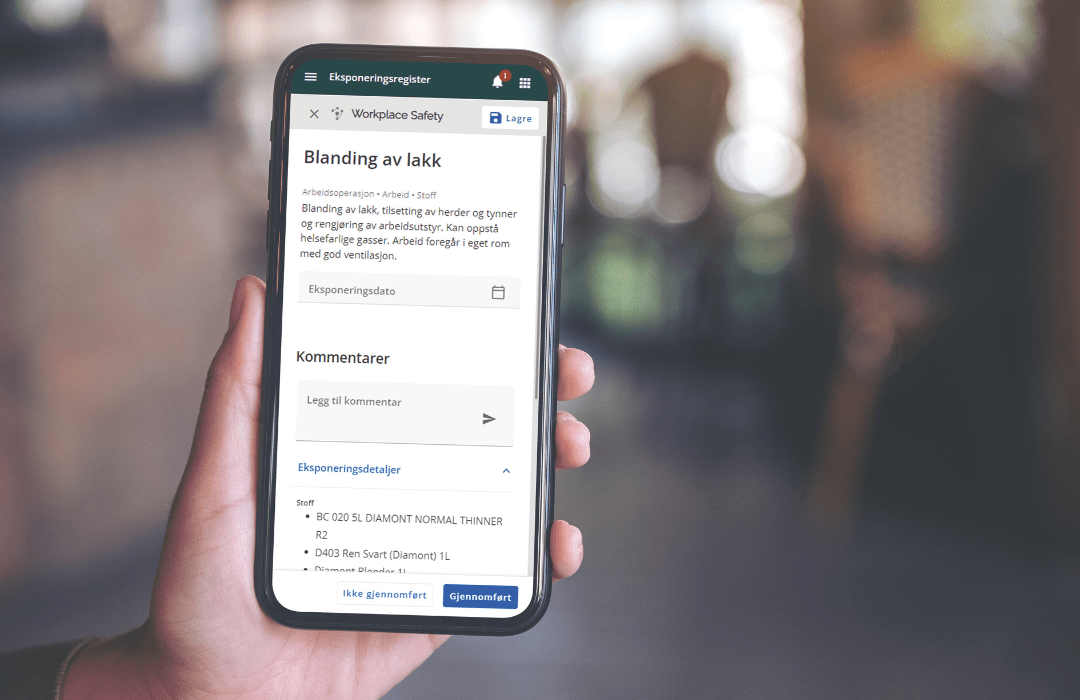
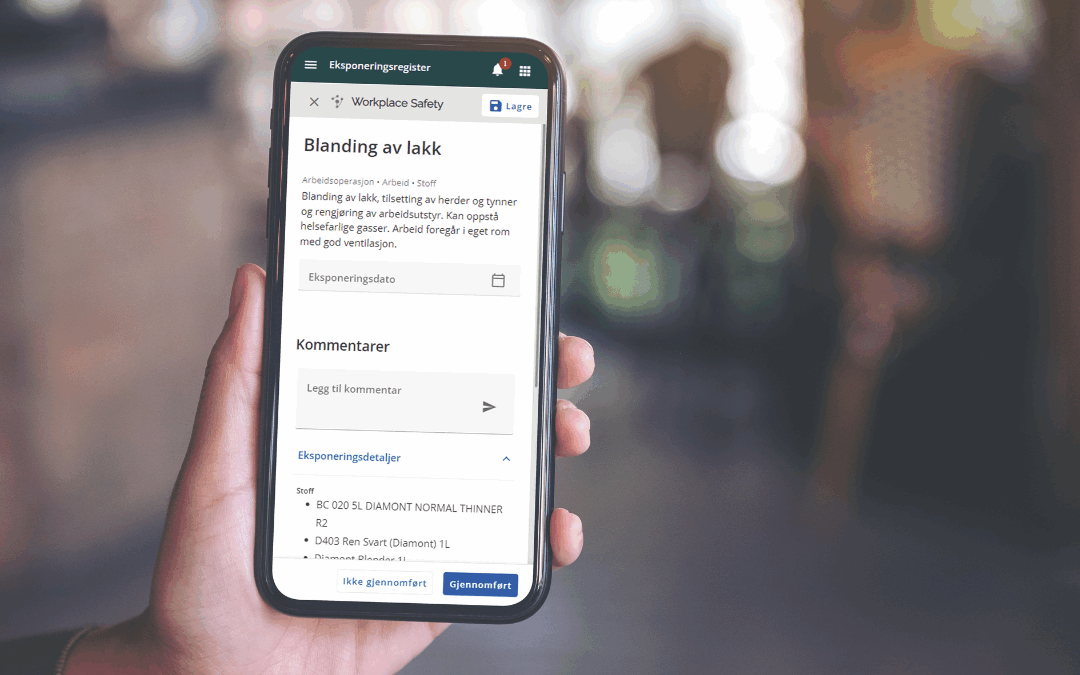
An exposure register documents employees’ potential or actual exposure to hazardous substances or processes.
Chapter 31 of the Regulations on the Performance of Work specifies which exposures are to be registered, but the wording of the regulations can be interpreted in different ways and we see that there are different practices for registering exposure among our Workplace Safety customers.
In order to get answers to our questions, we invited the Norwegian Labor Inspection Authority to a webinar, and everyone who works with hazardous chemicals was welcome to participate. Some of these questions are summarized here.
Our summary of the questions
Who is responsible for the exposure register?
The employer is the obligated party. This means that it is the employer who has the overall responsibility for ensuring that a register is kept – and that the exposures are recorded correctly.
What should be entered in the register?
This is explained in Chapter 31 of the Regulations on the performance of work:
- 31-1 (a, b and c)
- 31-2
- 31-3
- 31-4
- 31-5
How do you know if the substances are classified as Carc 1A and 1B, Mut 1A and 1B, Repr. 1A or Repr. 1B?
Use the safety data sheet in the substance register to find out if the substance belongs to any of the classifications that require registration under section 31-1. This information can also be found on the product’s packaging.
Classification is given in Annex VI of the CLP Regulation, Table 3
In Workplace Safety, products in these classes will automatically be marked with an exposure icon, so it is easy to see in the substance register whether exposed employees must be registered.
You can also search for classification on the website of the European Chemicals Agency, ECHA:
C&L Inventory (Classification and Labeling database)
New registry requirement for reprotoxic substances
As of April 5, 2024, work with substances classified as Repr 1A and Repr 1B is also subject to registration in the exposure register.
Are there requirements for the format of an exposure register?
No, the Norwegian Labor Inspection Authority has no format requirements. The requirements for what the register should contain are set out in the regulations, but the exposure register can be an Excel sheet.
What does “anyone who is, or may be, exposed” mean?
This means all work situations where employee exposure cannot be ruled out.
The requirement for exposure registration should be interpreted as follows: All employees who are exposed, or who may be exposed, MUST be registered.
It also means considering personnel who may be exposed even if they are not directly engaged in tasks or processes where they may be exposed. This could be cleaning and maintenance staff, or other functions that are only present at the workplace for a short period of time.
How do you know which work operations or processes to register?
The employer’s risk assessment must always form the basis for this assessment.
The Norwegian Labor Inspection Authority does not have a set answer to which exposure situations should be registered. It is up to the company itself to risk assess the various conditions, and it is up to the company itself to decide whether employees are exposed or not.
If the employer believes that a register is not required, this must be documented.
What if the concentration is far below the limit value?
There is no lower limit for concentration, where you do not need to keep records.
Limit values are based on current knowledge of health effects, and also take into account economic and technical aspects.
There is no absolute limit to when health risks can occur. Therefore, all exposures should be recorded, no matter how low.
This may mean that almost all employees in a company must be registered. In cases where exposure is very low, this will be stated in the register information.
How should you record the time and duration of the exposure?
The Norwegian Labor Inspection Authority is clear that you can have a pragmatic approach to entering time and duration. It should be as detailed as possible, but it should also be practically feasible.
Here it is permitted to provide average calculations. In other words, you don’t have to take measurements every day to find out what concentrations you were exposed to on different days.
Should personal protective equipment be taken into account in a risk assessment?
No, you don’t.
The protection provided by PPE will never be 100% safe (lack of maintenance, incorrect use, lack of training etc.), therefore this should not be taken into account in an exposure risk assessment.
What exactly is meant by “rock work”?
The Norwegian Labor Inspection Authority confirms that the text of the regulation is unclear on what is considered rock work, and that this is something they will work on to specify. The Labor Inspection Authority associates rock work with mining, quarrying, tunneling and other rock excavation that is carried out on a large scale.
Should crushing rock in a laboratory be considered rock work?
The answer from the Labor Inspection Authority is no. The crushing of rock in a laboratory is not considered rock work. This means that, according to the regulations, there are no registration requirements for employees who are exposed to carcinogenic chemicals, such as quartz, when crushing rock in a laboratory.
Quartz is not classified in accordance with CLP and is therefore not subject to a registration requirement. This is a weakness, according to the Norwegian Labor Inspection Authority. They therefore communicate that companies can start registering this type of exposure now, even though it is not a requirement.
Some of the companies that use the exposure register in Workplace Safety explain that they interpret quartz as a carcinogenic chemical, and that they therefore record exposure to it when they work with crushing rock in the lab. This registration is not a requirement at present, as the work is not considered rock work. But it should be, according to the Labor Inspection Authority.
However, if you are exposed to quartz in rock work (i.e. rock excavation carried out on a large scale), it is subject to registration (even though quartz is not classified in CLP). This is because dust containing quartz is considered to be a process-generated hazardous substance that can come from the bedrock. Ref. § Section 31-5 of the Regulations on the performance of work.
Do all employers have to keep a register of COVID-19 sufferers?
Yes, if the employees became ill as a result of infection at work.
All employees who have been infected at work and who have become ill as a result of the infection must be registered.
The requirement came into force shortly after the SARS-CoV-2 outbreak and applies to all businesses.
There’s a lot we don’t yet know about COVID-19 in terms of after-effects and so on. That’s why it’s important that those who suffer health damage due to infection at work are registered so that their exposure is documented.
For healthcare workers, the requirements are even stricter: Healthcare workers who treat people with COVID-19 must always be entered into an exposure register – regardless of whether they have become ill or not.

Do you have questions about exposure registers or chemical management?