

Classification and CLP labelling
Classification and CLP labelling

Clear and accurate labelling of chemicals is a fundamental prerequisite for a safe working environment. CLP labelling plays a key role in communicating chemical hazards in a standardised and easily understandable way.
What is CLP labelling?
CLP stands for Classification, Labelling and Packaging and is the EU’s regulation for the classification, labelling, and packaging of chemicals. The regulation is based on the UN’s Globally Harmonized System of Classification and Labelling of Chemicals (GHS), with the aim of ensuring that workers and users receive clear, unambiguous information about chemical hazards.
Although CLP is an EU regulation, its principles are largely harmonised with regulations in many other parts of the world. This makes CLP labelling relevant also for companies that operate internationally or use chemicals supplied from other markets.
You can find more information about the CLP Regulation, also known as the CLP Regulation, at ECHA.
CLP labelling is more than just a formal requirement. It can also help to:
- Protecting employees from health hazards
- Prevent accidents and misuse
- Ensure compliance with HSE and working environment requirements
- Creating safer workplaces across industries
When the information on the label is accurate, up-to-date, and easy to understand, it becomes easier for everyone to handle chemicals safely.
What does a CLP label contain?
A CLP label should provide the user with all the information necessary for the safe handling of the substance or mixture. A complete label includes, among other things:
- Supplier information: Name, address, and telephone number of the supplier. From July 1, 2026, suppliers must be established in the EU/EEA.
- Product identification: Clear name or identifier that makes it clear which substance or mixture the label applies to.
- Nominal quantity: Quantity of contents, when the product is intended for the general public and this is not stated elsewhere on the packaging.
- Hazard information: This may include hazard symbols (pictograms), hazard signal words, hazard and safety statements, and any additional information required by other regulations.
CLP also sets requirements for the size, design, and placement of the label. It must be securely attached, easily visible, legible, and durable throughout the product’s lifetime. In some cases, such as very small containers, there are limited exceptions where not all information can be included. In such cases, certain elements may be omitted, but this must be done in accordance with the regulations.
CLP hazard symbols
Hazard symbols, also known as hazard pictograms, provide immediate visual information about the hazards posed by a chemical. Under CLP, there are nine different pictograms covering, among other things:
- Health hazard
- Chronic health hazard
- Flammable substances
- Corrosive chemicals
- Acute toxicity
- Gas under pressure
- Environmental hazard
- Explosive
- Oxidising substances
The correct use of hazard symbols is crucial for employees to be able to quickly identify risks, especially in environments where many chemicals are used in parallel. The symbols must always correspond to the classification of the substance and the most serious hazards.
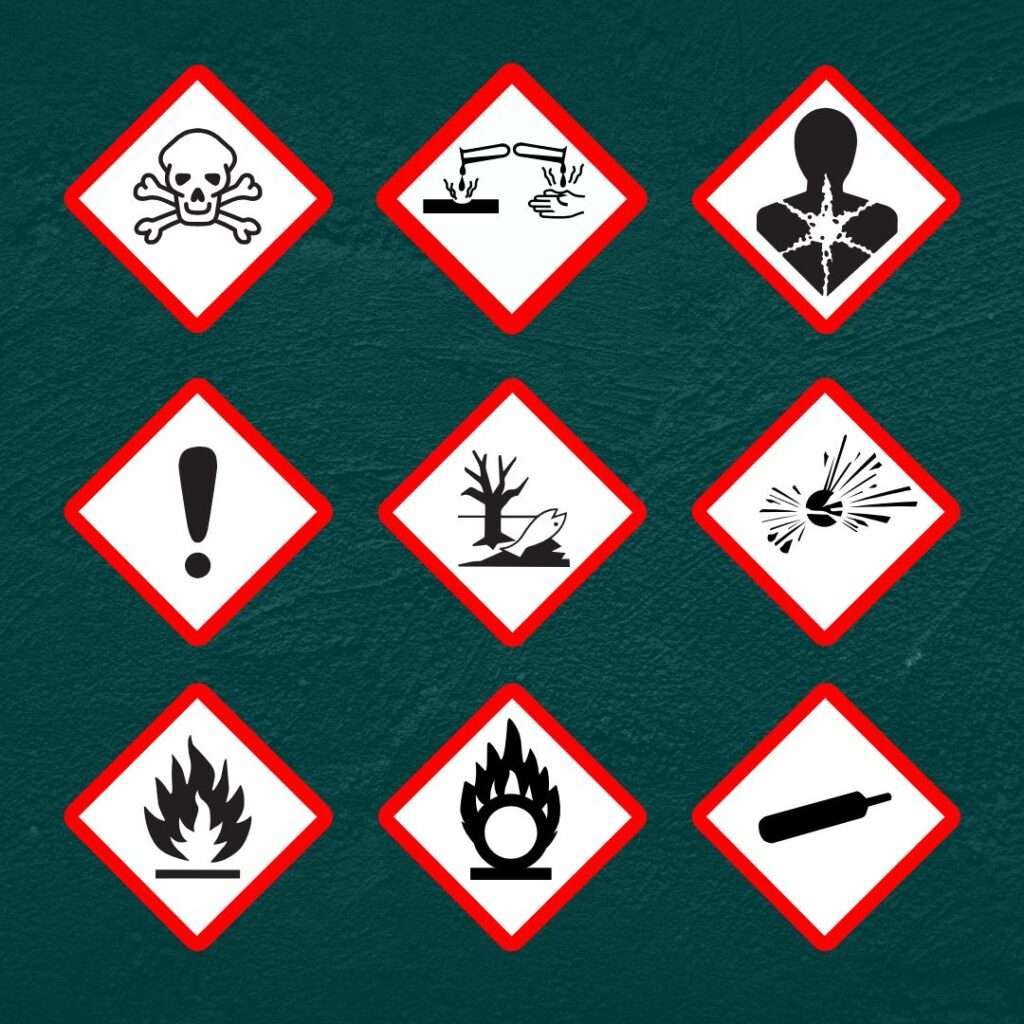
Read more about hazard symbols and labelling for chemicals here.
Common challenges in chemical labelling
Many organisations experience the same issues when working with CLP labelling:
- Changes in classifications and regulations over time
- Consistency between label and safety data sheet (SDS)
- Language requirements and multilingual labelling
- Limited space on small containers
- Manual processes that increase the risk of errors
- Need for updates across locations and departments
Incorrect or inadequate labelling can lead to safety risks, regulatory non-compliance, and, in the worst case, serious incidents.
Classification and labelling according to CLP is a key part of systematic HSE work in companies that handle chemicals. Correct CLP labelling helps ensure that hazards are understood quickly and correctly, and provides employees with the necessary basis for the safe use, storage, and handling of chemical substances and mixtures. At the same time, the regulations set clear requirements for the content, design, and updating of labels. Changes in classifications, language requirements, and compliance with SDS mean that chemical labelling can be demanding to manage over time. Nevertheless, the consequences of errors or omissions are often far greater than the effort required to do it right.


