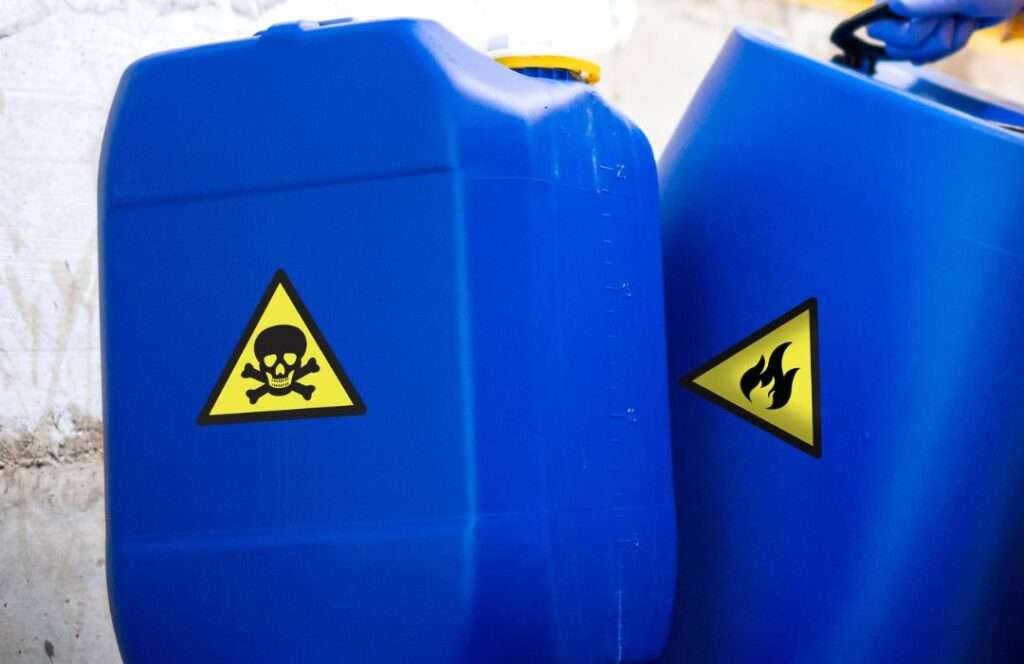
Carcinogenic chemicals need to be higher on the HSE agenda
Cancer is the most common cause of work-related death, accounting for more than half of all occupational deaths in Western countries. It is largely due to exposure to chemicals at work.
This clear message from the Norwegian National Institute of Occupational Health (STAMI) is a serious reminder of the need for better control and knowledge in working life.
Having up-to-date, documented and accessible information about carcinogenic chemicals in the workplace is crucial – both to protect workers here and now, and to ensure verifiable knowledge in the years to come. Many cancers develop over a long period of time, and exposures today can lead to serious illness decades later. Therefore, exposures must be logged and preserved, even when protective equipment is in use and the health effects are not immediately visible.
With a clear overview of which substances, processes and work operations involve risk, the company can work more purposefully with prevention, substitution and technical measures.
The costs of work-related cancer are high, both for individuals and society. For those affected, the disease can mean loss of health, ability to work and quality of life. It also affects relatives, who often find themselves in a demanding and unpredictable care situation. For society, this entails large expenses for treatment, social security benefits, lost labor and compensation cases. A systematic focus on documenting and registering chemical exposures is therefore not only good HSE – it is also socio-economically and ethically responsible.
Why do we need to prioritise carcinogenic chemicals?
According to STAMI, work-related cancer can be prevented – but only if we know who is exposed, to what, and in what quantities. In the articleWith good knowledge we can prevent work-related cancer, this is highlighted as a critical point: The most important sources of exposure are chemicals and dust in the process industry, construction, offshore activities and laboratories. Yet many companies lack the necessary overview and documentation.
This is also supported by the government’s national cancer strategy (2025-2035), where Ten-year goal 5: Prevent more, detect earlier states that work-related cancer should be reduced. The strategy points to the need for better registration, systematics and prevention, with particular emphasis on measures such as exposure registers and chemical inventory.
Prioritising the work with carcinogenic substances is therefore not just about regulatory compliance – it’s about protecting life and health through knowledge-based and documented HSE work.
Control of hazardous chemicals and exposures is crucial
Working with carcinogens occurs both through the use of classified chemicals, such as benzene, formaldehyde and gasoline, and in work processes that generate hazardous pollutants. Many of these process-generated substances are both widespread and underreported, posing a real health risk in a number of industries.
Examples of such sources of exposure include:
Respirable crystalline silica (quartz): Particularly in drilling, concrete sawing, sandblasting and other work with mineral materials
Asbestos: Which is still present in older buildings and poses a hazard during refurbishment and demolition
Diesel exhaust: From vehicles and machinery in enclosed or poorly ventilated areas
Welding fume: A complex mixture of metal oxides, nitrogen oxides and particles
Radon: An invisible, radioactive gas that can build up in tunnels, basements and mining areas
In order to reduce health risks, and at the same time comply with the requirements of Chapter 31 of the Regulations on the Performance of Work, companies must have a systematic overview and documentation.
This means:
Chemical inventory: Up-to-date overview of all hazardous chemicals in use and process-generated substances, including hazard labeling and safety data sheets
Risk assessments: Mapping of which work operations and substances pose cancer risks, as well as which technical and organisational measures are required
Exposure register: Accurate documentation of who has been exposed, to which substances, where and when – as a basis for health monitoring and possible compensation for occupational diseases
Exposure register – the most important document you (might) not have
An exposure register must be kept for employees who are, or may be, exposed to health hazards at work. This is a requirement in Chapter 31 of the Regulations on the performance of work, and applies to a number of known risk factors.
Who should be registered?
The exposure register includes employees who are or may be exposed:
1. Classified chemicals:
Carcinogenic substances: Carc 1A / 1B
Substances harmful to genetic material: Mut 1A / 1B
Substances harmful to reproduction: Repr 1A / 1B
2. Specific processes and substances mentioned in the regulation:
Preparation of auramine
Exposure to polycyclic aromatic hydrocarbons (PAHs) in soot, tar or pitch
Exposure to polycyclic aromatic hydrocarbons (PAHs) in soot, tar or pitch
Preparation of 2-propanol by strongly acidic process
Exposure to hardwood dust
3. Other exposures harmful to health:
Lead and lead compounds
Asbestos fiber and asbestos-containing dust
Biological factors in infection risk group 3 or 4, or with annotation D
Ionizing radiation
Hazardous substances in rock work
Why is the exposure register so important?
The exposure register has three key purposes:
To give the employer an overview of who has been exposed to harmful conditions
Ensuring traceability over time, so that exposure can be traced even many decades later
The register must be verifiable and stored for 40-60 years, which places high demands on data security, maintenance and system management. It is also important to note that the use of protective equipment does not exempt from registration – it is the exposure itself that must be documented, regardless of the level of protection.
A well-maintained exposure register is not only a legal requirement, but a key tool for long-term health monitoring, prevention and responsible working environment management.
Digital tools that provide overview and control of chemicals
With good digital solutions in place, HSE work becomes more efficient, more verifiable and, not least, far better equipped to prevent health risks in practice. When it comes to chemical handling, this is particularly important: It must be possible to track, risk assess and follow up each individual chemical, over time and across workplaces.
Digital tools such as Workplace Safety and ChemCenter have been developed precisely to meet these requirements. They support the company in working in a structured way with substance records, risk assessments and exposure overviews, and help ensure that chemical information is up-to-date, accessible and in line with regulations. The result is better control, higher quality documentation and better conditions for preventing damage to health. Such tools lay the foundation for HSE work that is effective, verifiable and sustainable over time.
Written by Hans Kristian Brekken, chemist and product developer at Workplace Safety.
Do you want guidance?
Many employers are unsure of what an exposure register should actually contain, how it should be established and what requirements apply in practice. Contact us for guidance on how to establish an exposure register with good routines that give you control, overview and peace of mind.
Q&A with the Norwegian Labor Inspection Authority: Exposure register
An exposure register documents employees’ potential or actual exposure to hazardous substances or processes.
Chapter 31 of the Regulations on the Performance of Work specifies which exposures are to be registered, but the wording of the regulations can be interpreted in different ways and we see that there are different practices for registering exposure among our Workplace Safety customers.
In order to get answers to our questions, we invited the Norwegian Labor Inspection Authority to a webinar, and everyone who works with hazardous chemicals was welcome to participate. Some of these questions are summarized here.
Our summary of the questions
Who is responsible for the exposure register?
The employer is the obligated party. This means that it is the employer who has the overall responsibility for ensuring that a register is kept – and that the exposures are recorded correctly.
How do you know if the substances are classified as Carc 1A and 1B, Mut 1A and 1B, Repr. 1A or Repr. 1B?
Use the safety data sheet in the substance register to find out if the substance belongs to any of the classifications that require registration under section 31-1. This information can also be found on the product’s packaging.
Classification is given in Annex VI of the CLP Regulation, Table 3
In Workplace Safety, products in these classes will automatically be marked with an exposure icon, so it is easy to see in the substance register whether exposed employees must be registered.
You can also search for classification on the website of the European Chemicals Agency, ECHA:
New registry requirement for reprotoxic substances
As of April 5, 2024, work with substances classified as Repr 1A and Repr 1B is also subject to registration in the exposure register.
Are there requirements for the format of an exposure register?
No, the Norwegian Labor Inspection Authority has no format requirements. The requirements for what the register should contain are set out in the regulations, but the exposure register can be an Excel sheet.
What does “anyone who is, or may be, exposed” mean?
This means all work situations where employee exposure cannot be ruled out.
The requirement for exposure registration should be interpreted as follows: All employees who are exposed, or who may be exposed, MUST be registered.
It also means considering personnel who may be exposed even if they are not directly engaged in tasks or processes where they may be exposed. This could be cleaning and maintenance staff, or other functions that are only present at the workplace for a short period of time.
How do you know which work operations or processes to register?
The employer’s risk assessment must always form the basis for this assessment.
The Norwegian Labor Inspection Authority does not have a set answer to which exposure situations should be registered. It is up to the company itself to risk assess the various conditions, and it is up to the company itself to decide whether employees are exposed or not.
If the employer believes that a register is not required, this must be documented.
What if the concentration is far below the limit value?
There is no lower limit for concentration, where you do not need to keep records.
Limit values are based on current knowledge of health effects, and also take into account economic and technical aspects.
There is no absolute limit to when health risks can occur. Therefore, all exposures should be recorded, no matter how low.
This may mean that almost all employees in a company must be registered. In cases where exposure is very low, this will be stated in the register information.
How should you record the time and duration of the exposure?
The Norwegian Labor Inspection Authority is clear that you can have a pragmatic approach to entering time and duration. It should be as detailed as possible, but it should also be practically feasible.
Here it is permitted to provide average calculations. In other words, you don’t have to take measurements every day to find out what concentrations you were exposed to on different days.
Should personal protective equipment be taken into account in a risk assessment?
No, you don’t.
The protection provided by PPE will never be 100% safe (lack of maintenance, incorrect use, lack of training etc.), therefore this should not be taken into account in an exposure risk assessment.
What exactly is meant by “rock work”?
The Norwegian Labor Inspection Authority confirms that the text of the regulation is unclear on what is considered rock work, and that this is something they will work on to specify. The Labor Inspection Authority associates rock work with mining, quarrying, tunneling and other rock excavation that is carried out on a large scale.
Should crushing rock in a laboratory be considered rock work?
The answer from the Labor Inspection Authority is no. The crushing of rock in a laboratory is not considered rock work. This means that, according to the regulations, there are no registration requirements for employees who are exposed to carcinogenic chemicals, such as quartz, when crushing rock in a laboratory.
Quartz is not classified in accordance with CLP and is therefore not subject to a registration requirement. This is a weakness, according to the Norwegian Labor Inspection Authority. They therefore communicate that companies can start registering this type of exposure now, even though it is not a requirement.
Some of the companies that use the exposure register in Workplace Safety explain that they interpret quartz as a carcinogenic chemical, and that they therefore record exposure to it when they work with crushing rock in the lab. This registration is not a requirement at present, as the work is not considered rock work. But it should be, according to the Labor Inspection Authority.
However, if you are exposed to quartz in rock work (i.e. rock excavation carried out on a large scale), it is subject to registration (even though quartz is not classified in CLP). This is because dust containing quartz is considered to be a process-generated hazardous substance that can come from the bedrock. Ref. § Section 31-5 of the Regulations on the performance of work.
Do all employers have to keep a register of COVID-19 sufferers?
Yes, if the employees became ill as a result of infection at work.
All employees who have been infected at work and who have become ill as a result of the infection must be registered.
The requirement came into force shortly after the SARS-CoV-2 outbreak and applies to all businesses.
There’s a lot we don’t yet know about COVID-19 in terms of after-effects and so on. That’s why it’s important that those who suffer health damage due to infection at work are registered so that their exposure is documented.
For healthcare workers, the requirements are even stricter: Healthcare workers who treat people with COVID-19 must always be entered into an exposure register – regardless of whether they have become ill or not.
Do you have questions about exposure registers or chemical management?
Companies that handle hazardous chemicals or other high-risk processes may be legally required to maintain an exposure register. The register must document which employees have been exposed to dangerous substances and may be of crucial importance if illness develops many years later.
Here, we examine the purpose of an exposure register, the relevant legal obligations, and how companies can ensure compliant registration and documentation practices.
What is an exposure register?
An exposure register should document employees’ potential and actual exposure, including accidents, spills and other incidents that may have led to contact with hazardous substances. This may be in connection with hazardous substances or processes related to:
Chemicals (carcinogenic, mutagenic and toxic to reproduction)
Asbestos
Mining work
Biological material
Radiation
Keep in mind that only certain chemicals are relevant for inclusion in the exposure register.
The exposure register is an important tool for identifying and monitoring exposure to hazardous factors. Because illnesses resulting from such exposure often develop over a long period, sometimes many years after the exposure occurred, it is essential to record incidents continuously and as early as possible.
An exposure register can help to:
Monitor employees’ health over time
Provide a basis for health surveillance and support risk assessments
Ensure documentation if illness develops several years after exposure
Who may be exposed?
Several occupational groups that may be exposed to hazardous substances and processes.
Typical examples are:
Employees in industry (chemical industry, metal production, welding and woodworking)
Employees in construction (demolition, remediation, work with asbestos and concrete dust)
Healthcare and laboratory workers (radiation, chemicals and infectious agents)
Employees in renovation and waste management (biological material and hazardous waste)
Employees in mines and tunnels (dust, gases and explosives residues)
Employees within energy and research (radioactive material and ionising radiation)
What must an exposure register contain?
The content of an exposure register may vary. The information that must be recorded depends on the type of exposure involved – for example chemicals (CMR substances), asbestos, biological agents, mining work, or ionising radiation.
The purpose of the register is to ensure traceable and verifiable documentation over time. The regulations therefore set clear requirements regarding the information that must be included. It is also specified that the register must not contain health data beyond what is authorised by the legislation.
Although the details vary depending on the type of exposure, an exposure register will typically include:
The employee’s name and national identification number
The work carried out
The substance, material, or process to which the employee has been exposed
The period and duration of the exposure
Any measurement results or assessments of exposure levels
The date of registration
An exposure register must only contain the information required by the regulations. It must not function as a medical record.
Documentation and storage requirements
The register must be kept for a very long time, often between 40 and 60 years, depending on the type of exposure. The information must be available for as long as the employee is alive, and can be decisive in documenting occupational diseases and any compensation cases.
Individual employees have the right to access their own registrations. In addition, the register must be available to relevant personnel, for example the occupational health services, safety representatives, the working environment committee and any other persons working with HSE in the company.
Who is responsible for the register?
Both employer and employee have certain responsibilities, but it is the employer who has the main responsibility for creating and maintaining the exposure register.
Employee’s responsibility
Follow the company’s routines and guidelines in connection with registration
Report accidents, exposures or other situations that may have led to contact with hazardous substances
Participate in necessary training and help ensure that the information recorded is correct
The employer’s responsibility
Establish routines and guidelines for exposure registration
Provide training on how employees should report
Thoroughly document and retain records for a sufficient period of time
Ensure that the register is used
Ensure that employees have access to their own registrations
Common challenges
Inadequate reporting and follow-up
Many companies find that employees do not report exposures, either because the incident is perceived as minor, the routines are unclear, or because it is simply forgotten. This is often linked to a lack of training in chemical safety and understanding of the risk. In addition, many companies are unsure when they are actually required by law to keep an exposure register.
Difficulty storing registrations over a longer period of time
As some types of exposure require the register to be kept for up to 60 years, it requires good routines for both storage and for safeguarding privacy (GDPR). As long as the employee is alive, it should be possible to document any exposure, especially if there is a risk of cancer. As there are no specific requirements for how records are kept, many companies lack good enough routines to handle this.
A well-maintained exposure register is an important tool for both the employee and the employer. It contributes to prevention, follow-up and documentation, especially because health damage often only becomes apparent many years after exposure. Digital HSE and chemical systems can help companies identify chemicals that are subject to registration, carry out the actual registration and ensure safe storage of the information.