10 reasons why chemical inventory should be on the HSE agenda
Chemicals are a natural part of everyday working life in many businesses, but a chemical inventory are often underestimated in day-to-day HSE work. That is why we have compiled ten good reasons why chemical inventory should be given higher priority on the HSE agenda.
1. Get a complete overview of chemicals in your business
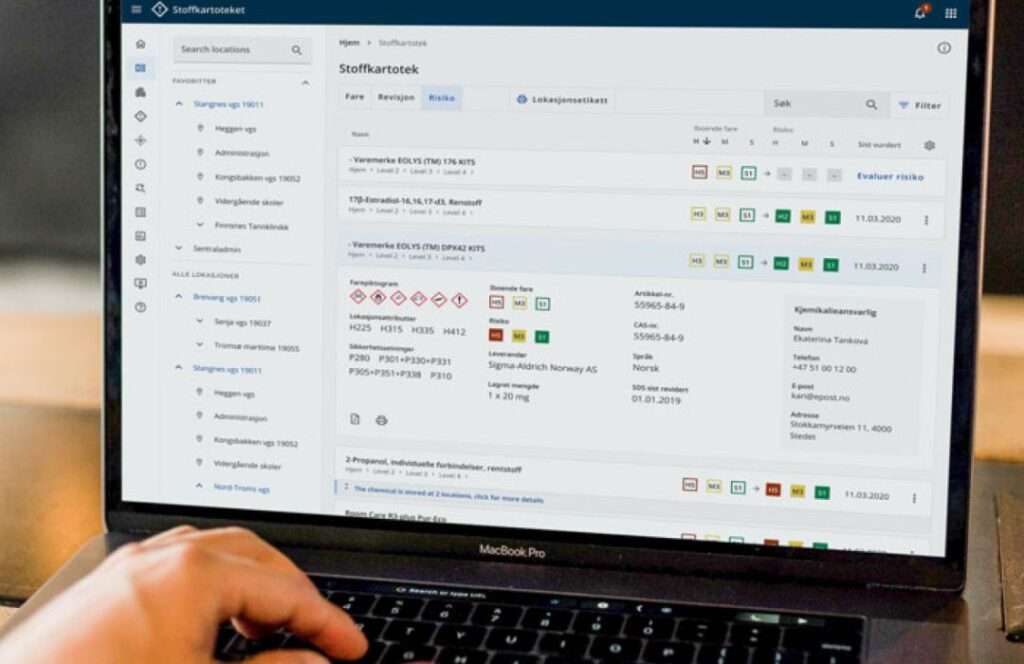
A robust chemical inventory provides a comprehensive and structured overview of all chemicals in use, where they are located, and how they are handled. This makes it easier to identify products that are no longer in use, chemicals with overlapping functions, or substances that create unnecessary risks. Such an overview is also crucial for planning, purchasing, and safe storage of chemical products.
2. Complies with Norwegian legal requirements
Norway has strict requirements for companies that use hazardous chemicals, anchored in both the Working Environment Act and the Regulations on the Performance of Work. One of the requirements is an up-to-date and accessible chemical inventory that ensures that the company has the latest version of safety data sheets (SDS). This strengthens compliance with the regulations and makes the company better prepared for inspections.
3. Strengthens internal control and documentation
The chemical inventory is a key part of the internal control system. When the company documents which chemicals are used, the hazards they pose, and the measures that have been implemented, a clear overview is created. This gives management a better basis for following up on HSE work and ensures that the company works more systematically with chemical management.
4. Ensures adequate training of employees
Employees who work with chemicals on a daily basis must have access to accurate and up-to-date information. The chemical inventory makes it possible to actively use SDS, see hazard classifications and recommended protective measures in training and practical work. When safety information is easily accessible, the risk of misuse and misunderstandings is reduced.
5. Reduces the risk of injuries and accidents
Access to updated information on health hazards, first aid, and proper handling increases safety in daily work. Many chemical accidents are caused by lack of knowledge, improper storage, or incorrect use of protective equipment. A well-maintained chemical index helps prevent such incidents and can reduce both health hazards and material damage.
6. Better risk assessments
The chemical inventory provides necessary information about exposure hazards, reactions, storage requirements, and risk reduction measures. This makes risk assessments more accurate and provides a better basis for choosing the right protective measures, working methods, and technical solutions. A comprehensive chemical inventory also makes it possible to monitor the development of risk over time.
7. Better preparedness for accidents and emergencies
In the event of spills, leaks, fires, or other undesirable incidents, time-critical information is crucial. The chemical inventory provides immediate access to information about first aid measures, extinguishing methods, measures in the event of accidental spills, and special handling requirements. This enables employees and emergency services to deal with the situation more quickly and effectively.
8. Simplifies substitution work
Norwegian regulations require companies to consider less hazardous alternatives wherever possible. An electronic chemical inventory makes it easier to identify high-risk substances and compare alternatives. This makes substitution efforts more targeted and contributes to a safer working environment.
9. Streamlines operational management
A digital chemical inventory saves time by providing easy access to documentation and automatic updates of safety data sheets. It reduces the need for manual routines and improves workflow between departments. A more efficient workflow can lead to financial savings over time.
10. Strengthens the safety culture
When a company prioritises overview, accessible information, and clear procedures, it sends a clear signal that safety is taken seriously. An ideal chemical inventory makes it easier for employees to take ownership of HSE work and creates a culture where safe chemical handling is a natural part of the working day.
The list makes it clear that the chemical inventory is a more important HSE tool than many people may realise. When a company prioritises keeping its chemical inventory up to date and accessible, it can contribute to increased safety and quality in the workplace. That is why the chemical inventory belongs on the HSE agenda – every single day.
Chemical management system: What to consider when choosing a new system
Time to get control of the chemicals in your workplace? A chemical management system can make everyday work easier and safer, but with so many solutions on the market, it can be challenging to know which one to choose.
That’s why we have created an overview of factors you should consider before investing in a new system for your business.
Easily accessible and user-friendly
A chemical management system should be easy to find, understand, and use for all employees. Whether you are an HSE manager, supervisor, or end user of chemicals, the system must be adaptable to different roles, tasks, and areas of responsibility. The easier the system is to use in practice, the greater the chance that it will actually be used.
Questions you can ask:
Does the system support different digital devices (e.g., PC, mobile phone, tablet)?
Is it possible to customise user access based on roles and departments?
Is offline support available in cases where it may be relevant (e.g., offshore work)?
Automated processes
The system should support automated processes and contribute to less manual work. Examples include automatic updating of safety data sheets (SDS) when the supplier publishes new versions, or notifications when risk assessments are approaching their expiration date. When such processes flow seamlessly between links, the risk of errors is reduced. Instead, processes become more efficient and data quality improves.
Questions you can ask:
Which processes are handled automatically in the system (e.g., safety data sheets updates)?
Does the system use new tools such as AI and machine learning to streamline chemical management (e.g., automatic interpretation of data)?
Does the system notify when work needs to be done (e.g., revision of risk assessment, substitution that needs to be done, planned work that requires exposure registration)?
Can the system be connected to our AD/SSO so that users and access management are created and maintained automatically?
Adapted to Norwegian legislation
Companies in Norway must comply with both national regulations, such as the Working Environment Act and associated regulations, and international regulations such as REACH and CLP. A proper chemical management tool should therefore be adapted to Norwegian conditions and make it easy to document compliance. In Norway, for example, there is a particular focus on recording exposures in an exposure register, which may be required if employees handle particularly hazardous chemicals.
Questions you can ask:
Has the supplier developed the system in accordance with local laws and regulations?
Does the system have an exposure register in accordance with Norwegian regulatory requirements?
Is it easy to export documentation for use in control and supervision?
Migrate data to new system
When a business transitions to a new chemical management system, there is often a lot of valuable information that needs to be transferred from old solutions. A successful migration is crucial to ensure that important documentation is not lost and that you do not have to start from scratch. It may be wise to find out whether the supplier offers assistance with data migration and how the process is handled in practice. The system should be able to import existing data in a structured manner, so that the company can quickly get started with a complete overview and retain its history.
Questions you can ask:
Can you get help migrating existing data into the system?
How long does the migration process take, and what is required of the business?
What types of data can be imported (e.g., SDS, risk assessments, exposure registers)?
Access to training and support
Getting to grips with a new system can be time-consuming. To get the most value out of the solution, it is a good idea to check whether the supplier offers support to help you get started. A proper onboarding can be crucial to ensure that the system is actually used effectively.
Questions you can ask:
Are user manuals, demos, training videos, or other training materials available?
Is it possible to get advice and support along the way if needed?
Is support available in a language I can understand?
Secure data storage
For some businesses, the contents of a chemical inventory may contain sensitive information, such as chemicals used in production or research projects. In addition, data stored in an exposure register may be considered health information and is therefore subject to strict privacy requirements. For many, it is a great advantage that the system supplier offers data storage in Norway, so that they can be confident that the information is handled in accordance with Norwegian law and the GDPR.
It is also important to consider how data is actually stored and secured, both during normal operation and in the event of a problem. Factors such as encryption, access control, and audit trails can be crucial in this regard.
Questions you can ask:
Where is the data physically stored (in EU/EEA, or outside of Europe)?
What are the backup and recovery procedures if something goes wrong?
Are there audit trails showing who has had access to the data and when?
How is personal data handled (e.g. exposure registration data)?
Clear reporting and documentation
During internal controls, inspections, or other audits, it is important that the necessary documentation can be retrieved quickly and easily. A flexible reporting system allows you to generate customised reports based on your own key figures and needs.
Questions you can ask:
What ready-made report templates are included (e.g., risk assessments, substance overviews)?
In which formats can reports be exported (e.g., Excel, PDF, CSV)?
Is it possible to schedule and send reports automatically at fixed times?
Favorable pricing models
When evaluating a chemical management system, it is wise to look closely at how the pricing model is structured. Some suppliers charge per user, per module, others per safety data sheet, and some combine several. This can have a significant impact on the total cost, especially if the company has many employees who need access, but only a few who actively administer the system.
Questions you can ask:
How is the system priced (e.g., per user, per module, per safety data sheet, or a combination)?
Are there different agreement levels with varying degrees of support and functionality?
Can you add or remove users yourself, and how does this affect the cost?
Possibility of scaling and customisation
A chemical management system should be able to grow with the business, both in terms of the number of users, departments, industries, and geographic locations. It should be easy to set up common standards, but at the same time allow for local adaptation. The option of multilingualism and support for different national regulations is a major advantage for companies that operate internationally.
Questions you can ask:
Can roles and access management be set up at multiple levels (e.g., group, department, project-based)?
Is the system designed for international growth (e.g., access to a global substance database, safety data sheets in multiple languages)?
Can the company itself create risk assessment templates, labels, and reports?
Are there any technical or licensing restrictions that one should be aware of?
The most important thing is to spend time finding a chemical management system that actually suits your business. Once a system has been chosen, it can be both time-consuming and resource-intensive to transfer data and retrain employees. Making the right choice from the outset will therefore save time, money, and potential frustration, while also contributing to a safer and more efficient working environment.
Substitution of chemicals: How to choose safer alternatives
Substitution is an important measure to improve the working environment, minimise environmental impact and make it easier to meet requirements from authorities and customers. Here are the basics you need to know about chemical substitution.
What is chemical substitution?
Substitution is about replacing a hazardous chemical with a safer alternative. It can involve replacing substances that are harmful to the environment or health, or changing processes so that the chemical is not needed at all.
Why substitute chemicals?
Substitution should be considered every time the company adopts new products, processes or technologies, especially when chemicals with health and environmental hazards are in use. The duty of substitution means that companies must actively consider alternatives when they exist, as long as this does not entail unreasonable costs or disadvantages.
Employers are required to assess and, where possible, replace hazardous chemicals with less hazardous alternatives. This follows from the Working Environment Act, Regulations on the Performance of Work and the Product Control Act, which together form the basis for the substitution obligation. The requirement also covers packaging and work processes that can affect exposure, in line with the principle of using the safest available alternatives.
Examples of substitution
Here are some examples of chemicals with safer alternatives:
Isocyanates in some adhesives, sealants and foams can be replaced with isocyanate-free or water-based products.
Solvent-based paints and varnishes can be replaced with water-based paint systems with lower VOC content.
Oil-based coolants and lubricants can be replaced with water-soluble or synthetic coolants with lower health risks.
Packaging for cleaning agents can be switched to solutions with reduced aerosol formation (e.g. pump bottle or foam dispenser) to minimise inhalation risk and exposure during use.
Substitution always requires a specific assessment, because conditions vary from business to business.
Challenges with substitution
There are some challenges with substitution in practice. Here are the most typical ones:
There is a lack of good substitutes: There is not always a better alternative with the same technical quality without the same risk.
Can be costly: Alternative chemicals can be more expensive than current products. In such cases, you need to consider the risk of keeping current chemicals versus the cost of switching to safer alternatives.
It can be time-consuming: Searching for alternatives, testing them, documenting, getting approval and changing procedures can take time.
May be unknown or new risk factors: Substitutes are not necessarily completely harmless. Alternative products may have other hazards that need to be considered.
New chemicals require training and new routines: New chemicals may involve changes in handling, storage and protective equipment. Inadequate training or adaptations can lead to misuse and accidents.
Benefits of substitution
Although substitution may seem challenging, it is one of the most important and effective ways to reduce chemical risks. Here are some of the benefits:
Safer working environment: Replacing hazardous chemicals reduces the risk of accidents and health problems.
Less environmental impact: Substitution can contribute to fewer emissions of environmentally hazardous substances.
Meeting stakeholder requirements: Customers, business partners and society in general are placing ever higher demands on the environment and safety.
Regulatory compliance: Choosing safer alternatives can help meet legal requirements from the Working Environment Act, REACH, CLP and other regulations.
Safer operations and delivery: Products that are hazardous to health and the environment may be subject to restrictions on use and sale through regulations.
Strengthened competitiveness: Through innovation, green profile and lower risk of future restrictions or costs, the business can strengthen its position in the market.
Identify which chemicals are used or planned to be used and assess the risk to health and the environment based on safety data sheets (SDS) and probability of exposure. Consider not only the hazard of the substance, but also the exposure situation. Involve your employees early in the process as they often have valuable practical experience.
2. Check if there are alternatives
Investigate possible alternatives through suppliers, industry associations or digital tools. Consider technical, practical and financial aspects.
3. Assess, compare and select
Compare the options in terms of risk, environmental impact, resource use and costs, and choose the one that provides the lowest overall risk and greatest benefit. Feel free to test the option on a small scale before full transition to ensure it works in practice.
4. Inform customers and suppliers
Share information about new chemicals or processes so that the change can be communicated throughout the value chain.
There are a number of resources and digital tools that can help identify, assess and document the substitution of chemicals. By working systematically to identify and introduce safer alternatives, businesses can reduce risk, meet regulatory and customer requirements and strengthen their competitiveness. Replacing hazardous chemicals is therefore not just about removing risk, but about creating new opportunities.
Carcinogenic chemicals need to be higher on the HSE agenda
Cancer is the most common cause of work-related death, accounting for more than half of all occupational deaths in Western countries. It is largely due to exposure to chemicals at work.
This clear message from the Norwegian National Institute of Occupational Health (STAMI) is a serious reminder of the need for better control and knowledge in working life.
Having up-to-date, documented and accessible information about carcinogenic chemicals in the workplace is crucial – both to protect workers here and now, and to ensure verifiable knowledge in the years to come. Many cancers develop over a long period of time, and exposures today can lead to serious illness decades later. Therefore, exposures must be logged and preserved, even when protective equipment is in use and the health effects are not immediately visible.
With a clear overview of which substances, processes and work operations involve risk, the company can work more purposefully with prevention, substitution and technical measures.
The costs of work-related cancer are high, both for individuals and society. For those affected, the disease can mean loss of health, ability to work and quality of life. It also affects relatives, who often find themselves in a demanding and unpredictable care situation. For society, this entails large expenses for treatment, social security benefits, lost labor and compensation cases. A systematic focus on documenting and registering chemical exposures is therefore not only good HSE – it is also socio-economically and ethically responsible.
Why do we need to prioritise carcinogenic chemicals?
According to STAMI, work-related cancer can be prevented – but only if we know who is exposed, to what, and in what quantities. In the articleWith good knowledge we can prevent work-related cancer, this is highlighted as a critical point: The most important sources of exposure are chemicals and dust in the process industry, construction, offshore activities and laboratories. Yet many companies lack the necessary overview and documentation.
This is also supported by the government’s national cancer strategy (2025-2035), where Ten-year goal 5: Prevent more, detect earlier states that work-related cancer should be reduced. The strategy points to the need for better registration, systematics and prevention, with particular emphasis on measures such as exposure registers and chemical inventory.
Prioritising the work with carcinogenic substances is therefore not just about regulatory compliance – it’s about protecting life and health through knowledge-based and documented HSE work.
Control of hazardous chemicals and exposures is crucial
Working with carcinogens occurs both through the use of classified chemicals, such as benzene, formaldehyde and gasoline, and in work processes that generate hazardous pollutants. Many of these process-generated substances are both widespread and underreported, posing a real health risk in a number of industries.
Examples of such sources of exposure include:
Respirable crystalline silica (quartz): Particularly in drilling, concrete sawing, sandblasting and other work with mineral materials
Asbestos: Which is still present in older buildings and poses a hazard during refurbishment and demolition
Diesel exhaust: From vehicles and machinery in enclosed or poorly ventilated areas
Welding fume: A complex mixture of metal oxides, nitrogen oxides and particles
Radon: An invisible, radioactive gas that can build up in tunnels, basements and mining areas
In order to reduce health risks, and at the same time comply with the requirements of Chapter 31 of the Regulations on the Performance of Work, companies must have a systematic overview and documentation.
This means:
Chemical inventory: Up-to-date overview of all hazardous chemicals in use and process-generated substances, including hazard labeling and safety data sheets
Risk assessments: Mapping of which work operations and substances pose cancer risks, as well as which technical and organisational measures are required
Exposure register: Accurate documentation of who has been exposed, to which substances, where and when – as a basis for health monitoring and possible compensation for occupational diseases
Exposure register – the most important document you (might) not have
An exposure register must be kept for employees who are, or may be, exposed to health hazards at work. This is a requirement in Chapter 31 of the Regulations on the performance of work, and applies to a number of known risk factors.
Who should be registered?
The exposure register includes employees who are or may be exposed:
1. Classified chemicals:
Carcinogenic substances: Carc 1A / 1B
Substances harmful to genetic material: Mut 1A / 1B
Substances harmful to reproduction: Repr 1A / 1B
2. Specific processes and substances mentioned in the regulation:
Preparation of auramine
Exposure to polycyclic aromatic hydrocarbons (PAHs) in soot, tar or pitch
Exposure to polycyclic aromatic hydrocarbons (PAHs) in soot, tar or pitch
Preparation of 2-propanol by strongly acidic process
Exposure to hardwood dust
3. Other exposures harmful to health:
Lead and lead compounds
Asbestos fiber and asbestos-containing dust
Biological factors in infection risk group 3 or 4, or with annotation D
Ionizing radiation
Hazardous substances in rock work
Why is the exposure register so important?
The exposure register has three key purposes:
To give the employer an overview of who has been exposed to harmful conditions
Ensuring traceability over time, so that exposure can be traced even many decades later
The register must be verifiable and stored for 40-60 years, which places high demands on data security, maintenance and system management. It is also important to note that the use of protective equipment does not exempt from registration – it is the exposure itself that must be documented, regardless of the level of protection.
A well-maintained exposure register is not only a legal requirement, but a key tool for long-term health monitoring, prevention and responsible working environment management.
Digital tools that provide overview and control of chemicals
With good digital solutions in place, HSE work becomes more efficient, more verifiable and, not least, far better equipped to prevent health risks in practice. When it comes to chemical handling, this is particularly important: It must be possible to track, risk assess and follow up each individual chemical, over time and across workplaces.
Digital tools such as Workplace Safety and ChemCenter have been developed precisely to meet these requirements. They support the company in working in a structured way with substance records, risk assessments and exposure overviews, and help ensure that chemical information is up-to-date, accessible and in line with regulations. The result is better control, higher quality documentation and better conditions for preventing damage to health. Such tools lay the foundation for HSE work that is effective, verifiable and sustainable over time.
Written by Hans Kristian Brekken, chemist and product developer at Workplace Safety.
Do you want guidance?
Many employers are unsure of what an exposure register should actually contain, how it should be established and what requirements apply in practice. Contact us for guidance on how to establish an exposure register with good routines that give you control, overview and peace of mind.
Did you know that all hazardous chemicals must have a safety data sheet? A safety data sheet can be the difference between control and chaos if an accident occurs. Find out what a safety data sheet is, why it is so important, and common challenges for businesses.
What is a safety data sheet (SDS)?
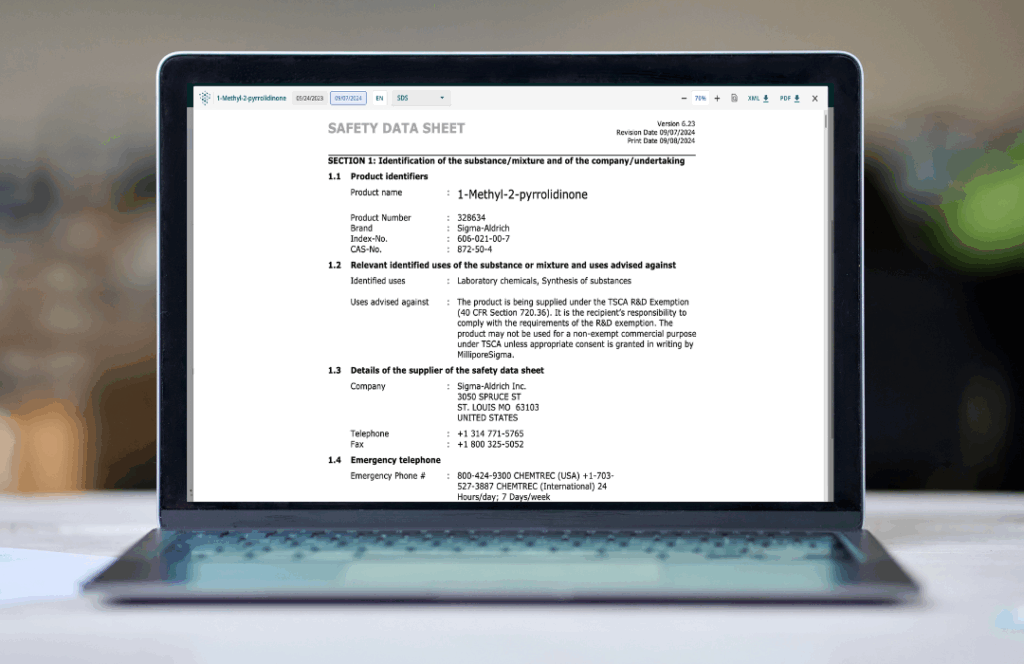
A Safety Data Sheet (SDS) is a document (digital or hard copy) that provides an overview of how chemicals should be handled, used and stored. All SDSs follow a standard 16-point layout so that the information is easy to find, no matter what chemical you are working with.
What is the difference between a safety data sheet and a chemical inventory?
A safety data sheet (SDS) provides information about a specific chemical, while a substance register provides an overview of all the chemicals in the company, and thus consists of several SDSs.
Why do we need safety data sheets?
SDSs are needed to handle chemicals safely, protect employees from health hazards and describe procedures for first aid, fire and spills. Not only that, but updated SDSs are required by law through the Regulations for the Performance of Work, REACH and CLP, and are an important part of a company’s health, safety and environment (HSE) work.
A safety data sheet is always structured according to a fixed 16-point template. This makes it easy to find the right information, no matter what chemical you are working with.
Identification (name of the substance/product and supplier)
Hazard identification (health, fire and environmental hazards)
Composition (content and hazardous components)
First aid measures (what to do in case of accidents)
Firefighting measures (suitable extinguishing media and protective measures)
Measures in the event of a spill (handling of spills and leaks)
Handling and storage (safe procedures and storage requirements)
Exposure controls/protective equipment (limit values and protective equipment)
Physical/chemical properties (appearance, smell, boiling point, etc.)
Stability/reactivity (conditions that may cause hazardous reactions)
Toxicology (effects on health)
Ecology (impact on the environment)
Disposal consideration (waste management)
Transport (UN number and transport requirements)
Regulations (laws and regulations that apply)
Other information (additional info and update date)
Who is responsible?
The supplier’s responsibility
The supplier is responsible for preparing and supplying safety data sheets in Norwegian when a hazardous chemical is marketed in Norway. The SDS must be free, up-to-date and available to professional users. Among other things, the data sheet must contain Norwegian limit values and the Poisons Information Center’s emergency number. In the event of new information or regulatory changes, the supplier must update the SDS and send it to customers who have received the product in the last 12 months.
The employer’s responsibility
Procedures must be established to ensure that safety data sheets are of satisfactory quality, meet the requirements of the regulations and are updated when new information or versions become available. The employer is responsible for checking the SDS when new chemicals are used, ensuring that the data sheets are up to date, and obtaining missing information from the supplier if they are incomplete.
If an error is discovered, the employer must check whether a newer version is available and contact the supplier for an update. It is particularly important to ensure that special Norwegian requirements are taken care of in the SDS, for example that chapter 8 contains Norwegian administrative limit values, that chapter 15 refers to relevant Norwegian regulations, and that any Norwegian product registration number (PRN) is listed there.
Known challenges
Difficult to keep SDS up to date
Many companies find it challenging to keep their chemical inventory and SDS documentation up to date. When the company uses chemicals from several manufacturers and suppliers, it quickly becomes challenging to keep track of all the changes they make to their SDS.
There are no fixed deadlines for updating data sheets, and changes can therefore be made at any time. SDSs must be revised as soon as there is new information about hazards or regulations. This requires good routines to ensure that the SDS is always updated in relation to the chemicals the company actually uses.
Safety information must be easily accessible and understandable for employees
It is a legal requirement that employees have easy access to safety data sheets for the chemicals they work with. In practice, this can be challenging if the data sheets are stored in digital systems that employees have not been adequately trained in, behind passwords, or only exist in paper archives.
Most people who handle chemicals at work are not chemists, and it can be challenging for employers to provide ongoing and necessary training in how an SDS should be understood and used.
A good SDS provides an overview, creates security and ensures compliance with legal requirements. When companies take safety data sheets seriously, both HSE work and emergency preparedness are strengthened. So make sure you have a system that makes it easy to keep all safety data sheets up to date and available, so that safety information becomes a natural part of your daily work with chemicals.