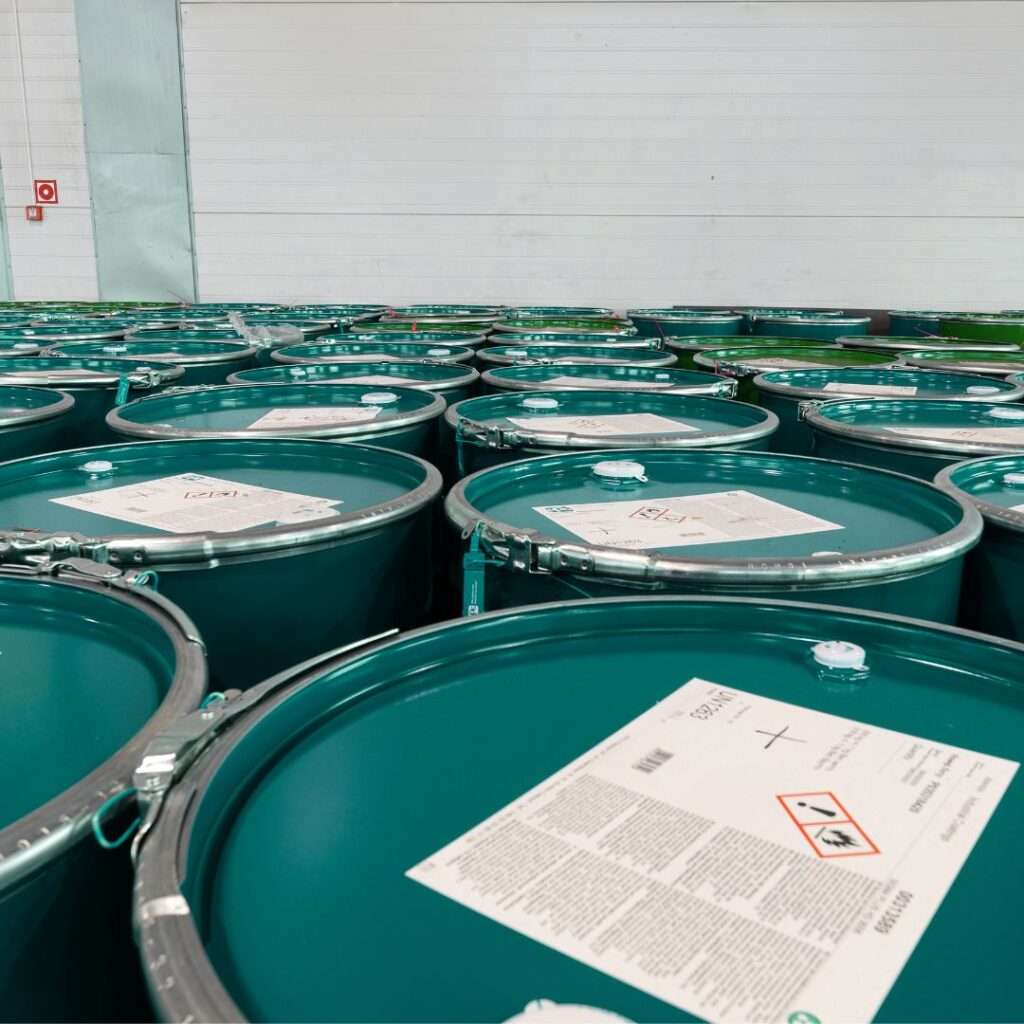
Clear and accurate labelling of chemicals is a fundamental prerequisite for a safe working environment. CLP labelling plays a key role in communicating chemical hazards in a standardised and easily understandable way.
What is CLP labelling?
CLP stands for Classification, Labelling and Packaging and is the EU’s regulation for the classification, labelling, and packaging of chemicals. The regulation is based on the UN’s Globally Harmonized System of Classification and Labelling of Chemicals (GHS), with the aim of ensuring that workers and users receive clear, unambiguous information about chemical hazards.
Although CLP is an EU regulation, its principles are largely harmonised with regulations in many other parts of the world. This makes CLP labelling relevant also for companies that operate internationally or use chemicals supplied from other markets.
You can find more information about the CLP Regulation, also known as the CLP Regulation, at ECHA.
CLP labelling is more than just a formal requirement. It can also help to:
Protecting employees from health hazards
Prevent accidents and misuse
Ensure compliance with HSE and working environment requirements
Creating safer workplaces across industries
When the information on the label is accurate, up-to-date, and easy to understand, it becomes easier for everyone to handle chemicals safely.
What does a CLP label contain?
A CLP label should provide the user with all the information necessary for the safe handling of the substance or mixture. A complete label includes, among other things:
Supplier information: Name, address, and telephone number of the supplier. From July 1, 2026, suppliers must be established in the EU/EEA.
Product identification: Clear name or identifier that makes it clear which substance or mixture the label applies to.
Nominal quantity: Quantity of contents, when the product is intended for the general public and this is not stated elsewhere on the packaging.
Hazard information: This may include hazard symbols (pictograms), hazard signal words, hazard and safety statements, and any additional information required by other regulations.
CLP also sets requirements for the size, design, and placement of the label. It must be securely attached, easily visible, legible, and durable throughout the product’s lifetime. In some cases, such as very small containers, there are limited exceptions where not all information can be included. In such cases, certain elements may be omitted, but this must be done in accordance with the regulations.
CLP hazard symbols
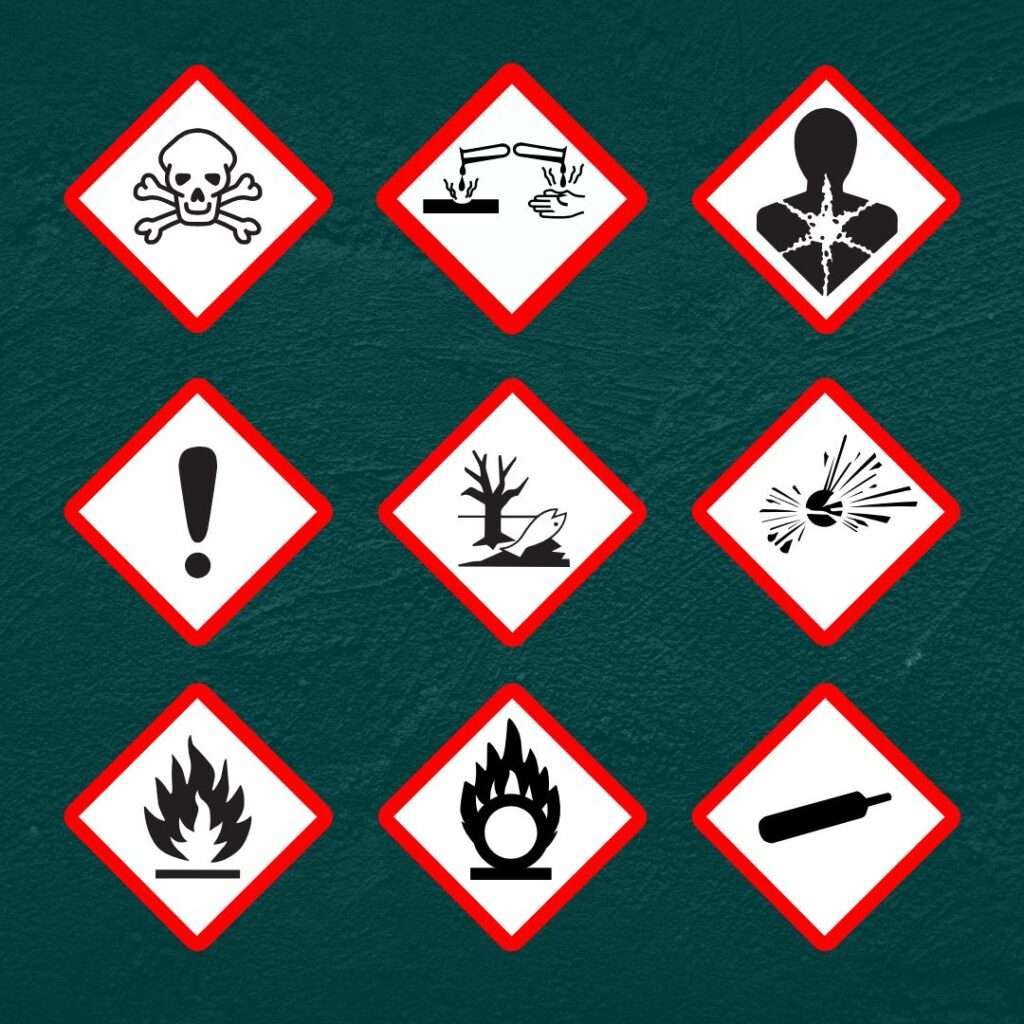
Hazard symbols, also known as hazard pictograms, provide immediate visual information about the hazards posed by a chemical. Under CLP, there are nine different pictograms covering, among other things:
Health hazard
Chronic health hazard
Flammable substances
Corrosive chemicals
Acute toxicity
Gas under pressure
Environmental hazard
Explosive
Oxidising substances
The correct use of hazard symbols is crucial for employees to be able to quickly identify risks, especially in environments where many chemicals are used in parallel. The symbols must always correspond to the classification of the substance and the most serious hazards.
Incorrect or inadequate labelling can lead to safety risks, regulatory non-compliance, and, in the worst case, serious incidents.
Classification and labelling according to CLP is a key part of systematic HSE work in companies that handle chemicals. Correct CLP labelling helps ensure that hazards are understood quickly and correctly, and provides employees with the necessary basis for the safe use, storage, and handling of chemical substances and mixtures. At the same time, the regulations set clear requirements for the content, design, and updating of labels. Changes in classifications, language requirements, and compliance with SDS mean that chemical labelling can be demanding to manage over time. Nevertheless, the consequences of errors or omissions are often far greater than the effort required to do it right.
Common challenges with chemical storage – and how to avoid them
Improper storage of chemicals and hazardous substances increases the risk of accidents, environmental damage and, in the worst case, regulatory breaches. Here we have gathered some of the most common challenges related to chemical storage, and how you can ensure safe chemical management in your organisation.
Inadequate labelling and documentation
One of the most widespread challenges is incorrect or inadequate labelling of products. When hazard symbols and labels are missing or difficult to read, it can lead to confusion or incorrect handling of chemical substances. Therefore, make sure that hazardous chemicals are labelled with clear hazard labels in accordance with CLP regulations, and that safety data sheets (SDS) are updated at all times.
Unsuitable storage conditions
Unsuitable storage conditions can create dangerous situations. Many chemicals can react to heat, moisture or direct sunlight, increasing the risk of leaks, explosions or fire. Therefore, ensure that chemicals are stored at the correct temperature, not in overheated rooms or near heat sources or machinery, and that storage areas have adequate ventilation.
Lack of overview of flammable and explosive substances
Many organisations lack a consolidated and up-to-date overview of flammable and explosive substances. This can make it difficult to assess risks, control storage quantities and ensure appropriate preventive measures. Without a good overview, the risk of incorrect storage, undetected ignition sources and inadequate emergency preparedness in the event of fire or explosion increases.
Insufficient training and safety and emergency procedures
Even the best chemical management systems are of little use if employees do not know how to use them. Lack of training can lead to incorrect handling, especially in the event of leaks or incidents. Therefore, ensure that clear procedures are in place for risk assessment, chemical handling and emergency situations, and that all employees receive the necessary training.
Outdated or inadequate equipment
If equipment is old, worn or no longer suited to the chemicals being stored, the risk of hazardous situations increases. Ensure that there are fixed routines for inspection, maintenance and replacement of equipment, and that employees have the correct protective equipment for their work.
Incorrect waste handling
Improper handling of chemical waste can lead to environmental damage and fire hazards. Unfortunately, many organisations lack clear procedures for how hazardous waste should be collected, labelled and stored. Therefore, ensure you have a clear waste management plan, use approved containers and label waste correctly. Waste collection should be arranged with certified waste management companies.
Storage of incompatible chemicals
Certain chemicals must never be stored together, as they can react dangerously with each other. Incorrect co-storage is one of the most common causes of serious accidents. Therefore, divide storage areas by substance type and hazard class. Use separate cabinets or rooms, and label clearly to prevent dangerous chemical reactions.
Examples of incompatible substances:
Acids and bases
Oxidising substances and flammable liquids
Chlorine and ammonia
Manual systems
Many organisations still use manual systems or unclear Excel lists for chemical management. This can increase the risk of errors, lack of updates and poor oversight. This can be avoided by implementing automated systems that provide full oversight of chemicals, documentation, storage conditions and waste management.
Digital tools can solve some of the challenges
By using a digital tool such as Workplace Safety, the company gets a comprehensive and up-to-date overview of chemicals and associated documentation. The system provides guidance on co-storage and alerts you to potential storage hazards, based on the German standard TRGS 510 for co-storage. It is also easy to look up the safety data sheet directly in the system, so requirements for handling, storage and stability are quickly available.
Chemical management is primarily about order, structure and good routines. By ensuring clear labelling, correct storage conditions, suitable equipment and simple, up-to-date systems, daily operations can become both safer and more efficient. Small improvements in routines can make a big difference.
Chemical management system: What to consider when choosing a new system
Time to get control of the chemicals in your workplace? A chemical management system can make everyday work easier and safer, but with many solutions on the market, it can be challenging to know which one to choose.
That is why we have created an overview of factors you should consider before investing in a new system for your organisation.
Easily accessible and user-friendly
A chemical management system should be easy to find, understand, and use for all employees. Whether you are an HSE manager, supervisor, or end user of chemicals, the system must be adaptable to different roles, tasks, and areas of responsibility. The easier the system is to use in practice, the greater the chance that it will actually be used.
Questions you can ask:
Does the system support different devices (e.g., PC, mobile phone, tablet)?
Is it possible to customise user access based on roles and departments?
Is offline support available in cases where it may be relevant (e.g., field and offshore work)?
Automated processes
The system should support automated processes and contribute to less manual work. Examples include automatic updates of safety data sheets (SDS) when the supplier publishes new versions, or notifications when risk assessments are approaching their expiration date. When such processes flow seamlessly between links, the risk of errors is reduced. Instead, processes become more efficient and data quality improves.
Questions you can ask:
Which processes are handled automatically in the system (e.g., safety data sheets updates)?
Does the system use new tools such as AI and machine learning to streamline chemical management (e.g., automatic interpretation of data)?
Does the system notify when work needs to be done (e.g., revision of risk assessment, substitution that needs to be done, planned work that requires exposure registration)?
Can the system be connected to our AD/SSO so that users and access management are created and maintained automatically?
Aligned with relevant legislation
Companies must comply with both national and international regulations, including frameworks such as REACH and CLP. A robust chemical management system should therefore be adaptable and enable clear, efficient documentation of compliance across different jurisdictions.
In some countries, there is also a specific requirement to record employee exposure to hazardous substances. For example, in Norway, employers may be required to maintain an exposure register if workers handle particularly hazardous chemicals.
Questions you can ask:
Has the supplier developed the system in accordance with local laws and regulations?
Does the system have reporting possibilities needed for documentation requirements?
Is it easy to export documentation for use in control and supervision?
Migrate data to new system
When a company transitions to a new chemical management system, there is often a lot of valuable information that needs to be transferred from old solutions. A successful migration is crucial to ensure that important documentation is not lost and that you do not have to start from scratch. It may be wise to find out whether the supplier offers assistance with data migration and how the process is handled in practice. The system should be able to import existing data in a structured manner, so that the company can quickly get started with a complete overview and retain its history.
Questions you can ask:
Can you get help migrate existing data into the system?
How long does the migration process take, and what is required of the company?
What types of data can be imported (e.g., SDS, risk assessments, exposure registers)?
Access to training and support
Getting to grips with a new system can be time-consuming. To get the most value out of the solution, it is a good idea to check whether the supplier offers support to help you get started. A proper onboarding can be crucial to ensure that the system is actually used effectively.
Questions you can ask:
Are user manuals, demos, training videos, or other training materials available?
Is it possible to get advice and support along the way if needed?
Is support available in a language I can understand?
Secure data storage
For some companies, the contents of a chemical inventory may contain sensitive information, such as chemicals used in production or research projects. In addition, data stored in an exposure register may be considered health information and is therefore subject to strict privacy requirements. For many, it is a great advantage that the system supplier offers data storage in Norway, so that they can be confident that the information is handled in accordance with strict Norwegian laws and GDPR.
It is also important to consider how data is actually stored and secured, both during normal operation and in the event of a problem. Factors such as encryption, access control, and audit trails can be crucial in this regard.
Questions you can ask:
Where is the data physically stored (in EU/EEA, or outside of Europe)?
What are the backup and recovery procedures if something goes wrong?
Are there audit trails showing who has had access to the data and when?
How is personal data handled (e.g. exposure registration data)?
Clear reporting and documentation
During internal controls, inspections, or other audits, it is important that the necessary documentation can be retrieved quickly and easily. A flexible reporting system allows you to generate customised reports based on your own key figures and needs.
Questions you can ask:
What ready-made report templates are included (e.g., risk assessments, substance overviews)?
In which formats can reports be exported (e.g., Excel, PDF, CSV)?
Is it possible to schedule and send reports automatically at fixed times?
Favorable pricing models
When evaluating a chemical management system, it is wise to look closely at how the pricing model is structured. Some suppliers charge per user, per module, others per safety data sheet, and some combine several. This can have a significant impact on the total cost, especially if the company has many employees who need access, but only a few who actively administer the system.
Questions you can ask:
How is the system priced (e.g., per user, per module, per safety data sheet, or a combination)?
Are there different agreement levels with varying degrees of support and functionality?
Can you add or remove users yourself, and how does this affect the cost?
Possibility of scaling and customisation
A chemical management system should be able to grow with the organisation, both in terms of the number of users, departments, industries, and geographic locations. It should be easy to set up common standards, but at the same time allow for local adaptation. The option of multilingualism and support for different national regulations is a major advantage for companies that operate internationally.
Questions you can ask:
Can roles and access management be set up at multiple levels (e.g., group, department, project-based)?
Is the system designed for international growth (e.g., access to a global substance database, safety data sheets in multiple languages)?
Can the company itself create risk assessment templates, labels, and reports?
Are there any technical or licensing restrictions that one should be aware of?
The most important thing is to spend time finding a chemical management system that actually suits your organisation. Once a system has been chosen, it can be both time-consuming and resource-intensive to transfer data and retrain employees. Making the right choice from the outset will therefore save time, money, and potential frustration, while also contributing to a safer and more efficient working environment.
Are you responsible for HSE and chemical management in your organisation? Here are 10 tips to help make your working day a little safer.
1. Create a clear chemical inventory
Make sure that your company has a chemical inventory that provides a complete overview of all hazardous chemicals in the workplace. Here, employees can easily see where the chemicals are located and what hazards they can cause.
2. Easily accessible safety data sheet
All chemicals must have an updated safety data sheet (SDS) with information on chemical handling, hazards, protective equipment and first aid measures. Therefore, make sure that these data sheets are easily accessible to employees (e.g. via QR code, on mobile/tablet), so that they can be actively used in the daily operation.
3. Training in safety practices and procedures
Employees must receive thorough training in the company’s safety routines and procedures. This can include everything from risk assessment to the choice and use of protective measures. If there are no clear guidelines for handling chemicals, the employer must ensure that such guidelines are established quickly and that employees receive adequate training in them.
Training can typically include:
Hazardous chemicals in the workplace, their names, risks and limits
Use of chemical inventory, risk assessments and changes to these
Correct use of work equipment
Necessary protective measures for safe execution
Managing disruptions and emergencies
4. Clear labelling and storage
All chemical products must be labelled with names and hazard symbols in accordance with the CLP regulations, and stored properly. This may involve storage in separate cabinets or rooms. For particularly hazardous chemicals, it may be necessary to lock cabinets or restrict access so that only qualified personnel have access.
5. Customised protective measures
Safety measures must always be adapted to the actual use of the chemicals and the specific work operation.
Examples of measures can be:
Spot extraction and fume cupboards
Sufficient general ventilation
Process-adapted ventilation when needed
Correct labelling and signage
Secure storage solutions
Restricted access
Protective gloves and goggles
Respiratory protection
Emergency response equipment
6. Follow established regulations
Working with chemicals is regulated by several laws and regulations, such as REACH and CLP. Be sure to follow these regulations carefully as violations can lead to fines and orders, but more importantly, compliance contributes to fewer accidents and a safer working environment.
7. Consider alternative chemicals
Always consider whether hazardous chemicals can be replaced with less hazardous alternatives (substitution). This reduces risk and is part of the substitution obligation. If your business uses a chemical management system, it can often provide automatic suggestions for safer alternatives.
8. Digitise documentation
A chemical inventory can be kept both on paper and digitally, but digital solutions often provide a better overview and ease of use. When documentation is digitised, it becomes easier to search for chemicals, update safety data sheets and share information across departments. Many systems also offer functions such as automatic notification of expired SDSs, suggestions for substitution and integration with risk assessments and internal control. A great idea is therefore to gather all documentation digitally in one place.
9. Revise and improve
Safe handling of chemicals is not a one-off task, but a continuous process as part of the company’s systematic HSE work. New chemicals, changed work routines or updated laws and regulations may require adjustments to routines and measures. Therefore, the company should regularly review the chemical inventory, safety routines and risk assessments to ensure that they are still relevant.
10. Involve your employees
Involve employees in chemical management and auditing work, as they have practical experience that can contribute to better solutions. When the people who actually work with chemicals are actively involved, you create both better routines and a stronger safety culture.
Safe chemical handling is about combining well-structured routines and systems with the right equipment and active employee involvement. By following these 10 tips, your business can reduce risk, prevent accidents and contribute to a safer working environment.
Norwegian universities and research institutes choose Workplace Safety
The knowledge sector’s service provider, Sikt, is organized as a government agency under the Ministry of Education and Research. Sikt works to simplify the everyday lives of employees, researchers and students in the knowledge sector by offering stable and efficient shared services.
As a buyer of Workplace Safety, Sikt has contributed to delivering a user-friendly chemical inventory and an effective chemical management system to Norwegian colleges, universities and research institutes.
A chemical inventory for both staff and students
Workplace Safety is an advanced management system used by managers, HSE professionals, researchers, and laboratory staff. Since chemicals are central to both teaching and research, strict requirements apply to safety information, and must be readily available to everyone, both staff and students.
Workplace Safety meets these needs with access management and role customisation, ensuring each user only sees what’s relevant to them. The system provides quick, easy access to safety data sheets (SDS), solving a major challenge in the industry.
A partner for industry-aligned development
With flexibility in mind, Workplace Safety has been developed to easily adapt to the needs of different industries. Through collaboration with Sikt, which represents a broad and important sector, we gain unique insight into shared challenges in Norway.
Insights that lead to better solutions
This approach gives us valuable insight into the specific challenges and needs of the knowledge sector, helping us further develop the solution. By collaborating with a single representative of the entire sector, we gain depth and efficiency that strengthen our ability to deliver a chemical management system tailored to the needs of higher education and research.
– Sikt is an important partner in the further development of Workplace Safety, and we greatly appreciate working with key players in higher education, says Hans Kristian Brekken, product developer with technical responsibility for Workplace Safety.
Collaboration for common practices in the sector
Sikt works proactively on behalf of the company to ensure the best solutions. To achieve this, they have established a working committee consisting of professionals representing the sector. The committee works together to develop a common practice for the use of the chemical management system across the knowledge sector.
Targeted further development
Sikt is the purchaser and contract manager, drawing on expertise from universities and university colleges. This ensures comprehensive and targeted further development of the system.
– The knowledge sector places high demands on both the product and us as an organisation. This has given us a clear direction in our efforts to adapt Workplace Safety to the sector’s needs, says Brekken.
Large-scale implementation and migration of data
In 2024, several of Norway’s universities and university colleges implemented the chemical management system. The process involved migrating large volumes of data and many users, but close collaboration between the Workplace Safety team and the institutions ensured a smooth transition.
– We are pleased to have completed the migration from the old system to Workplace Safety in a safe and efficient way, says Ask Hide, Project Manager at Workplace Safety.
– This marks an important milestone in our joint efforts to strengthen the safety and efficiency of chemical handling across institutions.
Technical implementation and professional advice
Adapting Workplace Safety to a company’s work processes and routines requires thorough mapping and close collaboration.
– A successful implementation requires strong cooperation from both parties. Working closely with customers enabled us to ensure they fully benefit from the system’s capabilities, Hide explains.
The team used a proprietary migration tool to simplify the transfer of safety data sheets (SDS) and system structure. Role assignments were tailored to each company, ensuring users received the right information and access from day one.
– The projects have been extensive, but our main focus has been to deliver quality at all stages, both in terms of technical implementation and professional advice, emphasises Hide.
Pilot project and further roll-out
The pilot project involved leading institutions such as the University of Bergen (UiB), the Norwegian University of Science and Technology (NTNU), the University of Stavanger (UiS) and NORCE – Norwegian Research Center. These have now completed the transition to Workplace Safety. The roll-out to the rest of the sector is well underway and will continue with full force in 2025.
At the time of writing, the majority of the companies that expressed an interest in joint purchasing of electronic substance files have been implemented.
Positive effects of digitalisation and automation
The implementation of Workplace Safety in the knowledge sector has demonstrated how targeted system adaptation can deliver clear benefits for both users and companies.
The system can be configured to reflect the company’s working methods, from simple routines to more complex processes. Through close collaboration with the institutions, we have developed workflows that make it easier to comply with legal requirements while ensuring chemical management is more transparent and user-friendly.
Odin Kvam, sector coordinator for the service and senior engineer at the University of Agder, shares his experiences:
– The transition to Workplace Safety gives us a tool that is flexible in meeting the many different ways chemicals are used in the higher education sector. The system integrates easily with the company’s organisation – without an extra login when students and employees visit the chemical inventory. Netpower provides continuous updates and improvements to keep Workplace Safety aligned with Norwegian and European regulations, and to further enhance user-friendliness in key functions such as the exposure register, substitution, and risk assessments.
Feedback that drives improvement
The implementation has generated a wealth of useful feedback, both praise and suggestions for improvement.
– We have worked closely with the companies in the sector to ensure a smooth transition to the new system. Feedback, both positive and critical, is valuable to us. The positive confirms that we are on the right track, while the critical ones provides insights we can use to make the solution even better. Our goal is to develop a system that really works for users in their everyday lives, says Hide.
– We look forward to continuing our collaboration with the Workplace Safety team at Netpower to meet future needs and ensure a safe working environment for both students and staff, Kvam concludes.