Clear and accurate labeling of chemicals is a fundamental prerequisite for a safe working environment. CLP labeling plays a key role in communicating chemical hazards in a standardized and easily understandable way.
What is CLP labeling?
CLP stands for Classification, Labelling and Packaging and is the EU’s regulation for the classification, labeling, and packaging of chemicals. The regulation is based on the UN’s Globally Harmonized System of Classification and Labelling of Chemicals (GHS), with the aim of ensuring that workers and users receive clear, unambiguous information about chemical hazards.
Although CLP is an EU regulation, its principles are largely harmonized with regulations in many other parts of the world. This makes CLP labeling relevant also for companies that operate internationally or use chemicals supplied from other markets.
You can find more information about the CLP Regulation, also known as the CLP Regulation, at Lovdata.
CLP labeling is more than just a formal requirement; it can also help to:
Protecting employees from health hazards
Prevent accidents and misuse
Ensure compliance with HSE and working environment requirements
Creating safer workplaces across industries
When the information on the label is accurate, up-to-date, and easy to understand, it becomes easier for everyone to handle chemicals safely.
What does a CLP label contain?
A CLP label should provide the user with all the information necessary for the safe handling of the substance or mixture. A complete label includes, among other things:
Supplier information: Name, address, and telephone number of the supplier. From July 1, 2026, suppliers must be established in the EU/EEA.
Product identification: Clear name or identifier that makes it clear which substance or mixture the label applies to.
Nominal quantity: Quantity of contents, when the product is intended for the general public and this is not stated elsewhere on the packaging.
Hazard information: This may include hazard symbols (pictograms), hazard signal words, hazard and safety statements, and any additional information required by other regulations.
CLP also sets requirements for the size, design, and placement of the label. It must be securely attached, easily visible, legible, and durable throughout the product’s lifetime. In some cases, such as very small containers, there are limited exceptions where not all information can be included. In such cases, certain elements may be omitted, but this must be done in accordance with the regulations.
CLP hazard symbols
Hazard symbols, also known as hazard pictograms, provide immediate visual information about the hazards posed by a chemical. Under CLP, there are nine different pictograms covering, among other things:
Health hazard
Chronic health hazard
Flammable substances
Corrosive chemicals
Acute toxicity
Gas under pressure
Environmental hazard
Explosive
Oxidizing substances
The correct use of hazard symbols is crucial for employees to be able to quickly identify risks, especially in environments where many chemicals are used in parallel. The symbols must always correspond to the classification of the substance and the most serious hazards.
Incorrect or inadequate labeling can lead to safety risks, regulatory non-compliance, and, in the worst case, serious incidents.
Classification and labeling according to CLP is a key part of systematic HSE work in companies that handle chemicals. Correct CLP labeling helps ensure that hazards are understood quickly and correctly, and provides employees with the necessary basis for the safe use, storage, and handling of chemical substances and mixtures. At the same time, the regulations set clear requirements for the content, design, and updating of labels. Changes in classifications, language requirements, and compliance with SDS mean that chemical labeling can be demanding to manage over time. Nevertheless, the consequences of errors or omissions are often far greater than the effort required to do it right.
Chemical management system: What to consider when choosing a new system
Time to get control of the chemicals in your workplace? A chemical management system can make everyday work easier and safer, but with so many solutions on the market, it can be challenging to know which one to choose.
That’s why we have created an overview of factors you should consider before investing in a new system for your business.
Easily accessible and user-friendly
A chemical management system should be easy to find, understand, and use for all employees. Whether you are an HSE manager, supervisor, or end user of chemicals, the system must be adaptable to different roles, tasks, and areas of responsibility. The easier the system is to use in practice, the greater the chance that it will actually be used.
Questions you can ask:
Does the system support different digital devices (e.g., PC, mobile phone, tablet)?
Is it possible to customise user access based on roles and departments?
Is offline support available in cases where it may be relevant (e.g., offshore work)?
Automated processes
The system should support automated processes and contribute to less manual work. Examples include automatic updating of safety data sheets (SDS) when the supplier publishes new versions, or notifications when risk assessments are approaching their expiration date. When such processes flow seamlessly between links, the risk of errors is reduced. Instead, processes become more efficient and data quality improves.
Questions you can ask:
Which processes are handled automatically in the system (e.g., safety data sheets updates)?
Does the system use new tools such as AI and machine learning to streamline chemical management (e.g., automatic interpretation of data)?
Does the system notify when work needs to be done (e.g., revision of risk assessment, substitution that needs to be done, planned work that requires exposure registration)?
Can the system be connected to our AD/SSO so that users and access management are created and maintained automatically?
Adapted to Norwegian legislation
Companies in Norway must comply with both national regulations, such as the Working Environment Act and associated regulations, and international regulations such as REACH and CLP. A proper chemical management tool should therefore be adapted to Norwegian conditions and make it easy to document compliance. In Norway, for example, there is a particular focus on recording exposures in an exposure register, which may be required if employees handle particularly hazardous chemicals.
Questions you can ask:
Has the supplier developed the system in accordance with local laws and regulations?
Does the system have an exposure register in accordance with Norwegian regulatory requirements?
Is it easy to export documentation for use in control and supervision?
Migrate data to new system
When a business transitions to a new chemical management system, there is often a lot of valuable information that needs to be transferred from old solutions. A successful migration is crucial to ensure that important documentation is not lost and that you do not have to start from scratch. It may be wise to find out whether the supplier offers assistance with data migration and how the process is handled in practice. The system should be able to import existing data in a structured manner, so that the company can quickly get started with a complete overview and retain its history.
Questions you can ask:
Can you get help migrating existing data into the system?
How long does the migration process take, and what is required of the business?
What types of data can be imported (e.g., SDS, risk assessments, exposure registers)?
Access to training and support
Getting to grips with a new system can be time-consuming. To get the most value out of the solution, it is a good idea to check whether the supplier offers support to help you get started. A proper onboarding can be crucial to ensure that the system is actually used effectively.
Questions you can ask:
Are user manuals, demos, training videos, or other training materials available?
Is it possible to get advice and support along the way if needed?
Is support available in a language I can understand?
Secure data storage
For some businesses, the contents of a chemical inventory may contain sensitive information, such as chemicals used in production or research projects. In addition, data stored in an exposure register may be considered health information and is therefore subject to strict privacy requirements. For many, it is a great advantage that the system supplier offers data storage in Norway, so that they can be confident that the information is handled in accordance with Norwegian law and the GDPR.
It is also important to consider how data is actually stored and secured, both during normal operation and in the event of a problem. Factors such as encryption, access control, and audit trails can be crucial in this regard.
Questions you can ask:
Where is the data physically stored (in EU/EEA, or outside of Europe)?
What are the backup and recovery procedures if something goes wrong?
Are there audit trails showing who has had access to the data and when?
How is personal data handled (e.g. exposure registration data)?
Clear reporting and documentation
During internal controls, inspections, or other audits, it is important that the necessary documentation can be retrieved quickly and easily. A flexible reporting system allows you to generate customised reports based on your own key figures and needs.
Questions you can ask:
What ready-made report templates are included (e.g., risk assessments, substance overviews)?
In which formats can reports be exported (e.g., Excel, PDF, CSV)?
Is it possible to schedule and send reports automatically at fixed times?
Favorable pricing models
When evaluating a chemical management system, it is wise to look closely at how the pricing model is structured. Some suppliers charge per user, per module, others per safety data sheet, and some combine several. This can have a significant impact on the total cost, especially if the company has many employees who need access, but only a few who actively administer the system.
Questions you can ask:
How is the system priced (e.g., per user, per module, per safety data sheet, or a combination)?
Are there different agreement levels with varying degrees of support and functionality?
Can you add or remove users yourself, and how does this affect the cost?
Possibility of scaling and customisation
A chemical management system should be able to grow with the business, both in terms of the number of users, departments, industries, and geographic locations. It should be easy to set up common standards, but at the same time allow for local adaptation. The option of multilingualism and support for different national regulations is a major advantage for companies that operate internationally.
Questions you can ask:
Can roles and access management be set up at multiple levels (e.g., group, department, project-based)?
Is the system designed for international growth (e.g., access to a global substance database, safety data sheets in multiple languages)?
Can the company itself create risk assessment templates, labels, and reports?
Are there any technical or licensing restrictions that one should be aware of?
The most important thing is to spend time finding a chemical management system that actually suits your business. Once a system has been chosen, it can be both time-consuming and resource-intensive to transfer data and retrain employees. Making the right choice from the outset will therefore save time, money, and potential frustration, while also contributing to a safer and more efficient working environment.
Webinar: New updates in Workplace Safety (Norwegian)
On Friday, October 31, we invite you to a free customer webinar to review the latest in Workplace Safety (version 1.2.7). Sign up here.
Webinar with Workplace Safety
A lot of exciting things have happened in Workplace Safety, and in this webinar Ask and Hans Kristian go through the new updates and answer any questions.
Q&A with the Norwegian Labor Inspection Authority: Exposure register
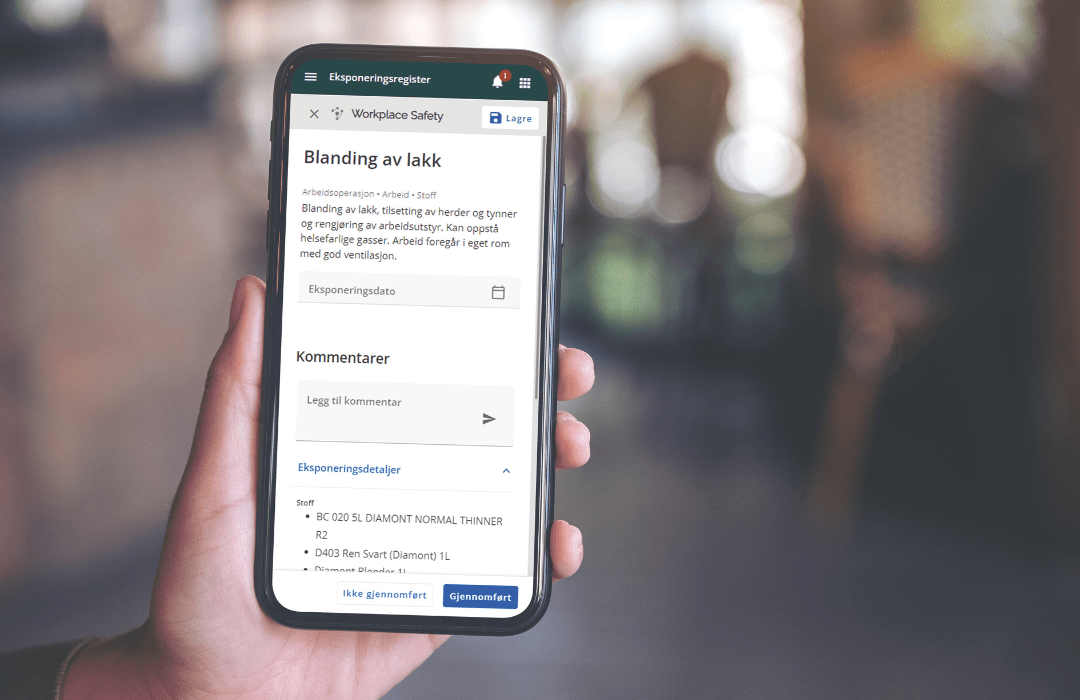
An exposure register documents employees’ potential or actual exposure to hazardous substances or processes.
Chapter 31 of the Regulations on the Performance of Work specifies which exposures are to be registered, but the wording of the regulations can be interpreted in different ways and we see that there are different practices for registering exposure among our Workplace Safety customers.
In order to get answers to our questions, we invited the Norwegian Labor Inspection Authority to a webinar, and everyone who works with hazardous chemicals was welcome to participate. Some of these questions are summarized here.
Our summary of the questions
Who is responsible for the exposure register?
The employer is the obligated party. This means that it is the employer who has the overall responsibility for ensuring that a register is kept – and that the exposures are recorded correctly.
How do you know if the substances are classified as Carc 1A and 1B, Mut 1A and 1B, Repr. 1A or Repr. 1B?
Use the safety data sheet in the substance register to find out if the substance belongs to any of the classifications that require registration under section 31-1. This information can also be found on the product’s packaging.
Classification is given in Annex VI of the CLP Regulation, Table 3
In Workplace Safety, products in these classes will automatically be marked with an exposure icon, so it is easy to see in the substance register whether exposed employees must be registered.
You can also search for classification on the website of the European Chemicals Agency, ECHA:
New registry requirement for reprotoxic substances
As of April 5, 2024, work with substances classified as Repr 1A and Repr 1B is also subject to registration in the exposure register.
Are there requirements for the format of an exposure register?
No, the Norwegian Labor Inspection Authority has no format requirements. The requirements for what the register should contain are set out in the regulations, but the exposure register can be an Excel sheet.
What does “anyone who is, or may be, exposed” mean?
This means all work situations where employee exposure cannot be ruled out.
The requirement for exposure registration should be interpreted as follows: All employees who are exposed, or who may be exposed, MUST be registered.
It also means considering personnel who may be exposed even if they are not directly engaged in tasks or processes where they may be exposed. This could be cleaning and maintenance staff, or other functions that are only present at the workplace for a short period of time.
How do you know which work operations or processes to register?
The employer’s risk assessment must always form the basis for this assessment.
The Norwegian Labor Inspection Authority does not have a set answer to which exposure situations should be registered. It is up to the company itself to risk assess the various conditions, and it is up to the company itself to decide whether employees are exposed or not.
If the employer believes that a register is not required, this must be documented.
What if the concentration is far below the limit value?
There is no lower limit for concentration, where you do not need to keep records.
Limit values are based on current knowledge of health effects, and also take into account economic and technical aspects.
There is no absolute limit to when health risks can occur. Therefore, all exposures should be recorded, no matter how low.
This may mean that almost all employees in a company must be registered. In cases where exposure is very low, this will be stated in the register information.
How should you record the time and duration of the exposure?
The Norwegian Labor Inspection Authority is clear that you can have a pragmatic approach to entering time and duration. It should be as detailed as possible, but it should also be practically feasible.
Here it is permitted to provide average calculations. In other words, you don’t have to take measurements every day to find out what concentrations you were exposed to on different days.
Should personal protective equipment be taken into account in a risk assessment?
No, you don’t.
The protection provided by PPE will never be 100% safe (lack of maintenance, incorrect use, lack of training etc.), therefore this should not be taken into account in an exposure risk assessment.
What exactly is meant by “rock work”?
The Norwegian Labor Inspection Authority confirms that the text of the regulation is unclear on what is considered rock work, and that this is something they will work on to specify. The Labor Inspection Authority associates rock work with mining, quarrying, tunneling and other rock excavation that is carried out on a large scale.
Should crushing rock in a laboratory be considered rock work?
The answer from the Labor Inspection Authority is no. The crushing of rock in a laboratory is not considered rock work. This means that, according to the regulations, there are no registration requirements for employees who are exposed to carcinogenic chemicals, such as quartz, when crushing rock in a laboratory.
Quartz is not classified in accordance with CLP and is therefore not subject to a registration requirement. This is a weakness, according to the Norwegian Labor Inspection Authority. They therefore communicate that companies can start registering this type of exposure now, even though it is not a requirement.
Some of the companies that use the exposure register in Workplace Safety explain that they interpret quartz as a carcinogenic chemical, and that they therefore record exposure to it when they work with crushing rock in the lab. This registration is not a requirement at present, as the work is not considered rock work. But it should be, according to the Labor Inspection Authority.
However, if you are exposed to quartz in rock work (i.e. rock excavation carried out on a large scale), it is subject to registration (even though quartz is not classified in CLP). This is because dust containing quartz is considered to be a process-generated hazardous substance that can come from the bedrock. Ref. § Section 31-5 of the Regulations on the performance of work.
Do all employers have to keep a register of COVID-19 sufferers?
Yes, if the employees became ill as a result of infection at work.
All employees who have been infected at work and who have become ill as a result of the infection must be registered.
The requirement came into force shortly after the SARS-CoV-2 outbreak and applies to all businesses.
There’s a lot we don’t yet know about COVID-19 in terms of after-effects and so on. That’s why it’s important that those who suffer health damage due to infection at work are registered so that their exposure is documented.
For healthcare workers, the requirements are even stricter: Healthcare workers who treat people with COVID-19 must always be entered into an exposure register – regardless of whether they have become ill or not.

Do you have questions about exposure registers or chemical management?
Working with chemicals or in environments where such substances are present can pose health risks. Some chemicals do not cause acute symptoms, but can lead to long-term effects such as cancer, respiratory disease or reproductive damage many years after exposure. Here is an overview of what an exposure register is, and which companies it may be relevant for.
What is an exposure register?
An exposure register should document employees’ potential and actual exposure, including accidents, spills and other incidents that may have led to contact with hazardous substances. This may be in connection with hazardous substances or processes related to:
Chemicals (carcinogenic, mutagenic and toxic to reproduction)
Several occupational groups that may be exposed to hazardous substances and processes.
Typical examples are:
Employees in industry (chemical industry, metal production, welding and woodworking)
Employees in construction (demolition, remediation, work with asbestos and concrete dust)
Healthcare and laboratory workers (radiation, chemicals and infectious agents)
Employees in renovation and waste management (biological material and hazardous waste)
Employees in mines and tunnels (dust, gases and explosives residues)
Employees within energy and research (radioactive material and ionising radiation)
Why do we need an exposure register?
In order to protect employees, the Working Environment Act and Chapter 31 of the Regulations on the Performance of Work require companies to keep an exposure register when working with carcinogenic, mutagenic or reprotoxic chemicals (CMR substances), as well as certain other hazardous exposures as described in the legislation. Because disease often develops many years after exposure, it is crucial to register such incidents immediately.
The register is an important tool for mapping work with high health risks in the workplace. It helps to:
Ensure documentation if illness occurs several years after exposure
What should an exposure register contain?
The content of the exposure register is clearly defined in the regulations. Based on the type of exposure (chemical, asbestos, rock work, biological or radiation), the content to be registered varies on the work subject to registration. The legislation is clear that the content of the register should not be anything other than what is described there.
Documentation and storage requirements
The register must be kept for a very long time, often between 40 and 60 years, depending on the type of exposure. The information must be available for as long as the employee is alive, and can be decisive in documenting occupational diseases and any compensation cases.
Individual employees have the right to access their own registrations. In addition, the register must be available to the Norwegian Labor Inspection Authority, occupational health services, safety representatives, the working environment committee and any other persons working with HSE in the company.
Who is responsible?
Both employer and employee have certain responsibilities, but it is the employer who has the main responsibility for creating and maintaining the exposure register.
Employee’s responsibility
Follow the company’s routines and guidelines in connection with registration
Report accidents, exposures or other situations that may have led to contact with hazardous substances
Participate in necessary training and help ensure that the information recorded is correct
The employer’s responsibility
Establish routines and guidelines for exposure registration
Provide training on how employees should report
Thoroughly document and retain records for a sufficient period of time
Ensure that the register is used
Ensure that employees have access to their own registrations
Known challenges
Inadequate reporting and follow-up
Many companies find that employees do not report exposures, either because the incident is perceived as minor, the routines are unclear, or because it is simply forgotten. This is often linked to a lack of training in chemical safety and understanding of the risk. In addition, many companies are unsure when they are actually required by law to keep an exposure register.
Difficulty storing registrations over a longer period of time
As some types of exposure require the register to be kept for up to 60 years, it requires good routines for both storage and for safeguarding privacy (GDPR). As long as the employee is alive, it should be possible to document any exposure, especially if there is a risk of cancer. As there are no specific requirements for how records are kept, many companies lack good enough routines to handle this.
A well-maintained exposure register is an important tool for both the employee and the employer. It contributes to prevention, follow-up and documentation, especially because health damage often only becomes apparent many years after exposure. Digital HSE and chemical systems can help companies identify chemicals that are subject to registration, carry out the actual registration and ensure safe storage of the information.