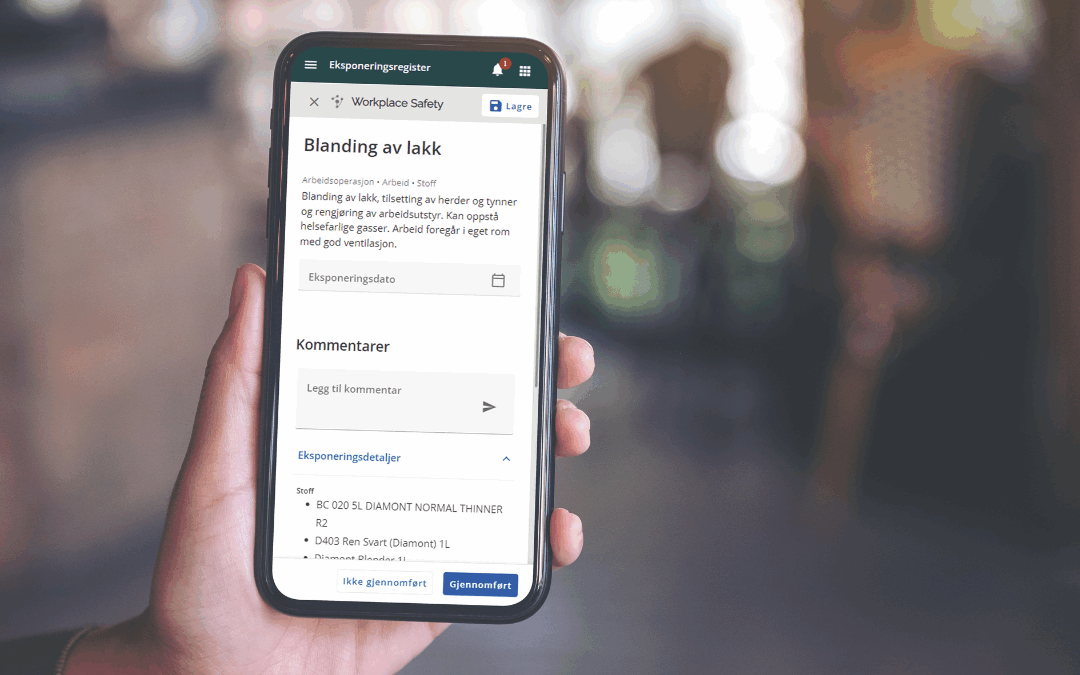
An exposure register documents employees’ potential or actual exposure to hazardous substances or processes.
Chapter 31 of the Regulations on the Performance of Work specifies which exposures are to be registered, but the wording of the regulations can be interpreted in different ways and we see that there are different practices for registering exposure among our Workplace Safety customers.
In order to get answers to our questions, we invited the Norwegian Labor Inspection Authority to a webinar, and everyone who works with hazardous chemicals was welcome to participate. Some of these questions are summarized here.
Our summary of the questions
Who is responsible for the exposure register?
The employer is the obligated party. This means that it is the employer who has the overall responsibility for ensuring that a register is kept – and that the exposures are recorded correctly.
How do you know if the substances are classified as Carc 1A and 1B, Mut 1A and 1B, Repr. 1A or Repr. 1B?
Use the safety data sheet in the substance register to find out if the substance belongs to any of the classifications that require registration under section 31-1. This information can also be found on the product’s packaging.
Classification is given in Annex VI of the CLP Regulation, Table 3
In Workplace Safety, products in these classes will automatically be marked with an exposure icon, so it is easy to see in the substance register whether exposed employees must be registered.
You can also search for classification on the website of the European Chemicals Agency, ECHA:
New registry requirement for reprotoxic substances
As of April 5, 2024, work with substances classified as Repr 1A and Repr 1B is also subject to registration in the exposure register.
Are there requirements for the format of an exposure register?
No, the Norwegian Labor Inspection Authority has no format requirements. The requirements for what the register should contain are set out in the regulations, but the exposure register can be an Excel sheet.
What does “anyone who is, or may be, exposed” mean?
This means all work situations where employee exposure cannot be ruled out.
The requirement for exposure registration should be interpreted as follows: All employees who are exposed, or who may be exposed, MUST be registered.
It also means considering personnel who may be exposed even if they are not directly engaged in tasks or processes where they may be exposed. This could be cleaning and maintenance staff, or other functions that are only present at the workplace for a short period of time.
How do you know which work operations or processes to register?
The employer’s risk assessment must always form the basis for this assessment.
The Norwegian Labor Inspection Authority does not have a set answer to which exposure situations should be registered. It is up to the company itself to risk assess the various conditions, and it is up to the company itself to decide whether employees are exposed or not.
If the employer believes that a register is not required, this must be documented.
What if the concentration is far below the limit value?
There is no lower limit for concentration, where you do not need to keep records.
Limit values are based on current knowledge of health effects, and also take into account economic and technical aspects.
There is no absolute limit to when health risks can occur. Therefore, all exposures should be recorded, no matter how low.
This may mean that almost all employees in a company must be registered. In cases where exposure is very low, this will be stated in the register information.
How should you record the time and duration of the exposure?
The Norwegian Labor Inspection Authority is clear that you can have a pragmatic approach to entering time and duration. It should be as detailed as possible, but it should also be practically feasible.
Here it is permitted to provide average calculations. In other words, you don’t have to take measurements every day to find out what concentrations you were exposed to on different days.
Should personal protective equipment be taken into account in a risk assessment?
No, you don’t.
The protection provided by PPE will never be 100% safe (lack of maintenance, incorrect use, lack of training etc.), therefore this should not be taken into account in an exposure risk assessment.
What exactly is meant by “rock work”?
The Norwegian Labor Inspection Authority confirms that the text of the regulation is unclear on what is considered rock work, and that this is something they will work on to specify. The Labor Inspection Authority associates rock work with mining, quarrying, tunneling and other rock excavation that is carried out on a large scale.
Should crushing rock in a laboratory be considered rock work?
The answer from the Labor Inspection Authority is no. The crushing of rock in a laboratory is not considered rock work. This means that, according to the regulations, there are no registration requirements for employees who are exposed to carcinogenic chemicals, such as quartz, when crushing rock in a laboratory.
Quartz is not classified in accordance with CLP and is therefore not subject to a registration requirement. This is a weakness, according to the Norwegian Labor Inspection Authority. They therefore communicate that companies can start registering this type of exposure now, even though it is not a requirement.
Some of the companies that use the exposure register in Workplace Safety explain that they interpret quartz as a carcinogenic chemical, and that they therefore record exposure to it when they work with crushing rock in the lab. This registration is not a requirement at present, as the work is not considered rock work. But it should be, according to the Labor Inspection Authority.
However, if you are exposed to quartz in rock work (i.e. rock excavation carried out on a large scale), it is subject to registration (even though quartz is not classified in CLP). This is because dust containing quartz is considered to be a process-generated hazardous substance that can come from the bedrock. Ref. § Section 31-5 of the Regulations on the performance of work.
Do all employers have to keep a register of COVID-19 sufferers?
Yes, if the employees became ill as a result of infection at work.
All employees who have been infected at work and who have become ill as a result of the infection must be registered.
The requirement came into force shortly after the SARS-CoV-2 outbreak and applies to all businesses.
There’s a lot we don’t yet know about COVID-19 in terms of after-effects and so on. That’s why it’s important that those who suffer health damage due to infection at work are registered so that their exposure is documented.
For healthcare workers, the requirements are even stricter: Healthcare workers who treat people with COVID-19 must always be entered into an exposure register – regardless of whether they have become ill or not.
Do you have questions about exposure registers or chemical management?
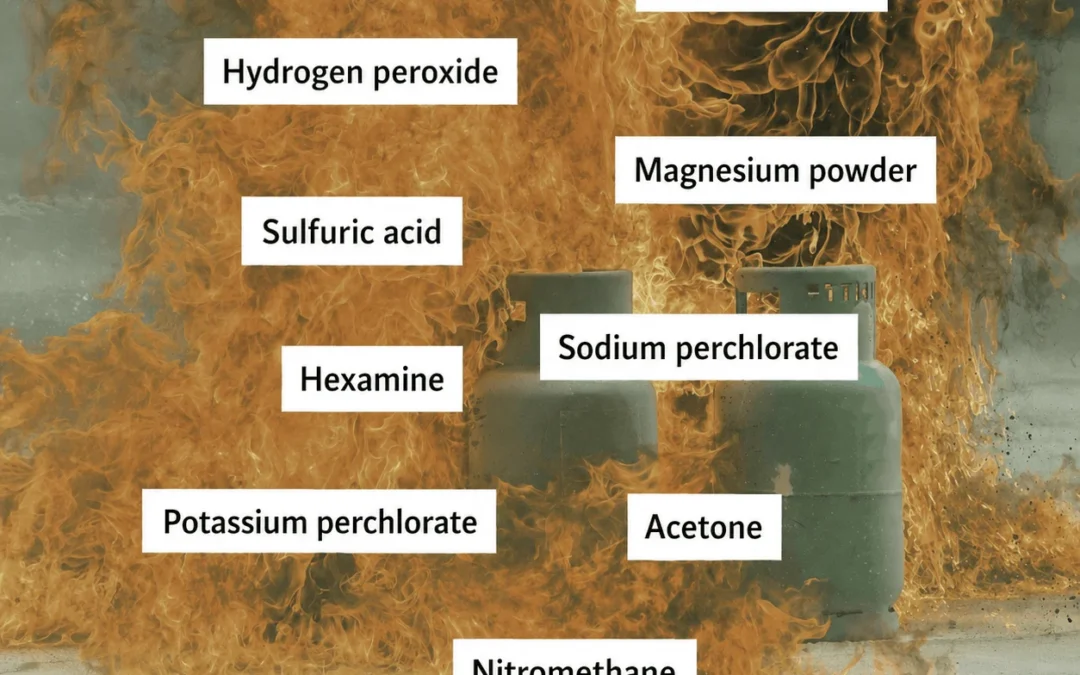
How should companies handle and store chemicals that can be used to make explosives? What do the regulations require – and which substances are covered?
Together with the Norwegian Directorate for Civil Protection (DSB), we invite you to an informative webinar covering how to identify such substances, the requirements for storage, use, and reporting. Lastly, your responsibilities as a company.
The webinar is ideal for anyone working with chemical handling in industry, offshore, research, or other activities where such substances may be present. You will receive practical advice and guidance directly from the authorities, with the chance to ask questions along the way.
Topics include:
What is DSB’s role in the field of chemicals and explosives?
What is the background to, and content of, the regulation on explosives precursors?
Which substances are covered (list 1 and list 2)?
What are the requirements for storing and securing such chemicals?
Registration
Tuesday, June 10, 2025, 10:00 – 11:00
Sign up to gain a clear overview of how your company can comply with the regulations on explosives precursors.
The knowledge sector’s service provider, Sikt, is organized as a government agency under the Ministry of Education and Research. Sikt works to simplify the everyday lives of employees, researchers and students in the knowledge sector by offering stable and efficient shared services.
As a buyer of Workplace Safety, Sikt has contributed to delivering a user-friendly chemical inventory and an effective chemical management system to Norwegian colleges, universities and research institutes.
A chemical inventory for both staff and students
Workplace Safety is an advanced management system used by managers, HSE professionals, researchers, and laboratory staff. Since chemicals are central to both teaching and research, strict requirements apply to safety information, and must be readily available to everyone, both staff and students.
Workplace Safety meets these needs with access management and role customisation, ensuring each user only sees what’s relevant to them. The system provides quick, easy access to safety data sheets (SDS), solving a major challenge in the industry.
A partner for industry-aligned development
With flexibility in mind, Workplace Safety has been developed to easily adapt to the needs of different industries. Through collaboration with Sikt, which represents a broad and important sector, we gain unique insight into shared challenges in Norway.
Insights that lead to better solutions
This approach gives us valuable insight into the specific challenges and needs of the knowledge sector, helping us further develop the solution. By collaborating with a single representative of the entire sector, we gain depth and efficiency that strengthen our ability to deliver a chemical management system tailored to the needs of higher education and research.
– Sikt is an important partner in the further development of Workplace Safety, and we greatly appreciate working with key players in higher education, says Hans Kristian Brekken, product developer with technical responsibility for Workplace Safety.
Collaboration for common practices in the sector
Sikt works proactively on behalf of the company to ensure the best solutions. To achieve this, they have established a working committee consisting of professionals representing the sector. The committee works together to develop a common practice for the use of the chemical management system across the knowledge sector.
Targeted further development
Sikt is the purchaser and contract manager, drawing on expertise from universities and university colleges. This ensures comprehensive and targeted further development of the system.
– The knowledge sector places high demands on both the product and us as an organisation. This has given us a clear direction in our efforts to adapt Workplace Safety to the sector’s needs, says Brekken.
Large-scale implementation and migration of data
In 2024, several of Norway’s universities and university colleges implemented the chemical management system. The process involved migrating large volumes of data and many users, but close collaboration between the Workplace Safety team and the institutions ensured a smooth transition.
– We are pleased to have completed the migration from the old system to Workplace Safety in a safe and efficient way, says Ask Hide, Project Manager at Workplace Safety.
– This marks an important milestone in our joint efforts to strengthen the safety and efficiency of chemical handling across institutions.
Technical implementation and professional advice
Adapting Workplace Safety to a company’s work processes and routines requires thorough mapping and close collaboration.
– A successful implementation requires strong cooperation from both parties. Working closely with customers enabled us to ensure they fully benefit from the system’s capabilities, Hide explains.
The team used a proprietary migration tool to simplify the transfer of safety data sheets (SDS) and system structure. Role assignments were tailored to each company, ensuring users received the right information and access from day one.
– The projects have been extensive, but our main focus has been to deliver quality at all stages, both in terms of technical implementation and professional advice, emphasises Hide.
Pilot project and further roll-out
The pilot project involved leading institutions such as the University of Bergen (UiB), the Norwegian University of Science and Technology (NTNU), the University of Stavanger (UiS) and NORCE – Norwegian Research Center. These have now completed the transition to Workplace Safety. The roll-out to the rest of the sector is well underway and will continue with full force in 2025.
At the time of writing, the majority of the companies that expressed an interest in joint purchasing of electronic substance files have been implemented.
Positive effects of digitalisation and automation
The implementation of Workplace Safety in the knowledge sector has demonstrated how targeted system adaptation can deliver clear benefits for both users and companies.
The system can be configured to reflect the company’s working methods, from simple routines to more complex processes. Through close collaboration with the institutions, we have developed workflows that make it easier to comply with legal requirements while ensuring chemical management is more transparent and user-friendly.
Odin Kvam, sector coordinator for the service and senior engineer at the University of Agder, shares his experiences:
– The transition to Workplace Safety gives us a tool that is flexible in meeting the many different ways chemicals are used in the higher education sector. The system integrates easily with the company’s organisation – without an extra login when students and employees visit the chemical inventory. Netpower provides continuous updates and improvements to keep Workplace Safety aligned with Norwegian and European regulations, and to further enhance user-friendliness in key functions such as the exposure register, substitution, and risk assessments.
Feedback that drives improvement
The implementation has generated a wealth of useful feedback, both praise and suggestions for improvement.
– We have worked closely with the companies in the sector to ensure a smooth transition to the new system. Feedback, both positive and critical, is valuable to us. The positive confirms that we are on the right track, while the critical ones provides insights we can use to make the solution even better. Our goal is to develop a system that really works for users in their everyday lives, says Hide.
– We look forward to continuing our collaboration with the Workplace Safety team at Netpower to meet future needs and ensure a safe working environment for both students and staff, Kvam concludes.
Are you unsure how to carry out good risk assessments of chemicals? Now is your chance to learn what you need!
Workplace Safety invites you to a practical and useful webinar where the Swedish Labor Inspection Authority’s occupational hygienist explains the requirements, shares good advice and answers relevant questions about the topic.
Date: Tuesday, February 11, 2025
Time: 10:00-10:45
What you get:
✅ Insight into the requirements for risk assessment of chemicals ✅ Specific guidance on what a risk assessment must contain ✅ Tips and tricks to make the process easier and more efficient
Who is it suitable for?
This webinar is suitable for managers, HSE managers or anyone who works with chemicals in the workplace.
The webinar is open to everyone and is especially relevant for companies that have hazardous chemicals in the workplace.
Feel free to share the registration page with others who you think might benefit from the webinar!
At Workplace Safety, we believe in practical, tailored training to ensure our customers make full use of the solution’s functionality.
Recently, we had the pleasure of hosting an in-person training day with Bamble municipality, which places a strong emphasis on safe and correct chemical handling across its departments.
This session proved to be a valuable arena for discussing their needs and adapting the system to the municipality’s specific requirements.
We share this experience to inspire other customers to consider investing in a training day.
Physical presence creates a stronger focus and commitment for both parties, offering benefits that go beyond digital meetings and giving participants a deeper understanding of the system.
A municipality with chemical management in focus
Bamble municipality in Telemark is a medium-sized municipality with just over 14,000 inhabitants. The municipality uses chemicals in a number of sectors, from municipal engineering and cleaning to nursing homes and schools.
With such diverse applications, it was important to provide training that addressed both administrative functions and specific workflows required when handling chemicals.
Bamble municipality is committed to safe and responsible chemical management and sought to strengthen competence around the statutory requirements that apply when working with chemicals. Therefore, the training also highlighted how Workplace Safety supports compliance through user-friendly workflows and continuous documentation of completed tasks.
Training and advice
The day began with a training session for administrator users, focusing on access management, advanced functionality, and best practices for structuring and managing the chemical inventory in Workplace Safety.
This gave Bamble municipality a clear understanding of the system’s capabilities, from standard setups to more advanced customisations. By sharing examples from other municipalities and public sector organisations using Workplace Safety, we were able to explore different approaches and solutions.
Next, we trained super-users in the most relevant modules, including risk assessment, substitution assessment, and exposure registration. The training combined theory with practical application with participants learning about regulations and obligations while working through case studies in the system. With demo access, they tested different features, getting hands-on experience, which is crucial to feel confident in the system.
We also supported Bamble municipality in setting up its own exposure and risk assessment routines. Through practical exercises and guidance, the participants developed a solid understanding of how to establish these processes in Workplace Safety, providing a strong foundation for ongoing work and compliance with statutory requirements.
Workplace Safety is a user-friendly solution that is easy to implement, but for those who want to unlock its full potential, we recommend a thorough review with our experts.
Our training offers customers real value by demonstrating the full range of possibilities within the system. While Workplace Safety is highly flexible, its broad features can sometimes make it challenging to see the complete picture.
Through our training, administrators and super-users gain the insight needed to go beyond the standard setup. This enables them to customise the system, work more efficiently, and adapt chemical management to the specific needs of their business.
Our experience shows that training with physical presence gives participants a deeper understanding of Workplace Safety.
Many companies face challenges with internal adoption of chemical management systems and understanding of legal requirements. A training day with our experts can provide exactly what is needed to strengthen internal competence and ensure full benefits of the system – streamlining processes, improving workflows, and enhancing compliance.
We hope this inspires more organisations to invest in tailored training and build stronger chemical management skills in the workplace. The goal is to get people started, engaged, and confident, making chemical management both safe and straightforward.
Get in touch with us to discuss how we can organise a training program for your company!
Requirement for training in the use of the chemical inventory
According to the Regulations on the performance of work §2-4, the employer must ensure that employees have easy access to the chemical inventory and that relevant safety data sheets (SDS) are available in the workplace.
Providing thorough training for administrators and super-users helps lower the threshold for further training across the organisation.