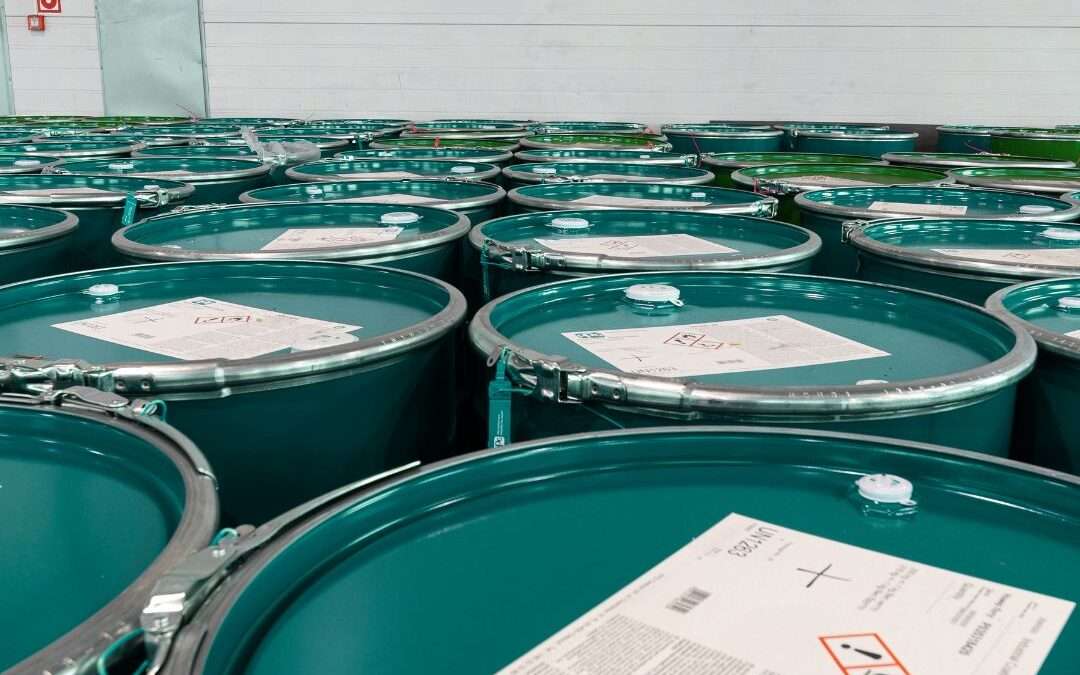
Are you responsible for HSE and chemical management in your organisation? Here are 10 tips to help make your working day a little safer.
1. Create a clear chemical inventory
Make sure that your company has a chemical inventory that provides a complete overview of all hazardous chemicals in the workplace. Here, employees can easily see where the chemicals are located and what hazards they can cause.
2. Easily accessible safety data sheet
All chemicals must have an updated safety data sheet (SDS) with information on chemical handling, hazards, protective equipment and first aid measures. Therefore, make sure that these data sheets are easily accessible to employees (e.g. via QR code, on mobile/tablet), so that they can be actively used in the daily operation.
3. Training in safety practices and procedures
Employees must receive thorough training in the company’s safety routines and procedures. This can include everything from risk assessment to the choice and use of protective measures. If there are no clear guidelines for handling chemicals, the employer must ensure that such guidelines are established quickly and that employees receive adequate training in them.
Training can typically include:
Hazardous chemicals in the workplace, their names, risks and limits
Use of chemical inventory, risk assessments and changes to these
Correct use of work equipment
Necessary protective measures for safe execution
Managing disruptions and emergencies
4. Clear labelling and storage
All chemical products must be labelled with names and hazard symbols in accordance with the CLP regulations, and stored properly. This may involve storage in separate cabinets or rooms. For particularly hazardous chemicals, it may be necessary to lock cabinets or restrict access so that only qualified personnel have access.
5. Customised protective measures
Safety measures must always be adapted to the actual use of the chemicals and the specific work operation.
Examples of measures can be:
Spot extraction and fume cupboards
Sufficient general ventilation
Process-adapted ventilation when needed
Correct labelling and signage
Secure storage solutions
Restricted access
Protective gloves and goggles
Respiratory protection
Emergency response equipment
6. Follow established regulations
Working with chemicals is regulated by several laws and regulations, such as REACH and CLP. Be sure to follow these regulations carefully as violations can lead to fines and orders, but more importantly, compliance contributes to fewer accidents and a safer working environment.
7. Consider alternative chemicals
Always consider whether hazardous chemicals can be replaced with less hazardous alternatives (substitution). This reduces risk and is part of the substitution obligation. If your business uses a chemical management system, it can often provide automatic suggestions for safer alternatives.
8. Digitise documentation
A chemical inventory can be kept both on paper and digitally, but digital solutions often provide a better overview and ease of use. When documentation is digitised, it becomes easier to search for chemicals, update safety data sheets and share information across departments. Many systems also offer functions such as automatic notification of expired SDSs, suggestions for substitution and integration with risk assessments and internal control. A great idea is therefore to gather all documentation digitally in one place.
9. Revise and improve
Safe handling of chemicals is not a one-off task, but a continuous process as part of the company’s systematic HSE work. New chemicals, changed work routines or updated laws and regulations may require adjustments to routines and measures. Therefore, the company should regularly review the chemical inventory, safety routines and risk assessments to ensure that they are still relevant.
10. Involve your employees
Involve employees in chemical management and auditing work, as they have practical experience that can contribute to better solutions. When the people who actually work with chemicals are actively involved, you create both better routines and a stronger safety culture.
Safe chemical handling is about combining well-structured routines and systems with the right equipment and active employee involvement. By following these 10 tips, your business can reduce risk, prevent accidents and contribute to a safer working environment.
An exposure register documents employees’ potential or actual exposure to hazardous substances or processes.
Chapter 31 of the Regulations on the Performance of Work specifies which exposures are to be registered, but the wording of the regulations can be interpreted in different ways and we see that there are different practices for registering exposure among our Workplace Safety customers.
In order to get answers to our questions, we invited the Norwegian Labor Inspection Authority to a webinar, and everyone who works with hazardous chemicals was welcome to participate. Some of these questions are summarized here.
Our summary of the questions
Who is responsible for the exposure register?
The employer is the obligated party. This means that it is the employer who has the overall responsibility for ensuring that a register is kept – and that the exposures are recorded correctly.
How do you know if the substances are classified as Carc 1A and 1B, Mut 1A and 1B, Repr. 1A or Repr. 1B?
Use the safety data sheet in the substance register to find out if the substance belongs to any of the classifications that require registration under section 31-1. This information can also be found on the product’s packaging.
Classification is given in Annex VI of the CLP Regulation, Table 3
In Workplace Safety, products in these classes will automatically be marked with an exposure icon, so it is easy to see in the substance register whether exposed employees must be registered.
You can also search for classification on the website of the European Chemicals Agency, ECHA:
New registry requirement for reprotoxic substances
As of April 5, 2024, work with substances classified as Repr 1A and Repr 1B is also subject to registration in the exposure register.
Are there requirements for the format of an exposure register?
No, the Norwegian Labor Inspection Authority has no format requirements. The requirements for what the register should contain are set out in the regulations, but the exposure register can be an Excel sheet.
What does “anyone who is, or may be, exposed” mean?
This means all work situations where employee exposure cannot be ruled out.
The requirement for exposure registration should be interpreted as follows: All employees who are exposed, or who may be exposed, MUST be registered.
It also means considering personnel who may be exposed even if they are not directly engaged in tasks or processes where they may be exposed. This could be cleaning and maintenance staff, or other functions that are only present at the workplace for a short period of time.
How do you know which work operations or processes to register?
The employer’s risk assessment must always form the basis for this assessment.
The Norwegian Labor Inspection Authority does not have a set answer to which exposure situations should be registered. It is up to the company itself to risk assess the various conditions, and it is up to the company itself to decide whether employees are exposed or not.
If the employer believes that a register is not required, this must be documented.
What if the concentration is far below the limit value?
There is no lower limit for concentration, where you do not need to keep records.
Limit values are based on current knowledge of health effects, and also take into account economic and technical aspects.
There is no absolute limit to when health risks can occur. Therefore, all exposures should be recorded, no matter how low.
This may mean that almost all employees in a company must be registered. In cases where exposure is very low, this will be stated in the register information.
How should you record the time and duration of the exposure?
The Norwegian Labor Inspection Authority is clear that you can have a pragmatic approach to entering time and duration. It should be as detailed as possible, but it should also be practically feasible.
Here it is permitted to provide average calculations. In other words, you don’t have to take measurements every day to find out what concentrations you were exposed to on different days.
Should personal protective equipment be taken into account in a risk assessment?
No, you don’t.
The protection provided by PPE will never be 100% safe (lack of maintenance, incorrect use, lack of training etc.), therefore this should not be taken into account in an exposure risk assessment.
What exactly is meant by “rock work”?
The Norwegian Labor Inspection Authority confirms that the text of the regulation is unclear on what is considered rock work, and that this is something they will work on to specify. The Labor Inspection Authority associates rock work with mining, quarrying, tunneling and other rock excavation that is carried out on a large scale.
Should crushing rock in a laboratory be considered rock work?
The answer from the Labor Inspection Authority is no. The crushing of rock in a laboratory is not considered rock work. This means that, according to the regulations, there are no registration requirements for employees who are exposed to carcinogenic chemicals, such as quartz, when crushing rock in a laboratory.
Quartz is not classified in accordance with CLP and is therefore not subject to a registration requirement. This is a weakness, according to the Norwegian Labor Inspection Authority. They therefore communicate that companies can start registering this type of exposure now, even though it is not a requirement.
Some of the companies that use the exposure register in Workplace Safety explain that they interpret quartz as a carcinogenic chemical, and that they therefore record exposure to it when they work with crushing rock in the lab. This registration is not a requirement at present, as the work is not considered rock work. But it should be, according to the Labor Inspection Authority.
However, if you are exposed to quartz in rock work (i.e. rock excavation carried out on a large scale), it is subject to registration (even though quartz is not classified in CLP). This is because dust containing quartz is considered to be a process-generated hazardous substance that can come from the bedrock. Ref. § Section 31-5 of the Regulations on the performance of work.
Do all employers have to keep a register of COVID-19 sufferers?
Yes, if the employees became ill as a result of infection at work.
All employees who have been infected at work and who have become ill as a result of the infection must be registered.
The requirement came into force shortly after the SARS-CoV-2 outbreak and applies to all businesses.
There’s a lot we don’t yet know about COVID-19 in terms of after-effects and so on. That’s why it’s important that those who suffer health damage due to infection at work are registered so that their exposure is documented.
For healthcare workers, the requirements are even stricter: Healthcare workers who treat people with COVID-19 must always be entered into an exposure register – regardless of whether they have become ill or not.
Do you have questions about exposure registers or chemical management?
Companies that handle hazardous chemicals or other high-risk processes may be legally required to maintain an exposure register. The register must document which employees have been exposed to dangerous substances and may be of crucial importance if illness develops many years later.
Here, we examine the purpose of an exposure register, the relevant legal obligations, and how companies can ensure compliant registration and documentation practices.
What is an exposure register?
An exposure register should document employees’ potential and actual exposure, including accidents, spills and other incidents that may have led to contact with hazardous substances. This may be in connection with hazardous substances or processes related to:
Chemicals (carcinogenic, mutagenic and toxic to reproduction)
Asbestos
Mining work
Biological material
Radiation
Keep in mind that only certain chemicals are relevant for inclusion in the exposure register.
The exposure register is an important tool for identifying and monitoring exposure to hazardous factors. Because illnesses resulting from such exposure often develop over a long period, sometimes many years after the exposure occurred, it is essential to record incidents continuously and as early as possible.
An exposure register can help to:
Monitor employees’ health over time
Provide a basis for health surveillance and support risk assessments
Ensure documentation if illness develops several years after exposure
Who may be exposed?
Several occupational groups that may be exposed to hazardous substances and processes.
Typical examples are:
Employees in industry (chemical industry, metal production, welding and woodworking)
Employees in construction (demolition, remediation, work with asbestos and concrete dust)
Healthcare and laboratory workers (radiation, chemicals and infectious agents)
Employees in renovation and waste management (biological material and hazardous waste)
Employees in mines and tunnels (dust, gases and explosives residues)
Employees within energy and research (radioactive material and ionising radiation)
What must an exposure register contain?
The content of an exposure register may vary. The information that must be recorded depends on the type of exposure involved – for example chemicals (CMR substances), asbestos, biological agents, mining work, or ionising radiation.
The purpose of the register is to ensure traceable and verifiable documentation over time. The regulations therefore set clear requirements regarding the information that must be included. It is also specified that the register must not contain health data beyond what is authorised by the legislation.
Although the details vary depending on the type of exposure, an exposure register will typically include:
The employee’s name and national identification number
The work carried out
The substance, material, or process to which the employee has been exposed
The period and duration of the exposure
Any measurement results or assessments of exposure levels
The date of registration
An exposure register must only contain the information required by the regulations. It must not function as a medical record.
Documentation and storage requirements
The register must be kept for a very long time, often between 40 and 60 years, depending on the type of exposure. The information must be available for as long as the employee is alive, and can be decisive in documenting occupational diseases and any compensation cases.
Individual employees have the right to access their own registrations. In addition, the register must be available to relevant personnel, for example the occupational health services, safety representatives, the working environment committee and any other persons working with HSE in the company.
Who is responsible for the register?
Both employer and employee have certain responsibilities, but it is the employer who has the main responsibility for creating and maintaining the exposure register.
Employee’s responsibility
Follow the company’s routines and guidelines in connection with registration
Report accidents, exposures or other situations that may have led to contact with hazardous substances
Participate in necessary training and help ensure that the information recorded is correct
The employer’s responsibility
Establish routines and guidelines for exposure registration
Provide training on how employees should report
Thoroughly document and retain records for a sufficient period of time
Ensure that the register is used
Ensure that employees have access to their own registrations
Common challenges
Inadequate reporting and follow-up
Many companies find that employees do not report exposures, either because the incident is perceived as minor, the routines are unclear, or because it is simply forgotten. This is often linked to a lack of training in chemical safety and understanding of the risk. In addition, many companies are unsure when they are actually required by law to keep an exposure register.
Difficulty storing registrations over a longer period of time
As some types of exposure require the register to be kept for up to 60 years, it requires good routines for both storage and for safeguarding privacy (GDPR). As long as the employee is alive, it should be possible to document any exposure, especially if there is a risk of cancer. As there are no specific requirements for how records are kept, many companies lack good enough routines to handle this.
A well-maintained exposure register is an important tool for both the employee and the employer. It contributes to prevention, follow-up and documentation, especially because health damage often only becomes apparent many years after exposure. Digital HSE and chemical systems can help companies identify chemicals that are subject to registration, carry out the actual registration and ensure safe storage of the information.