A chemical inventory is a legally required overview of hazardous chemicals and a central part of a company’s health and safety (HSE) management. The inventory provides employees with quick access to safety data sheets (SDS), risk assessments and information on safe handling in line with current regulations. Here you will find a clear explanation of what a chemical inventory is, the legal requirements that apply in Europe, and how to get started.
What is a chemical inventory?
A chemical is considered hazardous if it is classified under European legislation as posing a health hazard, physical hazard or environmental hazard. A chemical inventory is a collection of necessary information about hazardous chemicals in the workplace, including safety data sheets.
The purpose of a chemical inventory is to make it easy for employees to find relevant information for safe and efficient handling of chemicals. The safety data sheets provide guidance on both preventive measures – such as the use of protective equipment, correct storage and handling routines – and reactive measures in the event of accidents, such as spills, fires or exposure to chemicals. In this way, the chemical inventory serves as a practical tool both in day-to-day HSE work and in emergency situations.
A chemical inventory is mandatory for companies that handle hazardous chemicals. The requirements are based on regulations from the European chemical legislation REACH and the CLP Regulation.
What should a chemical inventory contain?
As a minimum, the chemical inventory must contain:
Chemical overview with names, classification, hazard symbols and updated SDS for hazardous chemicals
Information sheets for non-classified chemicals in the workplace, such as pharmaceuticals, welding fumes and other process-generated chemicals
Both the employer and the employee have certain responsibilities, but it is the employer who is primarily responsible for creating and maintaining the chemical inventory.
The employee’s responsibility:
Use personal protective equipment in accordance with the information in the chemical inventory and the SDS
Familiarise themselves with the contents of the SDS before using new chemicals
Follow instructions for storage, labelling and disposal of hazardous substances
Participate actively in risk assessments where required
Help prevent accidents by reporting hazardous conditions or near misses
Ensure safe handling to protect themselves and their colleagues
The employer’s responsibility:
Identify and maintain an overview of the chemicals used in the business
Carry out risk assessments when using hazardous chemicals
Ensure that SDS are available in the language needed and updated in accordance with current legislation
Update the chemical inventory when new chemicals are introduced or when regulations change
Ensure substitution of hazardous chemicals where possible (replace with less hazardous alternatives)
Verify that employees have access to and understand the information in the chemical inventory
Implement necessary protective measures based on the SDS
Ensure regular review and revision of the chemical inventory
Common challenges
Lack of quality control of SDS
For many companies, keeping their chemical inventory up to date is a challenge. Data sheets or chemical overviews may be out of date, resulting in incorrect or incomplete information. This weakens HSE work and can lead to both orders and fines from the authorities.
Difficult to find information
In the past, it was a requirement that the chemical inventory should be on paper. Many companies still use physical binders, which results in a lot of manual work. Regardless of the format, the MSDS can contain large amounts of information that can be difficult to navigate without good routines and adequate training.
Benefits of a digital chemical inventory
A digital chemical inventory can make day-to-day work easier for those responsible for chemical management. When all safety data sheets and risk assessments are gathered in one system, there is no need to search through binders or separate folders. It also becomes easier to add new products when they are purchased and to remove or archive chemicals that are no longer in use.
Many digital solutions provide notifications when a safety data sheet has been updated by the supplier, making it easier for the companies to keep information aligned with the latest available version. Search functions and filtering options make it quicker to find the correct product and the relevant protective measures. In addition, employees can access the chemical inventory via mobile phone or tablet while working on site, which can be helpful when information is needed quickly.
A digital chemical inventory does not in itself ensure effective health and safety performance, but it can support a more organised, consistent and systematic approach to managing chemicals in the workplace.
Get started with a digital chemical inventory
An effective chemical inventory starts with clear procedures for purchasing and systematic HSE work, as described in the company’s management system. Ensure that roles and responsibilities are clearly defined so that the chemical management system is followed up and maintained.
Map the chemicals: Get an overview of all chemicals present in the workplace
Build structure: Organise your chemical inventory to reflect how and where chemicals are stored
Enter information: Register the chemicals and retrieve approved safety data sheets, preferably through an easy-to-use chemical management system (such as Workplace Safety)
Make the information accessible: Make sure that all employees who handle chemicals have easy access to the chemical inventory
Keep your inventory up to date: Add new chemicals when purchasing, and archive products you no longer use
An up-to-date chemical inventory gives your company control over the chemicals it uses and is a legal requirement to prevent damage to health and the environment. With a digital and automated chemical system, it is easier to ensure that the information is always up-to-date, correct and accessible.
Did you know that all hazardous chemicals must have a safety data sheet? A safety data sheet can be the difference between control and chaos if an accident occurs. Find out what a safety data sheet is, why it is so important, and common challenges for businesses.
What is a safety data sheet (SDS)?
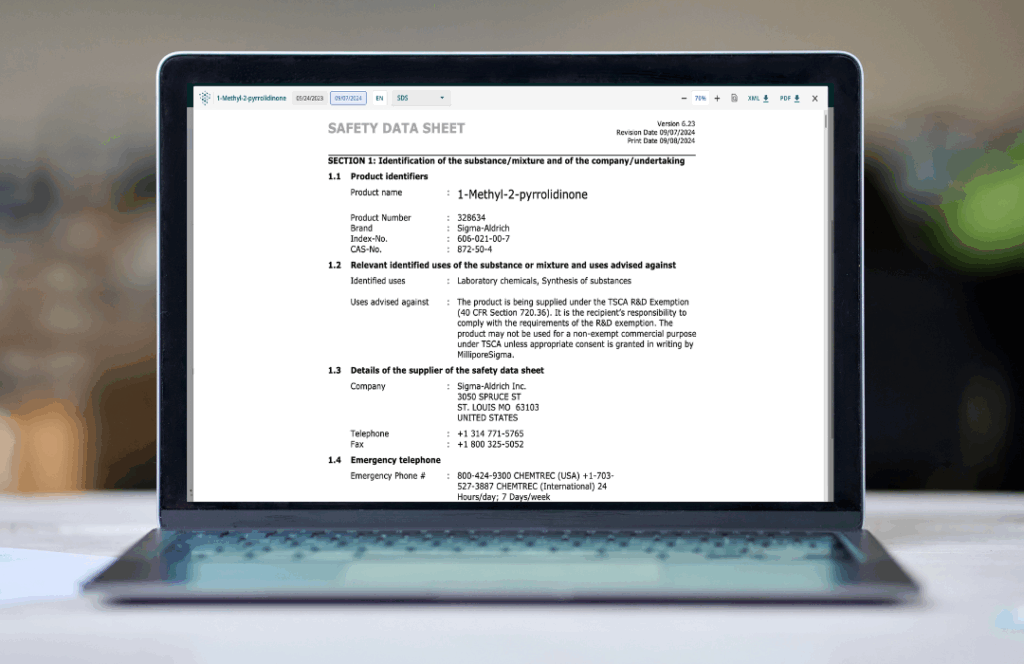
A Safety Data Sheet (SDS) is a document (digital or hard copy) that provides an overview of how chemicals should be handled, used and stored. All SDSs follow a standard 16-point layout so that the information is easy to find, no matter what chemical you are working with.
All companies that manufacture, import, distribute or use hazardous chemicals must have access to up-to-date safety data sheets. This requirement applies both to suppliers and to employers who handle chemicals as part of their daily operations.
Examples of sectors where SDS are required:
Agriculture and aquaculture
Automotive and mechanical engineering
Cleaning and facilities management
Construction and civil engineering
Healthcare
Industrial manufacturing
Laboratory and research
Painting and surface treatment
What is the difference between a safety data sheet and a chemical inventory?
A safety data sheet applies to one specific chemical. It describes the hazards associated with the substance, how it should be handled and used safely, and what to do in the event of spills, fire or other incidents.
A chemical inventory is a complete overview of all hazardous chemicals within a business. It contains all the safety data sheets and enables employees to quickly find the information they need.
In short: A safety data sheet provides detailed information about one chemical. A chemical inventory brings together all the safety data sheets used within the organisation in one place.
Why do we need safety data sheets?
SDSs are needed to handle chemicals safely, protect employees from health hazards and describe procedures for first aid, fire and spills. Not only that, but updated SDSs are required by law through REACH and CLP, and are an important part of a company’s health, safety and environment (HSE) work.
Examples of situations where SDS is needed:
When receiving new chemicals in the workplace: When a new chemical is introduced into the organisation, the SDS must be reviewed to assess risks, the need for personal protective equipment (PPE), storage requirements and any special precautions.
In the event of spills, fire or other incidents: In emergency situations, the SDS provides clear instructions on how to handle the incident, which extinguishing agents may be used, and how to protect people and the environment.
During inspections by authorities: Regulatory authorities may require documentation showing that the business has up-to-date SDS and that they are actively used as part of health and safety management.
During the transport of dangerous goods: The SDS contains information on classification, packaging and labelling required for safe transport and compliance with current regulations.
When using a new chemical: Before a new substance is put into use, employees need to understand its hazards, the required protective measures and the correct handling procedures. The SDS provides the foundation for instruction and training.
For waste handling: The SDS provides guidance on how chemical residues and packaging should be handled and disposed of safely to prevent environmental harm and legal breaches.
In risk assessments: The SDS is used as a basis for identifying hazards, assessing risks and implementing necessary preventive measures within the organisation.
What should a safety data sheet contain?
A safety data sheet is always structured according to a fixed 16-point template. This makes it easy to find the right information, no matter what chemical you are working with.
The 16 points consist of:
Identification (name of the substance/product and supplier)
Hazard identification (health, fire and environmental hazards)
Composition (content and hazardous components)
First aid measures (what to do in case of accidents)
Firefighting measures (suitable extinguishing media and protective measures)
Measures in the event of a spill (handling of spills and leaks)
Handling and storage (safe procedures and storage requirements)
Exposure controls/protective equipment (limit values and protective equipment)
Physical/chemical properties (appearance, smell, boiling point, etc.)
Stability/reactivity (conditions that may cause hazardous reactions)
Toxicology (effects on health)
Ecology (impact on the environment)
Disposal consideration (waste management)
Transport (UN number and transport requirements)
Regulations (laws and regulations that apply)
Other information (additional info and update date)
Who is responsible?
The supplier’s responsibility
The SDS must be free, up-to-date and available to professional users. Among other things, the data sheet must contain limit values and relevant emergency number. In the event of new information or regulatory changes, the supplier must update the SDS and send it to customers who have received the product in the last 12 months.
The employer’s responsibility
Procedures must be established to ensure that safety data sheets are of satisfactory quality, meet the requirements of the regulations and are updated when new information or versions become available. The employer is responsible for checking the SDS when new chemicals are used, ensuring that the data sheets are up to date, and obtaining missing information from the supplier if they are incomplete.
If an error is discovered, the employer must check whether a newer version is available and contact the supplier for an update.
Known challenges
Difficult to keep SDS up to date
Many companies find it challenging to keep their chemical inventory and SDS documentation up to date. When the company uses chemicals from several manufacturers and suppliers, it quickly becomes challenging to keep track of all the changes they make to their SDS.
There are no fixed deadlines for updating data sheets, and changes can therefore be made at any time. SDSs must be revised as soon as there is new information about hazards or regulations. This requires structured routines to ensure that the SDS is always updated in relation to the chemicals the company actually uses.
Safety information must be easily accessible and understandable for employees
It is a legal requirement that employees have easy access to safety data sheets for the chemicals they work with. In practice, this can be challenging if the data sheets are stored in digital systems that employees have not been adequately trained in, behind passwords, or only exist in paper archives.
Most people who handle chemicals at work are not chemists, and it can be challenging for employers to provide ongoing and necessary training in how an SDS should be understood and used.
A proper SDS provides an overview, creates security and ensures compliance with legal requirements. When companies take safety data sheets seriously, both HSE work and emergency preparedness are strengthened. So make sure you have a system that makes it easy to keep all safety data sheets up to date and available, so that safety information becomes a natural part of your daily work with chemicals.
Chemicals are a natural part of everyday life in many companies – from industrial production and laboratories to construction sites and agriculture. With chemicals also comes a responsibility: to protect employees, customers and the environment. That is why you see the little red hazard symbols on bottles, containers and safety data sheets.
Here we go through what the hazard symbols mean, how they should be handled in practice, and what laws and regulations apply.
What is a hazard symbol?
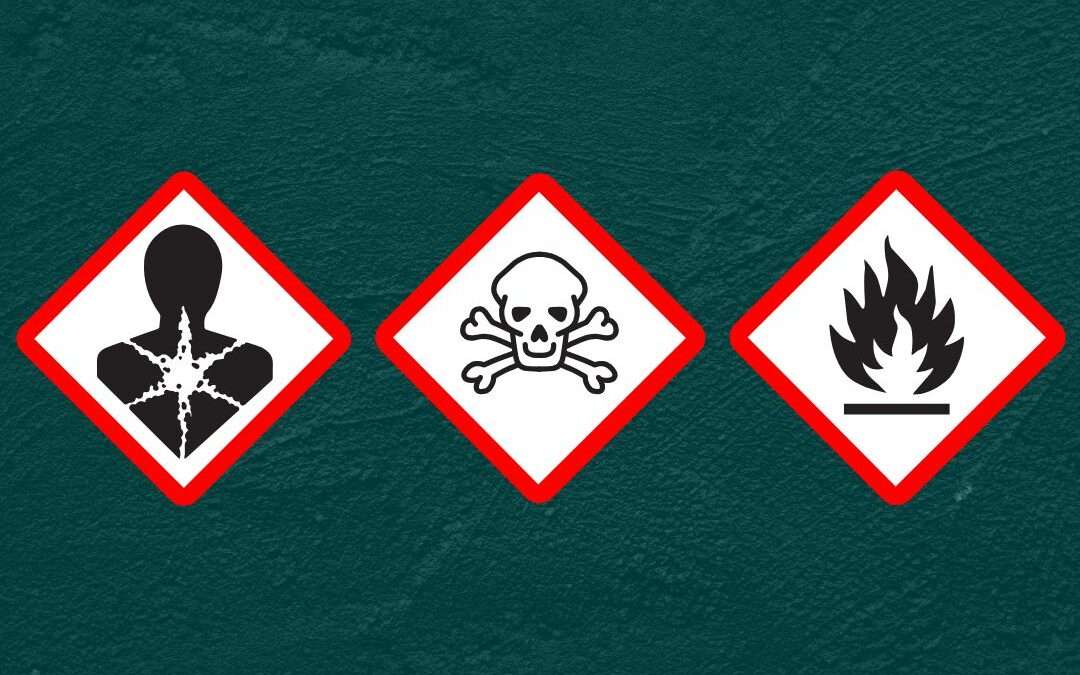
A hazard symbol (also known as a hazard pictogram and hazard label) is a pictorial icon that highlights the risk of chemicals that may expose the user to health, environmental, fire or explosion hazards. The hazard symbols are designed to be understandable for everyone. In other words, you don’t need to know chemistry to understand that a picture of a flame means “flammable”. This makes it easy to identify potential hazards, regardless of situation and language.
Where are the hazard symbols located?
The hazard symbols must be clearly marked on the product being used, and can be found on the packaging or in the safety data sheet (SDS). Sometimes the workplace may also have its own lists of hazard symbols on cabinets, containers or other storage areas, for example when storing chemicals in large quantities.
What do the hazard symbols mean?
Previously, orange hazard symbols were used, but from 2015 these were replaced by red and white diamonds. Each symbol represents a specific type of chemical hazard:
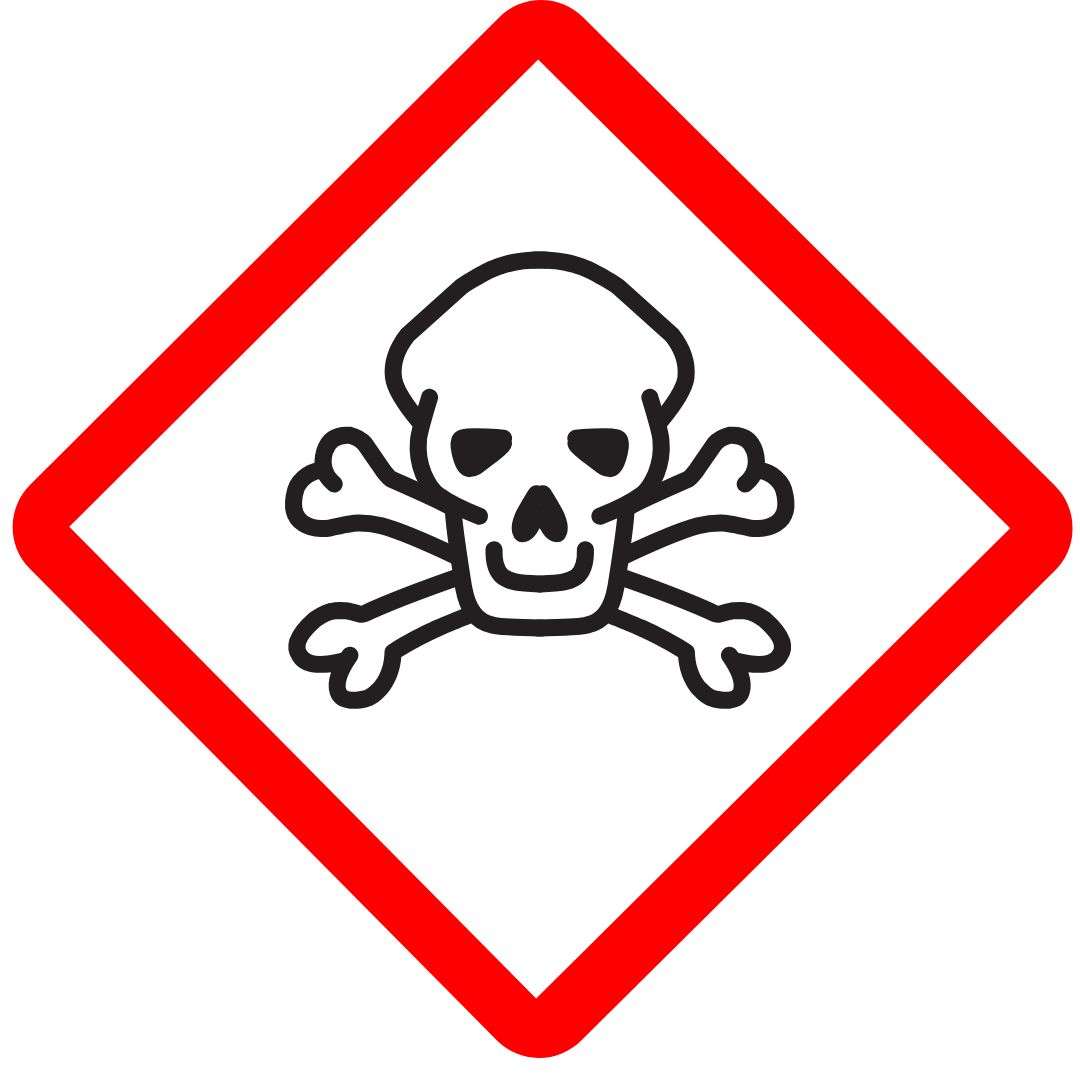
Acute toxicity
May cause life-threatening injuries if swallowed, in contact with skin or inhaled.
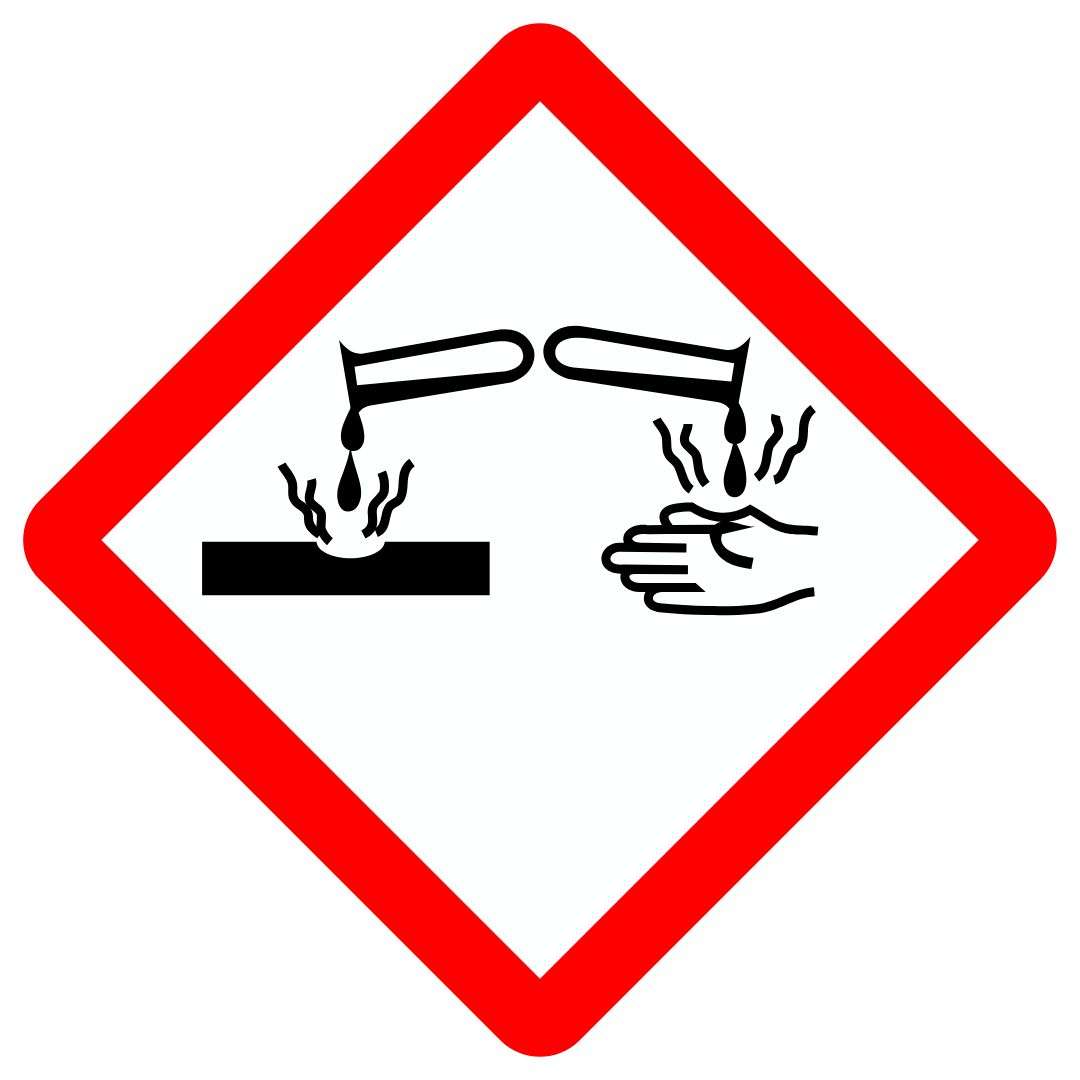
Corrosive
May cause burns to skin and eyes or serious eye damage. Also used for chemicals that may be corrosive to metals.
Health hazard
May cause irritation to the skin, eyes and respiratory tract, allergic skin reactions, drowsiness and dizziness.
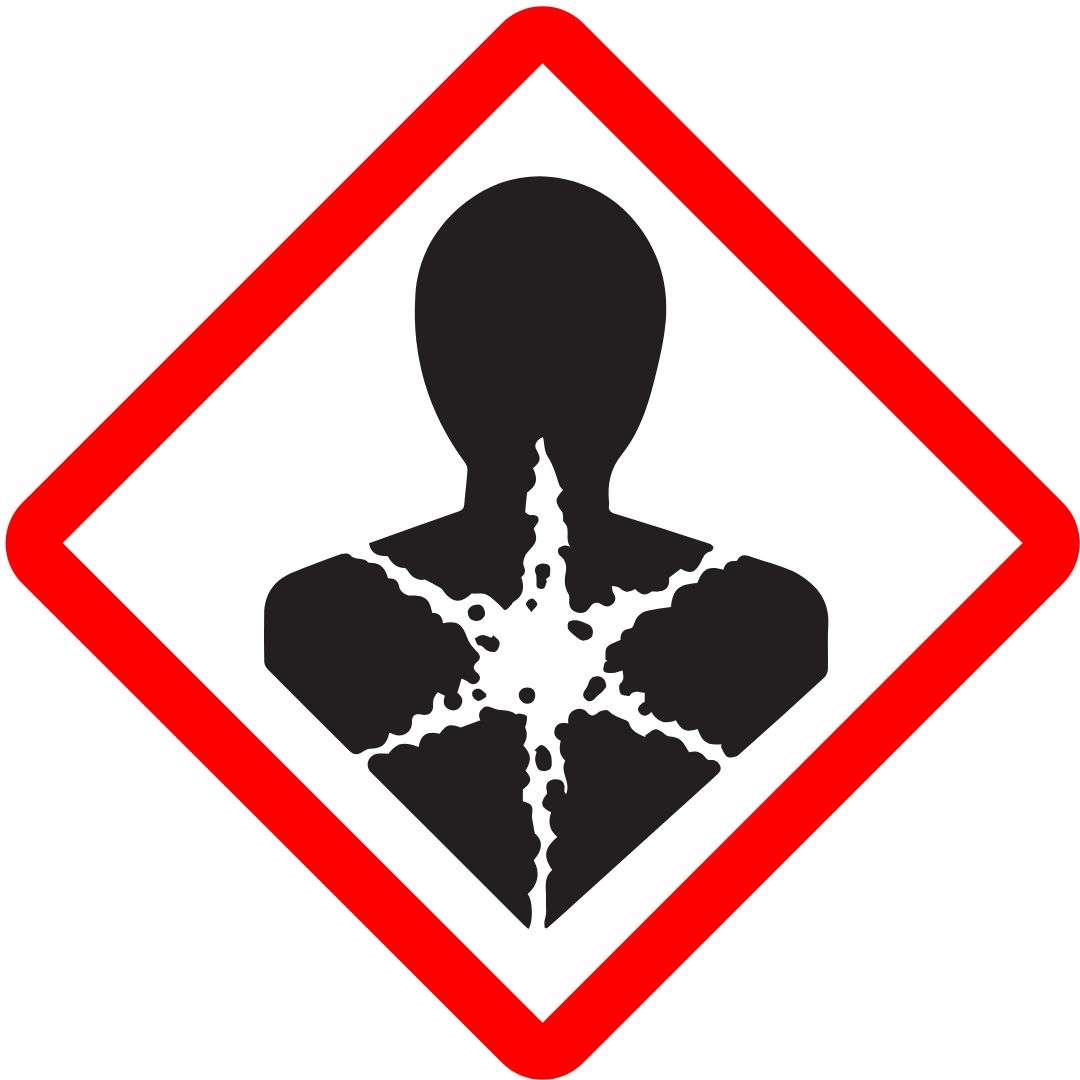
Chronic health hazard
May cause cancer, genetic damage, reduced fertility, birth defects, inhalation allergy, chemical pneumonia or other serious health effects.
Environmental hazard
Can be acute or long-term toxic, and/or cause long-term damage because the substance is persistent and bioaccumulative. Must be handled so that the product, either in use or as waste, does not harm nature.
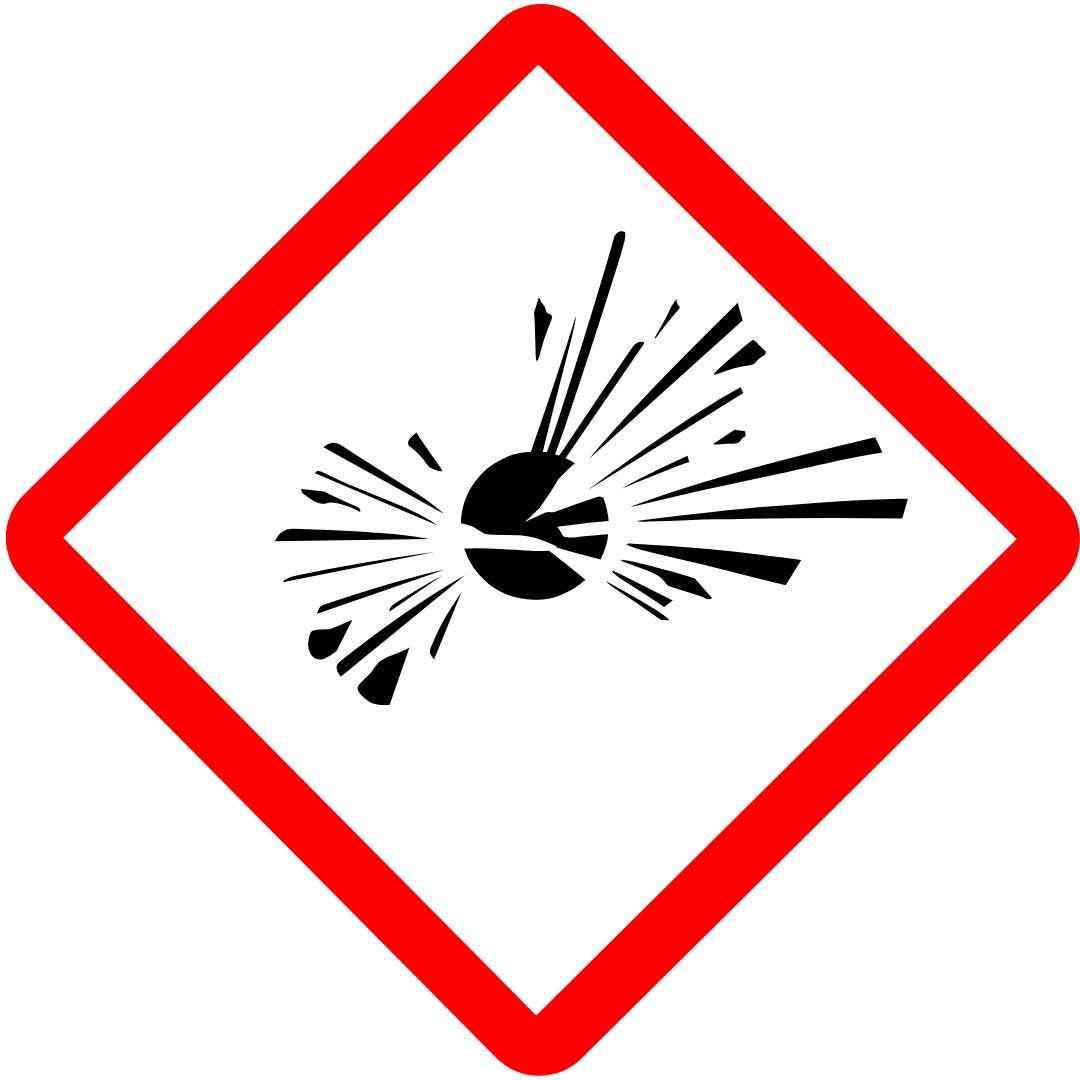
Explosive
May explode on impact, friction, sparks or heat.
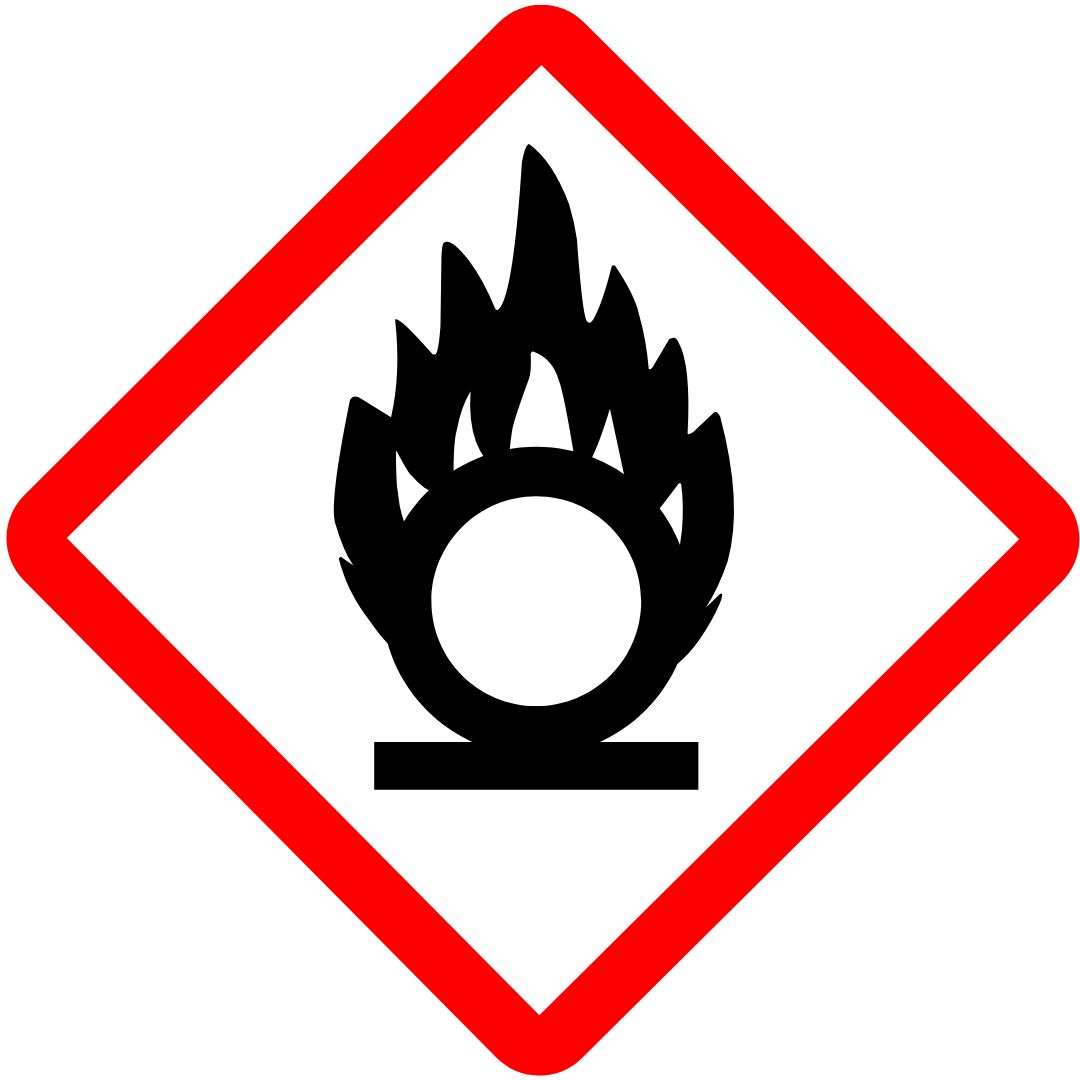
Oxidising
May cause fire or contribute to the combustion of other materials.
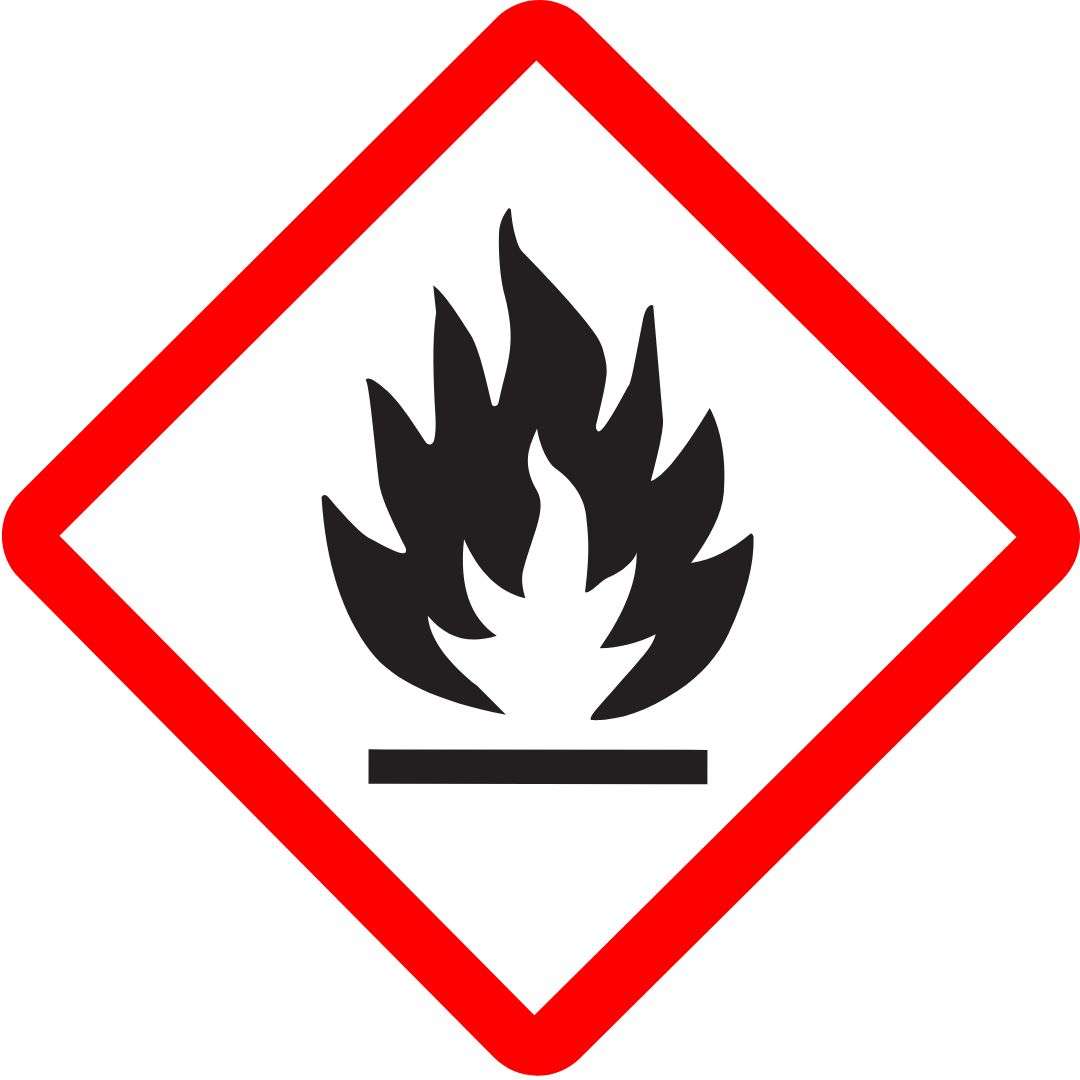
Flammable
Can ignite easily and burn violently. Some chemicals produce flammable gas in contact with water or self-ignite in air.
Gas under pressure
Container with pressurised gas or extremely low temperature. May explode in case of external fire.
How to handle hazard symbols?
Hazardous chemicals must be labeled with a hazard label that provides information about hazards and necessary precautions. Among other things, the label must contain a hazard symbol, warning words and hazard and safety phrases (H and P phrases).
If you notice a hazard symbol on a product, you must take extra precautions. This may involve:
Always read the hazard label before use
Check SDS for more information
Follow the instructions carefully
Use the right protective equipment
Ensure sufficient ventilation
Avoid mixing incompatible chemicals
Wash hands, clothes and equipment thoroughly after use
If swallowed or poisoned, contact poison control or emergency services
International laws and regulations
Most European countries follows the CLP regulation (Classification, Labelling, and Packaging), which is based on the global system GHS (Globally Harmonized System and Classification and Labelling of Chemicals). CLP ensures that chemical hazards are clearly communicated through standardized symbols, signal words, and safety statements. In addition, the REACH regulation (Registration, Evaluation, Authorisation and Restriction of Chemicals) also applies within the European Union.
Outside the EU, many countries have implemented or are aligning with GHS-based classification and labelling systems. However, the specific regulatory frameworks, registration requirements, and enforcement practices vary between jurisdictions.
Companies must therefore ensure compliance with the applicable chemical control legislation in each country where their products are manufactured, imported, distributed, or used.
Important: In addition to regional frameworks, national and local regulations may apply. Individual countries may have supplementary requirements related to storage, transport, workplace safety, environmental protection, or reporting obligations. It is essential to verify compliance with all applicable laws in the relevant market.
Hazard symbols are not just little red icons on a label. They are the key to understanding and following chemical regulations. When employees know the symbols, read the labels and follow the instructions, they contribute to a safer working day in line with national and international requirements.
In addition, the hazard symbols provide a common recipe for how chemicals should be described and labeled, no matter where in the world they are used. This makes communication easier, provides a better overview in the workplace and ensures that everyone speaks the same “language” about chemicals.
Chemicals are a natural part of everyday working life in many businesses, but a chemical inventory are often underestimated in day-to-day HSE work. That is why we have compiled ten reasons why a chemical inventory should be given higher priority on the HSE agenda.
1. Get a complete overview of chemicals in your business
A robust chemical inventory provides a comprehensive and structured overview of all chemicals in use, where they are located, and how they are handled. This makes it easier to identify products that are no longer in use, chemicals with overlapping functions, or substances that create unnecessary risks. Such an overview is also crucial for planning, purchasing, and safe storage of chemical products.
2. Complies with legal requirements
Many countries have strict requirements for companies that use hazardous chemicals, typically anchored in occupational health and safety legislation and supporting regulations. One common requirement is maintaining an up-to-date and accessible chemical inventory, ensuring that the latest versions of safety data sheets (SDS) are readily available.
3. Strengthens internal control and documentation
The chemical inventory is a key part of the internal control system. When the company documents which chemicals are used, the hazards they pose, and the measures that have been implemented, a clear overview is created. This gives management a better basis for following up on HSE work and ensures that the company works more systematically with chemical management.
4. Ensures adequate training of employees
Employees who work with chemicals on a daily basis must have access to accurate and up-to-date information. The chemical inventory makes it possible to actively use SDS, see hazard classifications and recommended protective measures in training and practical work. When safety information is easily accessible, the risk of misuse and misunderstandings is reduced.
5. Reduces the risk of injuries and accidents
Access to updated information on health hazards, first aid, and proper handling increases safety in daily work. Many chemical accidents are caused by lack of knowledge, improper storage, or incorrect use of protective equipment. A well-maintained chemical inventory helps prevent such incidents and can reduce both health hazards and material damage.
6. Better risk assessments
The chemical inventory provides necessary information about exposure hazards, reactions, storage requirements, and risk reduction measures. This makes risk assessments more accurate and provides a better basis for choosing the right protective measures, working methods, and technical solutions. A comprehensive chemical inventory also makes it possible to monitor the development of risk over time.
7. Better preparedness for accidents and emergencies
In the event of spills, leaks, fires, or other undesirable incidents, time-critical information is crucial. The chemical inventory provides immediate access to information about first aid measures, extinguishing methods, measures in the event of accidental spills, and special handling requirements. This enables employees and emergency services to deal with the situation more quickly and effectively.
8. Simplifies substitution work
Some regulations require companies to consider less hazardous alternatives wherever possible. An electronic chemical inventory makes it easier to identify high-risk substances and compare alternatives. This makes substitution efforts more targeted and contributes to a safer working environment.
9. Streamlines operational management
A chemical inventory can save time by providing easy access to documentation and automatic updates of safety data sheets. It reduces the need for manual routines and improves workflow between departments. A more efficient workflow can lead to financial savings over time.
10. Strengthens the safety culture
When a company prioritises overview, accessible information, and clear procedures, it sends a clear signal that safety is taken seriously. An ideal chemical inventory makes it easier for employees to take ownership of HSE work and creates a culture where safe chemical handling is a natural part of the working day.
The list makes it clear that the chemical inventory is a more important HSE tool than many people may realise. When a company prioritises keeping its chemical inventory up to date and accessible, it can contribute to increased safety and quality in the workplace. That is why the chemical inventory belongs on the HSE agenda – every single day.
Time to get control of the chemicals in your workplace? A chemical management system can make everyday work easier and safer, but with many solutions on the market, it can be challenging to know which one to choose.
That is why we have created an overview of factors you should consider before investing in a new system for your organisation.
Easily accessible and user-friendly
A chemical management system should be easy to find, understand, and use for all employees. Whether you are an HSE manager, supervisor, or end user of chemicals, the system must be adaptable to different roles, tasks, and areas of responsibility. The easier the system is to use in practice, the greater the chance that it will actually be used.
Questions you can ask:
Does the system support different devices (e.g., PC, mobile phone, tablet)?
Is it possible to customise user access based on roles and departments?
Is offline support available in cases where it may be relevant (e.g., field and offshore work)?
Automated processes
The system should support automated processes and contribute to less manual work. Examples include automatic updates of safety data sheets (SDS) when the supplier publishes new versions, or notifications when risk assessments are approaching their expiration date. When such processes flow seamlessly between links, the risk of errors is reduced. Instead, processes become more efficient and data quality improves.
Questions you can ask:
Which processes are handled automatically in the system (e.g., safety data sheets updates)?
Does the system use new tools such as AI and machine learning to streamline chemical management (e.g., automatic interpretation of data)?
Does the system notify when work needs to be done (e.g., revision of risk assessment, substitution that needs to be done, planned work that requires exposure registration)?
Can the system be connected to our AD/SSO so that users and access management are created and maintained automatically?
Aligned with relevant legislation
Companies must comply with both national and international regulations, including frameworks such as REACH and CLP. A robust chemical management system should therefore be adaptable and enable clear, efficient documentation of compliance across different jurisdictions.
In some countries, there is also a specific requirement to record employee exposure to hazardous substances. For example, in Norway, employers may be required to maintain an exposure register if workers handle particularly hazardous chemicals.
Questions you can ask:
Has the supplier developed the system in accordance with local laws and regulations?
Does the system have reporting possibilities needed for documentation requirements?
Is it easy to export documentation for use in control and supervision?
Migrate data to new system
When a company transitions to a new chemical management system, there is often a lot of valuable information that needs to be transferred from old solutions. A successful migration is crucial to ensure that important documentation is not lost and that you do not have to start from scratch. It may be wise to find out whether the supplier offers assistance with data migration and how the process is handled in practice. The system should be able to import existing data in a structured manner, so that the company can quickly get started with a complete overview and retain its history.
Questions you can ask:
Can you get help migrate existing data into the system?
How long does the migration process take, and what is required of the company?
What types of data can be imported (e.g., SDS, risk assessments, exposure registers)?
Access to training and support
Getting to grips with a new system can be time-consuming. To get the most value out of the solution, it is a good idea to check whether the supplier offers support to help you get started. A proper onboarding can be crucial to ensure that the system is actually used effectively.
Questions you can ask:
Are user manuals, demos, training videos, or other training materials available?
Is it possible to get advice and support along the way if needed?
Is support available in a language I can understand?
Secure data storage
For some companies, the contents of a chemical inventory may contain sensitive information, such as chemicals used in production or research projects. In addition, data stored in an exposure register may be considered health information and is therefore subject to strict privacy requirements. For many, it is a great advantage that the system supplier offers data storage in Norway, so that they can be confident that the information is handled in accordance with strict Norwegian laws and GDPR.
It is also important to consider how data is actually stored and secured, both during normal operation and in the event of a problem. Factors such as encryption, access control, and audit trails can be crucial in this regard.
Questions you can ask:
Where is the data physically stored (in EU/EEA, or outside of Europe)?
What are the backup and recovery procedures if something goes wrong?
Are there audit trails showing who has had access to the data and when?
How is personal data handled (e.g. exposure registration data)?
Clear reporting and documentation
During internal controls, inspections, or other audits, it is important that the necessary documentation can be retrieved quickly and easily. A flexible reporting system allows you to generate customised reports based on your own key figures and needs.
Questions you can ask:
What ready-made report templates are included (e.g., risk assessments, substance overviews)?
In which formats can reports be exported (e.g., Excel, PDF, CSV)?
Is it possible to schedule and send reports automatically at fixed times?
Favorable pricing models
When evaluating a chemical management system, it is wise to look closely at how the pricing model is structured. Some suppliers charge per user, per module, others per safety data sheet, and some combine several. This can have a significant impact on the total cost, especially if the company has many employees who need access, but only a few who actively administer the system.
Questions you can ask:
How is the system priced (e.g., per user, per module, per safety data sheet, or a combination)?
Are there different agreement levels with varying degrees of support and functionality?
Can you add or remove users yourself, and how does this affect the cost?
Possibility of scaling and customisation
A chemical management system should be able to grow with the organisation, both in terms of the number of users, departments, industries, and geographic locations. It should be easy to set up common standards, but at the same time allow for local adaptation. The option of multilingualism and support for different national regulations is a major advantage for companies that operate internationally.
Questions you can ask:
Can roles and access management be set up at multiple levels (e.g., group, department, project-based)?
Is the system designed for international growth (e.g., access to a global substance database, safety data sheets in multiple languages)?
Can the company itself create risk assessment templates, labels, and reports?
Are there any technical or licensing restrictions that one should be aware of?
The most important thing is to spend time finding a chemical management system that actually suits your organisation. Once a system has been chosen, it can be both time-consuming and resource-intensive to transfer data and retrain employees. Making the right choice from the outset will therefore save time, money, and potential frustration, while also contributing to a safer and more efficient working environment.