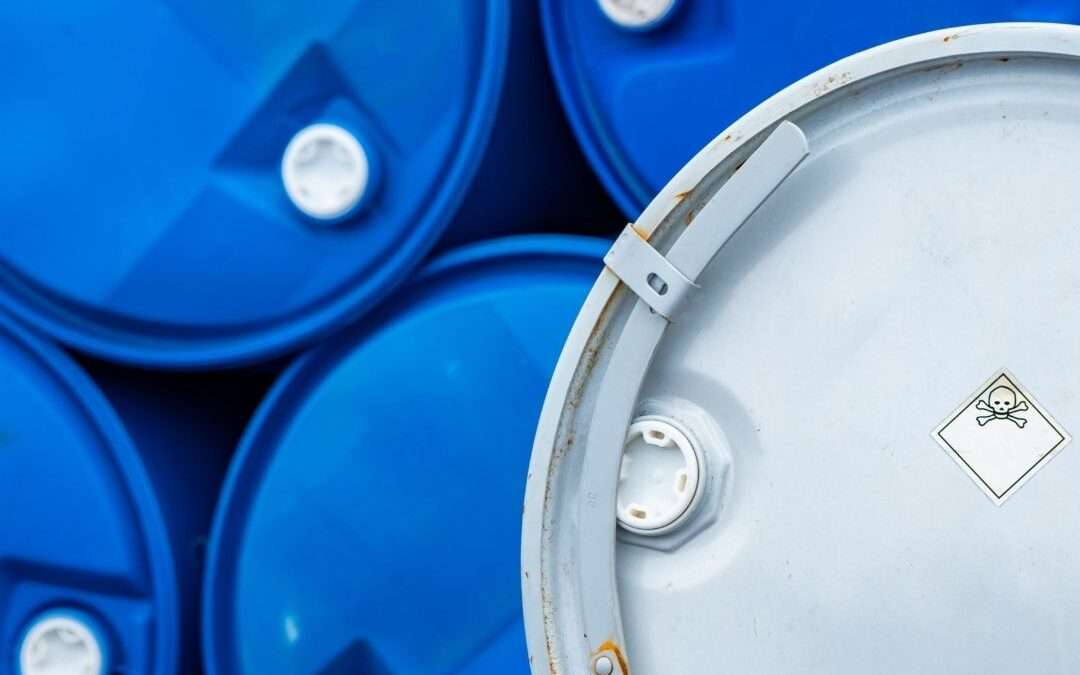
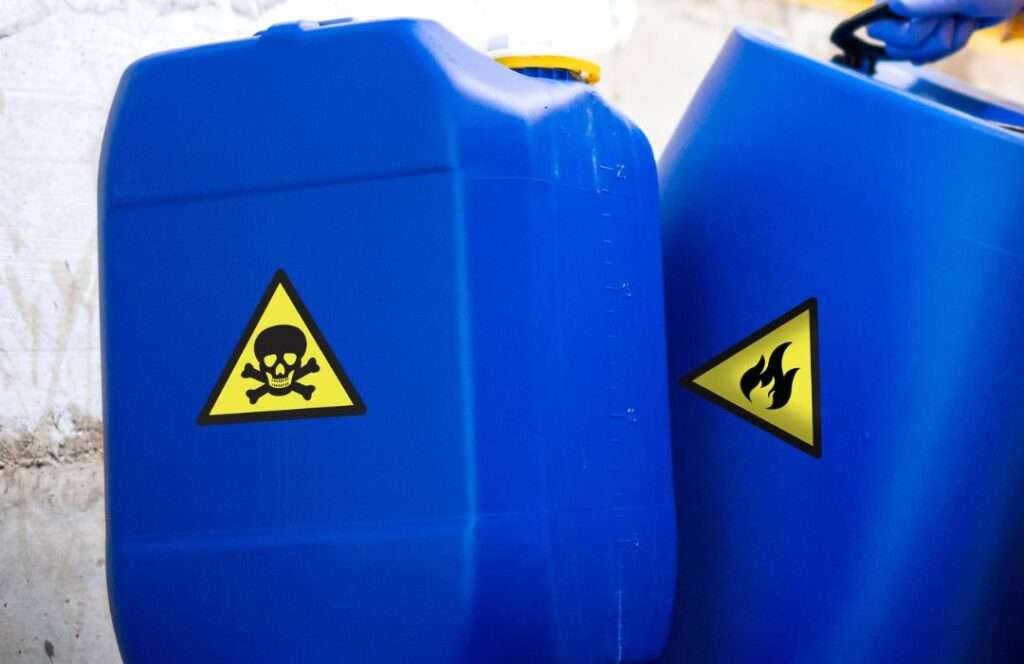
Waste management and waste declaration of hazardous chemicals require more than just sorting at source – they require careful planning, proper handling and clear documentation. Here we have gathered the basics you need to know about safe handling and declaration of hazardous waste.
Why safe handling of chemical waste is important
Chemical waste is not like other waste. It may contain hazardous substances that are flammable, corrosive, toxic, reactive and/or harmful to the environment. Many accidents occur after chemicals have been used, when they are stored or disposed of incorrectly.
A thorough risk assessment should always form the basis and include hazards related to storage, transport, interim storage and disposal. Such risk management is an important part of the organisation’s health, safety and environment (HSE) work.
Chemical waste is not only a workplace risk; it can also have a significant impact on the environment. Improper handling can lead to contamination of soil, water and air, and create long-term environmental consequences.
Classification and labelling of waste
It is important that all classified chemical waste is labelled correctly before it is stored or sent to a receiving facility. This includes, among other things:
Identification of the type of substance (e.g. corrosive, flammable or toxic)
Use of appropriate packaging that can withstand the contents
Clear labelling with contents, date, responsible person and hazard pictograms
Separation of incompatible substances (e.g. acids and bases)
Waste declaration
Waste declaration is the process by which organisations report the types and quantities of hazardous waste they generate. Its purpose is to ensure traceability and the safe handling of waste from its point of origin through to final treatment.
In many countries, organisations that produce hazardous waste are required to deliver it to an authorised collection or treatment facility and complete a waste declaration in advance. This is often done through a national or digital reporting system before the waste is transferred.
Roles, responsibilities and training
It must be clearly defined who is responsible within the organisation. This will often be an HSE manager or subject specialist with overall responsibility for chemical handling and waste declaration.
Everyone who handles hazardous waste must have the necessary training in chemical safety, procedures and emergency preparedness. This should form part of the organisation’s systematic HSE work.
Checklist: Safe waste management and waste declaration
Make sure you can tick off these points. Then you are well on your way to ensuring safe and efficient waste management:
Use appropriate packaging (e.g. sealed, labelled and compatible with the chemical)
Clear labelling of chemical waste
Ensure correct interim storage of chemicals
Complete waste declaration before delivery
Establish fixed routines for emptying and handling
Carry out regular risk assessments
Provide employees with adequate training
Document and track your waste
Ensure sufficient ventilation and containment in the waste area
Have emergency preparedness and protective equipment available
Safe handling and correct waste declaration of hazardous chemicals require planning, proper procedures and clear documentation. When this is an integrated part of HSE work, the risk of accidents is reduced and the organisation ensures both compliance with regulations and responsibility for people and the environment.
Improper storage of chemicals and hazardous substances increases the risk of accidents, environmental damage and, in the worst case, regulatory breaches. Here we have gathered some of the most common challenges related to chemical storage, and how you can ensure safe chemical management in your organisation.
Inadequate labelling and documentation
One of the most widespread challenges is incorrect or inadequate labelling of products. When hazard symbols and labels are missing or difficult to read, it can lead to confusion or incorrect handling of chemical substances. Therefore, make sure that hazardous chemicals are labelled with clear hazard labels in accordance with CLP regulations, and that safety data sheets (SDS) are updated at all times.
Unsuitable storage conditions
Unsuitable storage conditions can create dangerous situations. Many chemicals can react to heat, moisture or direct sunlight, increasing the risk of leaks, explosions or fire. Therefore, ensure that chemicals are stored at the correct temperature, not in overheated rooms or near heat sources or machinery, and that storage areas have adequate ventilation.
Lack of overview of flammable and explosive substances
Many organisations lack a consolidated and up-to-date overview of flammable and explosive substances. This can make it difficult to assess risks, control storage quantities and ensure appropriate preventive measures. Without a good overview, the risk of incorrect storage, undetected ignition sources and inadequate emergency preparedness in the event of fire or explosion increases.
Insufficient training and safety and emergency procedures
Even the best chemical management systems are of little use if employees do not know how to use them. Lack of training can lead to incorrect handling, especially in the event of leaks or incidents. Therefore, ensure that clear procedures are in place for risk assessment, chemical handling and emergency situations, and that all employees receive the necessary training.
Outdated or inadequate equipment
If equipment is old, worn or no longer suited to the chemicals being stored, the risk of hazardous situations increases. Ensure that there are fixed routines for inspection, maintenance and replacement of equipment, and that employees have the correct protective equipment for their work.
Incorrect waste handling
Improper handling of chemical waste can lead to environmental damage and fire hazards. Unfortunately, many organisations lack clear procedures for how hazardous waste should be collected, labelled and stored. Therefore, ensure you have a clear waste management plan, use approved containers and label waste correctly. Waste collection should be arranged with certified waste management companies.
Storage of incompatible chemicals
Certain chemicals must never be stored together, as they can react dangerously with each other. Incorrect co-storage is one of the most common causes of serious accidents. Therefore, divide storage areas by substance type and hazard class. Use separate cabinets or rooms, and label clearly to prevent dangerous chemical reactions.
Examples of incompatible substances:
Acids and bases
Oxidising substances and flammable liquids
Chlorine and ammonia
Manual systems
Many organisations still use manual systems or unclear Excel lists for chemical management. This can increase the risk of errors, lack of updates and poor oversight. This can be avoided by implementing automated systems that provide full oversight of chemicals, documentation, storage conditions and waste management.
Digital tools can solve some of the challenges
By using a digital tool such as Workplace Safety, the company gets a comprehensive and up-to-date overview of chemicals and associated documentation. The system provides guidance on co-storage and alerts you to potential storage hazards, based on the German standard TRGS 510 for co-storage. It is also easy to look up the safety data sheet directly in the system, so requirements for handling, storage and stability are quickly available.
Chemical management is primarily about order, structure and good routines. By ensuring clear labelling, correct storage conditions, suitable equipment and simple, up-to-date systems, daily operations can become both safer and more efficient. Small improvements in routines can make a big difference.
Substitution of chemicals is an important measure for improving the working environment, minimising environmental impact, and making it easier to meet requirements from authorities and customers. By working systematically with this, organisations can reduce risk and create a safer working day. In this article, you will find a simple explanation of what substitution is, why it is important, and how you can carry it out in practice.
What is chemical substitution?
Substitution is about replacing a hazardous chemical with a safer alternative. It can involve replacing substances that are harmful to the environment or health, or changing processes so that the chemical is not needed at all.
Why substitute chemicals?
Substitution should be considered every time the company adopts new products, processes or technologies, especially when chemicals with health and environmental hazards are in use. The duty of substitution means that companies must actively consider alternatives when they exist, as long as this does not entail unreasonable costs or disadvantages.
Employers are required to assess and, where possible, replace hazardous chemicals with less hazardous alternatives.
Examples of substitution
Here are some examples of chemicals with safer alternatives:
Isocyanates in some adhesives, sealants and foams can be replaced with isocyanate-free or water-based products.
Solvent-based paints and varnishes can be replaced with water-based paint systems with lower VOC content.
Oil-based coolants and lubricants can be replaced with water-soluble or synthetic coolants with lower health risks.
Packaging for cleaning agents can be switched to solutions with reduced aerosol formation (e.g. pump bottle or foam dispenser) to minimise inhalation risk and exposure during use.
Substitution always requires a specific assessment, because conditions vary from business to business.
Challenges with substitution
There are some challenges with substitution in practice. Here are the most typical ones:
There is a lack of optimal substitutes: There is not always a better alternative with the same technical quality without the same risk.
Can be costly: Alternative chemicals can be more expensive than current products. In such cases, you need to consider the risk of keeping current chemicals versus the cost of switching to safer alternatives.
It can be time-consuming: Searching for alternatives, testing them, documenting, getting approval and changing procedures can take time.
May be unknown or new risk factors: Substitutes are not necessarily completely harmless. Alternative products may have other hazards that need to be considered.
New chemicals require training and new routines: New chemicals may involve changes in handling, storage and protective equipment. Inadequate training or adaptations can lead to misuse and accidents.
Benefits of substitution
Although substitution may seem challenging, it is one of the most important and effective ways to reduce chemical risks. Here are some of the benefits:
Safer working environment: Replacing hazardous chemicals reduces the risk of accidents and health problems.
Less environmental impact: Substitution can contribute to fewer emissions of environmentally hazardous substances.
Meeting stakeholder requirements: Customers, business partners and society in general are placing ever higher demands on the environment and safety.
Regulatory compliance: Choosing safer alternatives can help meet legal requirements from REACH, CLP and other regulations.
Safer operations and delivery: Products that are hazardous to health and the environment may be subject to restrictions on use and sale through regulations.
Strengthened competitiveness: Through innovation, green profile and lower risk of future restrictions or costs, the business can strengthen its position in the market.
Improved decision-making through AI: The use of artificial intelligence can help identify and assess safer alternatives more quickly and accurately. AI can analyze large volumes of data on the health and environmental properties of chemicals, regulatory requirements, and areas of application, thereby supporting the substitution process.
How to implement chemical substitution?
Here is a recommended step-by-step process for substitution:
1. Get information
Identify which chemicals are used or planned to be used and assess the risk to health and the environment based on safety data sheets (SDS) and probability of exposure. Consider not only the hazard of the substance, but also the exposure situation. Involve your employees early in the process as they often have valuable practical experience.
2. Check if there are alternatives
Investigate possible alternatives through suppliers, industry associations or digital tools. Consider technical, practical and financial aspects.
3. Assess, compare and select
Compare the options in terms of risk, environmental impact, resource use and costs, and choose the one that provides the lowest overall risk and greatest benefit. Feel free to test the option on a small scale before full transition to ensure it works in practice.
4. Inform customers and suppliers
Share information about new chemicals or processes so that the change can be communicated throughout the value chain.
There are a number of resources and digital tools that can help identify, assess and document the substitution of chemicals. By working systematically to identify and introduce safer alternatives, businesses can reduce risk, meet regulatory and customer requirements and strengthen their competitiveness. Replacing hazardous chemicals is therefore not just about removing risk, but about creating new opportunities.
Cancer is the most common cause of work-related death, accounting for more than half of all occupational deaths in Western countries. It is largely due to exposure to chemicals at work.
This clear message from the Norwegian National Institute of Occupational Health (STAMI) is a serious reminder of the need for better control and knowledge in working life.
Having up-to-date, documented and accessible information about carcinogenic chemicals in the workplace is crucial – both to protect workers here and now, and to ensure verifiable knowledge in the years to come. Many cancers develop over a long period of time, and exposures today can lead to serious illness decades later. Therefore, exposures must be logged and preserved, even when protective equipment is in use and the health effects are not immediately visible.
With a clear overview of which substances, processes and work operations involve risk, the company can work more purposefully with prevention, substitution and technical measures.
The costs of work-related cancer are high, both for individuals and society. For those affected, the disease can mean loss of health, ability to work and quality of life. It also affects relatives, who often find themselves in a demanding and unpredictable care situation. For society, this entails large expenses for treatment, social security benefits, lost labor and compensation cases. A systematic focus on documenting and registering chemical exposures is therefore not only good HSE – it is also socio-economically and ethically responsible.
Why do we need to prioritise carcinogenic chemicals?
According to STAMI, work-related cancer can be prevented – but only if we know who is exposed, to what, and in what quantities. In the articleWith good knowledge we can prevent work-related cancer, this is highlighted as a critical point: The most important sources of exposure are chemicals and dust in the process industry, construction, offshore activities and laboratories. Yet many companies lack the necessary overview and documentation.
This is also supported by the government’s national cancer strategy (2025-2035), where Ten-year goal 5: Prevent more, detect earlier states that work-related cancer should be reduced. The strategy points to the need for better registration, systematics and prevention, with particular emphasis on measures such as exposure registers and chemical inventory.
Prioritising the work with carcinogenic substances is therefore not just about regulatory compliance – it’s about protecting life and health through knowledge-based and documented HSE work.
Control of hazardous chemicals and exposures is crucial
Working with carcinogens occurs both through the use of classified chemicals, such as benzene, formaldehyde and gasoline, and in work processes that generate hazardous pollutants. Many of these process-generated substances are both widespread and underreported, posing a real health risk in a number of industries.
Examples of such sources of exposure include:
Respirable crystalline silica (quartz): Particularly in drilling, concrete sawing, sandblasting and other work with mineral materials
Asbestos: Which is still present in older buildings and poses a hazard during refurbishment and demolition
Diesel exhaust: From vehicles and machinery in enclosed or poorly ventilated areas
Welding fume: A complex mixture of metal oxides, nitrogen oxides and particles
Radon: An invisible, radioactive gas that can build up in tunnels, basements and mining areas
In order to reduce health risks, and at the same time comply with the requirements of Chapter 31 of the Regulations on the Performance of Work, companies must have a systematic overview and documentation.
This means:
Chemical inventory: Up-to-date overview of all hazardous chemicals in use and process-generated substances, including hazard labeling and safety data sheets
Risk assessments: Mapping of which work operations and substances pose cancer risks, as well as which technical and organisational measures are required
Exposure register: Accurate documentation of who has been exposed, to which substances, where and when – as a basis for health monitoring and possible compensation for occupational diseases
Exposure register – the most important document you (might) not have
An exposure register must be kept for employees who are, or may be, exposed to health hazards at work. This is a requirement in Chapter 31 of the Regulations on the performance of work, and applies to a number of known risk factors.
Who should be registered?
The exposure register includes employees who are or may be exposed:
1. Classified chemicals:
Carcinogenic substances: Carc 1A / 1B
Substances harmful to genetic material: Mut 1A / 1B
Substances harmful to reproduction: Repr 1A / 1B
2. Specific processes and substances mentioned in the regulation:
Preparation of auramine
Exposure to polycyclic aromatic hydrocarbons (PAHs) in soot, tar or pitch
Exposure to polycyclic aromatic hydrocarbons (PAHs) in soot, tar or pitch
Preparation of 2-propanol by strongly acidic process
Exposure to hardwood dust
3. Other exposures harmful to health:
Lead and lead compounds
Asbestos fiber and asbestos-containing dust
Biological factors in infection risk group 3 or 4, or with annotation D
Ionizing radiation
Hazardous substances in rock work
Why is the exposure register so important?
The exposure register has three key purposes:
To give the employer an overview of who has been exposed to harmful conditions
Ensuring traceability over time, so that exposure can be traced even many decades later
The register must be verifiable and stored for 40-60 years, which places high demands on data security, maintenance and system management. It is also important to note that the use of protective equipment does not exempt from registration – it is the exposure itself that must be documented, regardless of the level of protection.
A well-maintained exposure register is not only a legal requirement, but a key tool for long-term health monitoring, prevention and responsible working environment management.
Digital tools that provide overview and control of chemicals
With good digital solutions in place, HSE work becomes more efficient, more verifiable and, not least, far better equipped to prevent health risks in practice. When it comes to chemical handling, this is particularly important: It must be possible to track, risk assess and follow up each individual chemical, over time and across workplaces.
Digital tools such as Workplace Safety and ChemCenter have been developed precisely to meet these requirements. They support the company in working in a structured way with substance records, risk assessments and exposure overviews, and help ensure that chemical information is up-to-date, accessible and in line with regulations. The result is better control, higher quality documentation and better conditions for preventing damage to health. Such tools lay the foundation for HSE work that is effective, verifiable and sustainable over time.
Written by Hans Kristian Brekken, chemist and product developer at Workplace Safety.
Do you want guidance?
Many employers are unsure of what an exposure register should actually contain, how it should be established and what requirements apply in practice. Contact us for guidance on how to establish an exposure register with good routines that give you control, overview and peace of mind.
This article was written for the Norwegian Automobile Industry Association and published in the member magazine Bilbransjen.
An important part of your HSE work
Risk assessment of chemicals is an important part of HSE work, especially in the automotive industry where employees handle a wide range of chemicals every day.
Chemicals can have hazardous properties, especially those used in workshops and paint shops. If handled incorrectly, they may cause acute or long-term health issues, environmental pollution, or even explosive incidents. Carrying out thorough risk assessments enables you to identify the necessary control measures to ensure safe use and management of chemicals.
Risk assessments must be documented in writing
In Norway, the requirements for chemical risk assessment are regulated by the Working Environment Act and regulations such as the Regulations on the Performance of Work. Employers are obligated to identify and assess all chemical substances used in the workplace, and every risk assessment must be documented in writing.
“The risk assessment should always cover the entire work operation in which the chemicals are used”
The way of use guides the risk assessment and measures
A risk assessment must always be based on the specific use of the chemical in question.
The assessment should evaluate the entire work operation in which the chemical is used. If the same chemical is applied in different work operations, this must either be reflected within a single risk assessment or addresses through separate assessments.
Different applications may require different protective equipment and additional training. For example, the use of diisocyanates with a high degree of exposure will trigger mandatory additional training.
Conducting a risk assessment
There are several ways to conduct a chemical risk assessment. This following steps provide a general overview of the process:
An updated chemical inventory: The chemical inventory provides an overview of all chemicals and their safety data sheets (SDS). Always use the latest version of the SDS and verify key information about hazardous properties.
Assessment of hazard: Assess the inherent hazards of the chemical using information from the SDS.
Exposure assessment: Analyse how the chemical is used, quantities handled, routes of exposure (e.g. inhalation, skin contact, and ingestion), frequency and duration of work, and existing workplace control measures.
Characterisation of risk: Combine hazard and exposure information to estimate the overall risk.
Implementation of control measures: Based on the risk assessment, implement measures to reduce risk, such as improved ventilation, appropriate PPE, or substitution with safer alternatives. Integrate these measures into work instructions, checklists, and training routines.
Documentation and auditing: Document the process and review it regularly to ensure assessments remain up to date.
Control measures
Control measures may include the following:
Necessary ventilation
Training of employees
Use of protective equipment
For example, a risk assessment of car painting may include multiple chemicals. This may require isolation of the work area, local exhaust ventilation, training in the use of diisocyanates during spray application, establishing a designated processing zone, and use of protective equipment.
Work smart with user-friendly tools
Digital chemical management systems provide structured processes that make it easier to conduct and document risk assessments in line with regulatory requirements.
Use the expertise of the occupational health service
The occupational health service is a key advisor in risk assessment and employee training on safe chemical handling.
With in-depth knowledge of safe working practices and chemical handling, they can help ensure a safe workplace.
Remember: if the risk conditions warrant it, it is a legal requirement to be affiliated with an approved occupational health service, so make full use of this resource.
Written by Hans Kristian Brekken, chemist and product developer at Workplace Safety.