Chemicals are a natural part of everyday operations in many organisations, but improper handling can have serious consequences for health, safety and the environment (HSE). Chemical risk assessment is therefore a key HSE measure for identifying hazards and implementing the necessary controls. In this article, we explain what risk assessment is, why it is important, and how chemical risk assessments can be carried out in practice.
What is chemical risk assessment?
Chemical risk assessment involves a systematic review of the hazards associated with chemical substances and mixtures, combined with an assessment of their use and how employees may actually be exposed during their day-to-day work.
The aim of the risk assessment is to determine whether the use of chemicals or a work activity involves an unacceptable risk of exposure, and what measures may be required to reduce the risk to an acceptable level.
Why is risk assessment important?
Chemicals can have serious consequences if they are not handled correctly. A systematic risk assessment gives the organisation an overview of the hazards associated with the use of chemicals and the measures needed to reduce risk and prevent injuries and incidents.
Health hazards
Many chemicals can cause harm to health if employees are exposed to them over time or through accidental contact. The health effects may be both acute and long-term, and can range from skin irritation, burns and eye injuries to allergies, respiratory problems, organ damage or cancer. The level of risk depends on both the properties of the chemical and the degree of exposure. A chemical risk assessment helps to identify relevant health hazards, assess how exposure may occur in day-to-day work, and ensure that appropriate measures are put in place to protect employees.
Fire and explosion hazards
Some chemicals are flammable, explosive or chemically reactive, and may pose a serious safety risk if they are stored, handled or used incorrectly. Vapours from flammable liquids can be ignited by sparks, hot surfaces or static electricity, leading to fire or explosion. A chemical risk assessment helps to identify such hazards and assess the risks associated with use, storage and handling, so that appropriate preventive measures can be put in place.
Environmental hazards
Chemical substances can harm the external environment if they are released into air, soil or water. Releases may occur as a result of spills, leaks, improper waste handling, or incidents during production and maintenance processes. A risk assessment evaluates the risk of environmental impact and provides the basis for measures to reduce the risk of pollution and environmental damage.
Regulations such as REACH and CLP set requirements for the handling of chemicals, labelling and documentation. Organisations are therefore legally required to carry out and document chemical risk assessments.
What are typical examples of situations where a risk assessment is required?
Chemical risk assessments must be carried out and updated in several situations, including:
When introducing new chemicals
When changes are made to work methods or processes
When new hazard information about a chemical becomes available
When new work tasks or equipment are introduced
Following incidents or near misses
As part of regular reviews of HSE work
If you are unsure whether a risk assessment is necessary, it is generally better to carry out one too many than one too few.
How to carry out a chemical risk assessment
There are several methods for carrying out a chemical risk assessment, but regardless of the method, the process should be systematic and documented. Below is a general approach that can be used as a starting point.
1. Ensure an up-to-date chemical inventory
The risk assessment process begins with establishing an overview of the chemicals used in the organisation. The chemical inventory must contain valid and up-to-date safety data sheets for all chemical substances and mixtures. This information must be accessible to employees, and chemicals that are no longer in use should be removed. An accurate chemical inventory forms the basis for further risk assessment.
2. Define the work involving the chemical
To ensure effective implementation and a realistic assessment of the risks associated with the use of chemicals, it is important to first clarify how the risk assessments should be structured and defined.
A practical approach is to carry out risk assessments for groups of chemicals, for example by:
Assessing chemicals used in the same work activity
Grouping chemicals within the same category or type of use
By identifying which chemicals can be assessed together, significant efficiency gains can be achieved. This reduces the need for individual assessments of each chemical, while providing a more practical and operational picture of risk.
3. Assess the hazardous properties of the chemical
The next step is to identify the hazards associated with the chemicals. This is done by reviewing the safety data sheets and assessing their classification. This includes identifying health hazards, environmental hazards, and physicochemical properties such as fire or explosion risks. The assessment provides an indication of how severe the consequences may be if exposure occurs.
4. Assess exposure and existing control measures
Risk largely depends on how chemicals are used in practice. It is therefore necessary to assess how employees may be exposed, including the work activities carried out, the quantities handled, how often and for how long the work takes place, and the relevant exposure routes, such as inhalation, skin contact or splashes. Existing control measures, such as ventilation and the use of personal protective equipment, must be included in the assessment. The purpose is to evaluate the risk-reducing effect of these measures and to document which controls must be used by end users when handling the chemicals.
5. Determine the level of risk
Once both hazard and exposure have been assessed, the level of risk can be determined. This involves evaluating the likelihood of an unwanted event occurring and the potential consequences if it does. The result provides the basis for deciding whether the risk is acceptable or if further measures are required.
6. Implement risk-reducing measures
If the risk assessment identifies the need for measures, these must be planned and implemented. Measures may include substitution of hazardous chemicals, technical solutions such as ventilation, changes to work procedures, employee training, or the use of personal protective equipment. The measures should be integrated into the organisation’s procedures, instructions and training programmes to ensure a lasting effect.
7. Document and review
All parts of the risk assessment must be documented so that the assessments can be reviewed and verified. The risk assessment must be kept up to date and revised when there are changes to chemicals, work processes, or following incidents. Regular review helps ensure that chemical risk assessment remains an active and integrated part of HSE work.
The employer has the primary responsibility for ensuring that risk assessments are carried out and followed up. Managers, safety representatives and employees should be involved, so that the assessment is based on practical knowledge of the work tasks.
Risk assessment in Workplace Safety
In Workplace Safety, chemical risk assessments are carried out directly within the system, linked to each individual chemical in the chemical inventory. The user is guided step by step through the assessment, from identifying hazardous properties and exposure conditions to evaluating work methods, storage and risk level. Chemicals can be assessed together in a simple and efficient way within the system, ensuring a comprehensive understanding of the risks associated with their use.
Workplace Safety facilitates structured documentation, risk assessment and follow-up of risk-reducing measures. Once the risk assessment is completed, it is stored together with the chemical and can easily be revised when there are changes in use, work processes or regulations.
Chemical risk assessment is a fundamental part of an organisation’s HSE work and an important tool for preventing injuries, incidents and adverse environmental impact. Tools such as Workplace Safety make it easier to carry out, document and follow up chemical risk assessments in practice, helping organisations gain better oversight, ensure regulatory compliance, and maintain a safe working environment over time.
Chemical substitution, replacing hazardous chemicals with less harmful alternatives, has long been an important tool for improving health, safety, and the environment. In the past, this work has been time-consuming and complex. Now, artificial intelligence (AI) is changing how companies in many industries work with chemicals and risk reduction.
Today’s challenges with substitution
Finding safer alternatives to existing chemicals is rarely straightforward. Companies often have to consider:
Hazard classification and health effects
Technical performance and function
Regulations and regulatory requirements
Availability in the supply chain
Traditionally, this has been done manually, by comparing safety data sheets (SDS), regulations, and internal experiences. The result can be lengthy processes, divergent assessments, and an increased risk of errors. This, in turn, can delay the introduction of safer chemicals and make it more difficult to meet HSE and sustainability requirements.
KI as support in substitution
Artificial intelligence makes it possible to work more systematically and data-driven with chemical substitution. Instead of relying on manual searches and individual assessments, AI can analyse large amounts of chemical data in a short time and provide structured suggestions for alternatives. This can contribute to a better overview, more consistent assessments, and faster decision-making processes.
Although AI can provide valuable analyses and recommendations, the results must always be evaluated by qualified professionals. AI is a decision support tool and not a substitute for chemical, HSE, or regulatory expertise.
Faster identification of safer alternatives
With the help of AI, companies can quickly analyse large amounts of SDS data and other chemical information. The system can suggest substances or products with lower hazard levels, similar functionality, and better regulatory status.
This is particularly useful when regulations change or when there is a need for rapid transition to safer solutions.
Automated assessment of hazards and risks
AI can help interpret complex data, classify hazards, and calculate risk levels in a more standardised way. This reduces differences in assessments between departments and projects.
In addition, KI can reveal incomplete or outdated information, enabling the business to identify where updates or professional reviews are needed.
Better control of regulations – nationally and internationally
Many companies operate in several countries or have to comply with both local and international requirements. AI-based solutions can monitor regulatory changes and automatically check whether chemicals and proposed alternatives comply with current requirements.
This reduces the risk of unintentional regulatory violations and supports a more proactive approach to chemical management.
Support for sustainability and ESG work
KI can also be used to compare environmental properties such as degradability, ecotoxicity, emissions, and life cycle impact. This provides a better basis for decision-making for companies that work systematically with sustainability, environmental reporting, and ESG requirements.
Artificial intelligence is simplifying and improving the work of chemical substitution. For companies that want to reduce risk, improve the working environment, and be better equipped for future requirements, AI-based solutions can be an important step forward. When used correctly, artificial intelligence can contribute to safer chemical use, better compliance with regulations, and more sustainable choices – across industries and national borders.
Clear and accurate labelling of chemicals is a fundamental prerequisite for a safe working environment. CLP labelling plays a key role in communicating chemical hazards in a standardised and easily understandable way.
What is CLP labelling?
CLP stands for Classification, Labelling and Packaging and is the EU’s regulation for the classification, labelling, and packaging of chemicals. The regulation is based on the UN’s Globally Harmonized System of Classification and Labelling of Chemicals (GHS), with the aim of ensuring that workers and users receive clear, unambiguous information about chemical hazards.
Although CLP is an EU regulation, its principles are largely harmonised with regulations in many other parts of the world. This makes CLP labelling relevant also for companies that operate internationally or use chemicals supplied from other markets.
You can find more information about the CLP Regulation, also known as the CLP Regulation, at ECHA.
CLP labelling is more than just a formal requirement. It can also help to:
Protecting employees from health hazards
Prevent accidents and misuse
Ensure compliance with HSE and working environment requirements
Creating safer workplaces across industries
When the information on the label is accurate, up-to-date, and easy to understand, it becomes easier for everyone to handle chemicals safely.
What does a CLP label contain?
A CLP label should provide the user with all the information necessary for the safe handling of the substance or mixture. A complete label includes, among other things:
Supplier information: Name, address, and telephone number of the supplier. From July 1, 2026, suppliers must be established in the EU/EEA.
Product identification: Clear name or identifier that makes it clear which substance or mixture the label applies to.
Nominal quantity: Quantity of contents, when the product is intended for the general public and this is not stated elsewhere on the packaging.
Hazard information: This may include hazard symbols (pictograms), hazard signal words, hazard and safety statements, and any additional information required by other regulations.
CLP also sets requirements for the size, design, and placement of the label. It must be securely attached, easily visible, legible, and durable throughout the product’s lifetime. In some cases, such as very small containers, there are limited exceptions where not all information can be included. In such cases, certain elements may be omitted, but this must be done in accordance with the regulations.
CLP hazard symbols
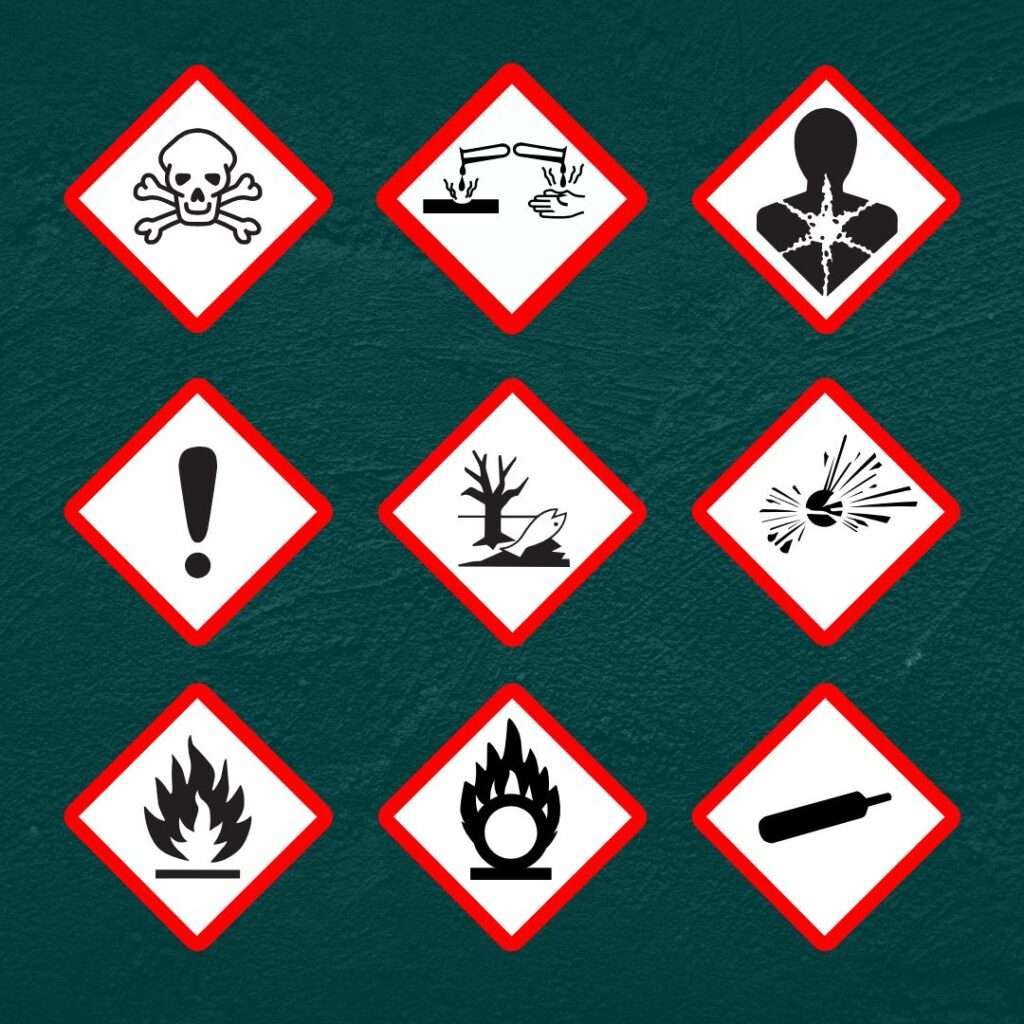
Hazard symbols, also known as hazard pictograms, provide immediate visual information about the hazards posed by a chemical. Under CLP, there are nine different pictograms covering, among other things:
Health hazard
Chronic health hazard
Flammable substances
Corrosive chemicals
Acute toxicity
Gas under pressure
Environmental hazard
Explosive
Oxidising substances
The correct use of hazard symbols is crucial for employees to be able to quickly identify risks, especially in environments where many chemicals are used in parallel. The symbols must always correspond to the classification of the substance and the most serious hazards.
Incorrect or inadequate labelling can lead to safety risks, regulatory non-compliance, and, in the worst case, serious incidents.
Classification and labelling according to CLP is a key part of systematic HSE work in companies that handle chemicals. Correct CLP labelling helps ensure that hazards are understood quickly and correctly, and provides employees with the necessary basis for the safe use, storage, and handling of chemical substances and mixtures. At the same time, the regulations set clear requirements for the content, design, and updating of labels. Changes in classifications, language requirements, and compliance with SDS mean that chemical labelling can be demanding to manage over time. Nevertheless, the consequences of errors or omissions are often far greater than the effort required to do it right.
Working with chemicals places high demands on safety, knowledge, and thorough procedures. The correct use of protective equipment is essential for protecting employees from health hazards and preventing accidents in the workplace. In this article, we explain why protective equipment is so important, the types that exist, and how to choose the right protection when handling chemicals.
The importance of protective equipment when handling chemicals
When working with chemicals, risks must primarily be prevented through technical and organisational measures. If the risk cannot be eliminated or sufficiently reduced through such measures, personal protective equipment (PPE) must be used.
Protective equipment acts as a barrier between the worker and hazardous chemicals and aims to prevent injuries. Missing or incorrect use of protective equipment can lead to exposure to chemicals that can have serious consequences. That is why it is important that companies have clear procedures for when and how to use protective equipment, and that employees have the necessary knowledge about the risks associated with the chemicals they work with.
Working with chemicals and the use of protective equipment are regulated through various occupational health and safety requirements, including national workplace safety legislation as well as international regulations such as REACH and CLP regulations.
Different types of protective equipment and measures when working with chemicals
Measures to reduce risks when handling chemicals can be divided into technical measures, organisational measures, and personal protective equipment. Technical and organisational measures should always be considered first.
Organisational measures
Organisational measures concern how work is planned, organised, and carried out in order to reduce risk when handling chemicals. Such measures help ensure that employees have the right knowledge, safe procedures, and clear work processes.
Examples of organisational measures:
Risk assessment: Mapping and assessment of risks associated with the use, storage and handling of chemicals. The risk assessment forms the basis for which measures and protective equipment are required.
Safe job analysis (SJA): A systematic review of work tasks before work starts, to identify hazards and ensure that necessary measures are in place.
Training and competence: Employees must be adequately trained in chemicals and associated hazards, use of protective equipment and safe handling.
Routines and procedures: Clear procedures for handling, storing, labelling and disposing of chemicals help reduce the risk of errors and accidents.
Access to safety data sheets: Employees must have easy access to up-to-date SDSs describing hazards, necessary measures and proper use of protective equipment.
Technical measures
Technical measures aim to reduce or eliminate exposure to hazardous chemicals at the source. Such measures contribute to a safer working environment for everyone in the area and can reduce the need for personal protective equipment.
Examples of technical measures:
Ventilation and local exhaust extraction: Removes hazardous vapours, gases, and particles from the work area before they can be inhaled. Effective ventilation reduces exposure and improves air quality.
Fume cupboards: Used when working with volatile or hazardous chemicals to prevent vapours and aerosols from spreading in the room. They protect both the user and the surrounding environment.
Closed systems and process enclosure: Prevent direct contact with chemicals by keeping processes physically contained. This reduces the risk of spills, leaks, and exposure.
Splash shields and barriers: Protect against splashes and unintended contact with hazardous substances during work. They help limit the consequences if an incident occurs.
Emergency and eyewash showers: Provide the possibility for rapid rinsing in case of exposure to chemicals. Quick access can significantly reduce the extent of injury.
Personal protective equipment
PPE is used when risks cannot be eliminated or sufficiently reduced through other measures. This is equipment used by the individual employee and must be suited to both the work task and the chemicals being handled.
Examples of personal protective equipment:
Respiratory protective equipment: Protects against the inhalation of harmful gases, vapours, dust, or aerosols. The correct type and filter must be selected based on the risk.
Eye and face protection: Prevents splashes and particles from coming into contact with the eyes and face. Used where there is a risk of chemical splashes or flying particles.
Gloves: Protect the hands from direct contact with chemicals and help prevent skin damage. The choice of material must be suited to the substances being handled.
Footwear: Chemical-resistant and slip-resistant footwear protects the feet from spills and provides safer movement in the work area.
Protective clothing: Protects the skin and body from splashes, spills, and exposure. This can range from aprons to full chemical protective suits, depending on the level of risk.
Choosing the right protective equipment
When selecting protective equipment, a thorough risk assessment should first be carried out. What type of work will be performed? What are the possible consequences? How likely is exposure? These questions form the basis for choosing appropriate protective equipment.
The risk assessment should take several factors into account:
Which chemicals are used, and how are they classified?
How can exposure occur, for example through splashes, inhalation, or skin contact?
How long does the work operation last, and how often is it carried out?
What is the working environment like, for example in terms of ventilation, temperature, and available space?
Can a combination of several chemicals or processes increase the risk?
The employer is responsible for ensuring that the necessary protective equipment is available in the workplace and that employees receive the required training in how to use it. Employees, in turn, are responsible for using the protective equipment as they have been trained and for reporting if the equipment does not meet requirements or has faults or deficiencies.
Chemical management system as support for safe chemical handling
A system for managing chemicals can simplify and streamline the work related to protective equipment and documentation. With systems such as Workplace Safety, organisations can:
Gain a complete overview of the chemicals used in the organisation
Access recommended protective equipment from safety data sheets
Ensure access to up-to-date safety data sheets
Document risk assessments and training
Communicate necessary measures to employees
By gathering information in one place, it becomes easier to ensure compliance with requirements and to work systematically with safety.
Proper handling of chemicals requires a comprehensive approach to safety. By combining technical measures, organisational measures, and the correct use of personal protective equipment, organisations can reduce risks and prevent health hazards. Accurate risk assessments, clear procedures, and adequate training are essential to ensure a safe working environment. When measures and protective equipment are used correctly, they provide the foundation for a safe and responsible working day when working with chemicals.
In chemical management, having an overview is crucial. Organisations must know which chemicals are in use, what inherent hazards they present, and which legal requirements apply. To manage chemical risks in a systematic and documentable way, a number of hazard lists and regulatory lists have been established.
Hazard lists and regulatory lists identify substances with particularly hazardous properties, regulate their use and placing on the market, and provide guidance for substitution, reporting, and risk assessment. This article explains what these lists are, how they relate to each other, and what they mean in practice.
What is meant by hazard lists and regulatory lists?
Hazard lists and regulatory lists are two closely connected mechanisms within chemicals legislation. Hazard lists identify substances with particularly problematic properties. Regulatory lists set out specific legal requirements related to these substances, such as information obligations, authorisation requirements, or prohibitions.
For organisations, this means they must both understand the risks associated with the substances they use and be aware of the legal obligations that apply. Together, the lists form the basis for sound chemical management and compliance with regulatory requirements.
The difference between hazard and regulation
Hazard relates to the inherent properties of a substance, for example whether it is carcinogenic, toxic for reproduction, or persistent in the environment. Regulation concerns the legal consequences of these properties.
A substance may be hazardous without being prohibited, yet still be subject to information obligations or expectations of phase-out. This distinction is essential for correct risk assessment and compliance.
Hazard lists
Hazard lists are based on scientific assessments and are used to identify substances that should be prioritised in risk assessment and substitution efforts. Typical criteria include:
CMR properties (carcinogenic, mutagenic, or toxic for reproduction)
PBT/vPvB (persistent, bioaccumulative, and toxic substances)
Endocrine-disrupting properties
Hazard lists function as an early warning system. Inclusion does not necessarily mean prohibition but signals increased regulatory attention.
Examples of hazard lists
Harmonised classification — CLP Annex VI
The IARC list (cancer hazard)
PBT and vPvB identification
Regulatory lists
Regulatory lists are directly anchored in legislation and specify which substances are subject to concrete requirements or prohibitions.
The central framework in the EU and EEA is the REACH Regulation. REACH is based on the principle that companies themselves are responsible for documenting safe use (“No data – no market”).
Examples of regulatory lists
REACH Candidate List
Authorisation List
Restriction List
Norwegian Priority List
How hazard lists and regulatory lists are connected
Regulation often occurs stepwise: a substance is first identified as problematic, placed on a candidate list, and may later become subject to authorisation or restrictions.
For organisations, this means chemical management is dynamic. A substance that today appears only on a hazard list may later become strictly regulated. This requires continuous oversight.
REACH’s three key lists
Candidate List (SVHC List)
The candidate list contains substances identified as SVHC (Substances of Very High Concern), i.e. substances with particularly serious properties. These can, for example, be carcinogenic, harmful to reproduction, persistent and bioaccumulative or endocrine disruptors.
When a substance is added to the candidate list, a duty of disclosure is triggered. In other words, the supplier must provide information about the presence of such substances above certain concentration limits. In addition, it creates a clear expectation that companies consider the substitution of products containing such substances. The candidate list therefore serves as an initial warning that stricter measures may be forthcoming.
Authorisation List
The authorisation list (REACH Annex XIV) contains substances that cannot be used without specific authorisation. Authorisation requires a comprehensive application, documentation of risk and assessment of alternative solutions.
If a substance is included on the Authorisation List, it is a clear signal that it is being phased out of the market. For many organisations, this means substitution becomes the most realistic solution in practice.
Restriction List
The restriction list (REACH Annex XVII) contains specific restrictions or bans on certain substances or areas of use. Restrictions may, for example, be that a substance is not permitted in consumer products, that concentration limits apply, or that its use is restricted to certain industries.
Norwegian Priority List
Norway also has a national priority list of pollutants that is managed by the Norwegian Environment Agency. The list is actively used in inspections and can often be stricter than the EU’s minimum requirements.
Today, the list includes 85 substances and substance groups, including:
Heavy metals: Persistent metals that can accumulate in organisms and cause serious health and environmental damage.
Endocrine-disrupting substances: Affect the hormonal system and may cause reproductive and developmental harm.
Flame retardants: Used to reduce fire risk, but several are persistent and bioaccumulative.
Per- and polyfluoroalkyl substances (PFAS): Highly persistent substances that degrade slowly and can accumulate in the environment and humans.
Organotin compounds: Toxic substances that can harm aquatic organisms and affect the hormonal system.
Polycyclic aromatic hydrocarbons (PAHs): Compounds often formed during combustion, several of which are carcinogenic.
UV stabilisers: Used to protect materials from sunlight; some are persistent and potentially endocrine disrupting.
Dioxins and furans: Highly toxic and persistent compounds that can form as by-products in industrial processes.
Siloxanes: Used in cosmetics and technical products; some are highly persistent and bioaccumulative.
Chlorinated organic substances: Often persistent and bioaccumulative compounds with significant environmental and health risks.
Other organic substances: A collective group for organic compounds with serious and long-term environmental effects.
New substances are continuously assessed, and the list is updated on an ongoing basis.
Hazard lists and regulatory lists give businesses insight into both risk and regulation. Understanding the difference between the inherent properties of substances and the legal framework that applies makes it easier to make the right choices in practice. Chemical management is constantly evolving. New substances are assessed, lists are updated and requirements change. To maintain control, companies must have an up-to-date overview, structured documentation and good systems for assessment. Digital solutions such as Workplace Safety bring this information together in one place and make it easier to work systematically with safe and forward-looking chemical management.